Newsroom


With four years remaining to achieve the Sustainable Development Goals (SDGs), only 15% of the 139 targets with sufficient trend data are on track or have been met, according to the United Nations’ 2026 SDG assessment.
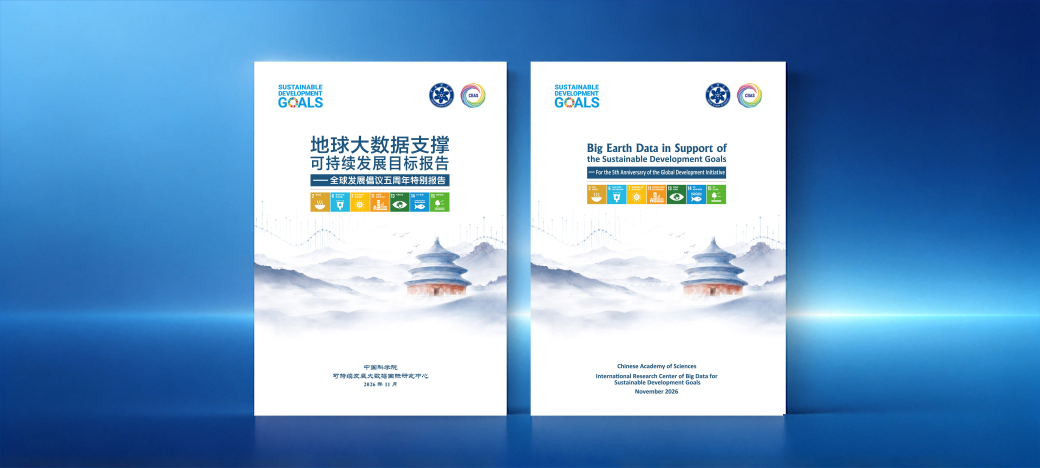
The 2026 edition of "Big Earth Data in Support of the Sustainable Development Goals" was published on the United Nations website and circulated to UN member states on Nov. 20. Led by the International Research Center of Big Data for Sustainable Development Goals (CBAS), the report was prepared by 170 experts from nearly 40 research institutions.
The report introduces a digital indicator framework for monitoring seven SDGs on food, water, energy, cities, climate, oceans and terrestrial ecosystems. It includes 99 indicators: 27 aligned with existing UN measures and 72 that extend monitoring capacity, including indicators for tree cover on farms, grasslands and in cities. The framework specifies datasets, calculation methods and verification procedures to support consistent comparisons across places and over time.
Its global assessments illustrate the value of combining Earth-observation and socioeconomic data. From 2015 to 2025, the number of people affected by floods worldwide increased by an average of 5.35% a year, even though the inundated area showed no statistically significant increase. About 95% of those affected were in Asia. The report also found that China accounted for about 41% of global utility-scale solar panel area in 2025, compared with 1% across the least developed countries.
The report documents other environmental trends, including a broad pattern of shrinking and less stable coral sand cays. It found that biosphere reserves cover 4.1% of global land area and contain records for 45.1% of documented plant species and 56.4% of documented vertebrate species.
In China, 147 of 234 assessed SDG indicators had reached or were close to their 2030 target levels by 2025. This represented 62.8% of assessed indicators, up from 38.9% in 2015. The report also found that water-use efficiency improved while water stress declined from 38.2% in 2015 to 31% in 2024.
The report emphasizes that national averages can obscure local conditions. In its China assessment, nonlinear interactions among SDG indicators accounted for 10.2% of identified relationships at the national scale and 37.6% at the provincial scale.
Published as a special report marking the fifth anniversary of the Global Development Initiative, the report also reviews international cooperation. More than 130 countries and international organizations have participated in the initiative, with more than 2,000 cooperation projects launched and more than 200,000 people trained. Data from the Sustainable Development Science Satellite-1 have been used in 118 countries.
Guo Huadong, director-general of CBAS and a member of the Chinese Academy of Sciences, said the framework is intended to help move methods from individual studies into routine monitoring and policy use. The report calls for common measurement standards, open tools and closer international cooperation to identify obstacles to progress and strengthen early warning of emerging risks.