Newsroom


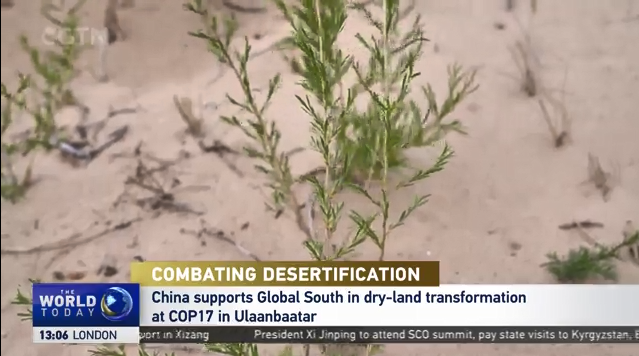
Scientists are calling for a fundamental shift in how global desertification is measured and managed. At the 17th Session of the Conference of the Parties to the United Nations Convention to Combat Desertification (UNCCD COP17), the Xinjiang Institute of Ecology and Geography (XIEG) of the Chinese Academy of Sciences and its international partners introduced new initiatives that prioritize long-term ecological resilience over traditional land-restoration metrics.
The core of this shift is detailed in a new scientific report, Unlocking Opportunities for Combating Desertification and Advancing Sustainable Dryland Governance. The report, co-authored by experts from China, Russia, and the U.S., argues that the success of desertification control should no longer be judged solely by the total area of land restored. Instead, it proposes a new evaluation framework based on regional ecological capacity, cross-sector coordination, and the ability of ecosystems to withstand climate stress.
A major bottleneck identified in the report is the persistent gap between laboratory research and field-level policy. To bridge this, XIEG and the Alliance of National and International Science Organizations (ANSO) launched the Dryland Sustainable Development Initiative.
This multilateral framework aims to translate systematic solutions—such as water-efficient irrigation and economic sand barriers—into standardized practices for rangeland management across the Belt and Road partner countries.
The proposed governance models are grounded in 30 years of field data from Xinjiang, China. Prof. DUAN Weili, deputy director of XIEG presented "landscape-scale" practices that treat deserts and rangelands as natural assets rather than wasteland.
These models integrate biodiversity conservation with economic incentives, such as using specialized vegetation to create "sand barriers" that protect infrastructure while providing sustainable livelihoods for local communities.
International collaboration is a central pillar of the new initiative. During the conference, XIEG finalized plans with the Mongolian Academy of Sciences to establish a joint regional laboratory for dryland technology.
The institute also entered discussions with the Pan-African Agency of the Great Green Wall to adapt Xinjiang’s desertification control models for use in the Sahel region, focusing on technical training and joint project implementation.
By aligning scientific innovation with multilateral governance, these initiatives aim to provide a scalable roadmap for dryland communities to achieve land degradation neutrality and sustainable economic growth.