
Newsroom


Chinese scientists have successfully recovered experimental samples from a study investigating the effects of space conditions on mammalian early embryos. The samples were returned to Earth aboard China's Shenzhou-22 spacecraft after its mission to the China Space Station, according to researchers at the Shenzhen Institute of Advanced Technology (SIAT) of the Chinese Academy of Sciences (CAS).
The project, led by Professor LEI Xiaohua at SIAT, aims to understand how the space environment influences mammalian preimplantation embryo development. Specifically, the research seeks to identify mechanisms related to mitochondrial damage and abnormal epigenetic modifications. This study is expected to contribute to future research on reproduction during long-duration space missions.
Using a biotechnology experiment cabinet on the China Space Station, the team cultured mouse embryos at the 1-cell, 2-cell and 4-cell stages. A key milestone was the first attempt to culture fertilized zygotes for development in orbit.
To manage the constraints of spacecraft resources and limited space, researchers developed a specialized microfluidic culture chamber. This device supports embryo culture, real-time imaging, and fixation within a compact design. The chamber was developed through a joint effort with researchers from SIAT's Biomedical Optics and Molecular Imaging Research Center.
Prior to the mission, the team established a detailed protocol for embryo culture, imaging, perfusion fixation, and cryopreservation under anticipated space station conditions, following a series of ground-based validation tests.
Preliminary results indicate that images of the developing embryos were successfully captured in orbit. Furthermore, the samples remained in good condition after fixation, confirming the efficacy of the established protocols.
The recovered samples have been transported to the CAS Technology and Engineering Center for Space Utilization in Beijing for further analysis. Researchers plan to compare the space-grown embryos with ground control samples using various techniques, including developmental phenotyping, immunostaining, high-resolution 3D chromatin imaging, and multi-omics sequencing.
China has a history of research into mammalian embryo development in space, spanning more than two decades. Earlier missions include real-time imaging of embryos in space via the Shijian-8 satellite in 2006, and the complete development of mouse embryos from the 2-cell stage to blastocysts aboard the Shijian-10 mission in 2016. A Japanese team also conducted related experiments on the International Space Station in 2021.
Professor LEI Xiaohua, who has participated in China's previous space embryo studies, highlighted that this latest mission represents the first attempt to investigate the in-orbit development of mouse embryos from the 1-cell stage. This research is expected to provide new insights into the effects of space conditions on early mammalian development.
During the mission, the team utilized a biotechnology experiment cabinet on the China Space Station to culture mouse embryos at the 1-cell, 2-cell, and 4-cell stages. A notable aspect of this experiment was the first attempt to culture fertilized zygotes in orbit to observe their development.
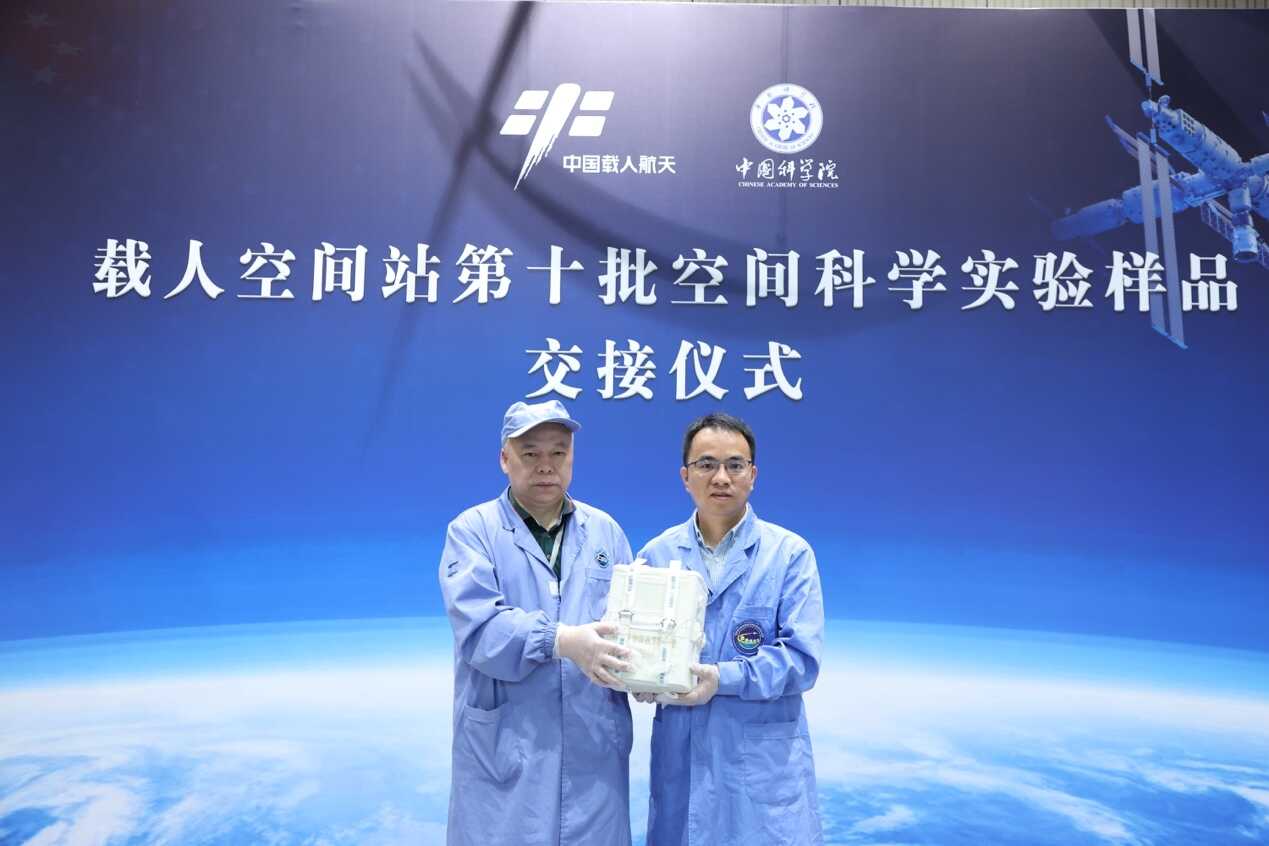
LEI Xiaohua receives mouse embryo samples returned from the space station. (Image by SIAT)
