
Newsroom



A farmer reaps wheat in a field in Wushi village, Sinan county, Guizhou province. YANG WENBIN/XINHUA
5. Scientists found cure for wheat's "cancer".
Fusarium head blight is a fungal disease that devastates wheat production and is difficult to control worldwide,and is known as the "cancer" of wheat. Kong Lingrang, a professor from Shandong Agricultural University, led his team to clone for the first time the gene Fhb7 from a wheat relative. The gene was proved effective in resisting the disease and was successfully transferred into wheat varieties.
According to Science, many genetic loci in wheat affect the gene's resistance but most only have minor effects. Kong's results were the first time that a gene was proved having a stable effect in improving resistance in breeding and it also has a detoxification function.
Currently, more than 30 organizations have applied the results for wheat genetic improvement of resistance to the disease. They have conducted extensive trials in East China's Shandong, Jiangsu and Anhui, and Central China's Henan provinces and yielded positive results.
6. Scientists reached a milestone for quantum supremacy.
Pan Jianwei and Lu Chaoyang, professors at the University of Science and Technology of China in East China's Anhui province, in collaboration with researchers from the Shanghai Institute of Microsystems and Information Technology, CAS, have created a light-based quantum computer called Jiuzhang.
The machine enabled China to reach its first milestone in quantum computing research that can demonstrate quantum supremacy, or quantum advantage, meaning the device can solve a problem no traditional supercomputer can tackle in any feasible amount of time. The results were published online in Science on Dec 4.
7. Scientists recreated the history of over 300 million years of biodiversity change on Earth.
The origin and evolution of life is one of the world's greatest scientific puzzles. More than 99 percent of the organisms that once lived on Earth have become extinct, making recreating the history of the Earth's biodiversity through fossil records an important way to understand the current development of the Earth's biodiversity inhabited by humans today.
Fan Junxuan and Shen Shuzhong, a professor and an academician, respectively, at Nanjing University in East China's Jiangsu province, built their own database, developed artificial intelligence algorithms and used the Tianhe II supercomputer to make the breakthrough, producing the world's first high-precision curve demonstrating the change of marine biodiversity over the 300 million years of the Paleozoic Era, with a resolution 400 times higher than similar international studies.
The curve accurately portrays several major extinctions and their effects on environmental changes. The results were published in Science on Jan 17.
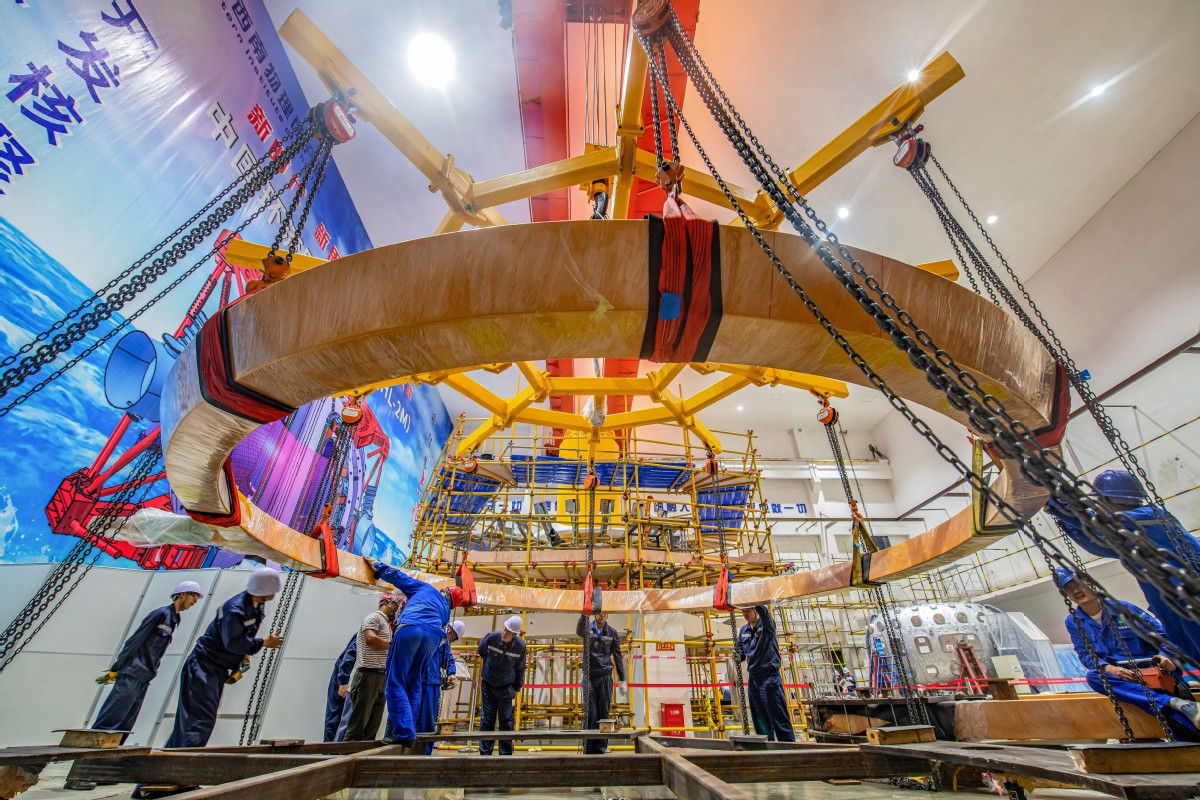
Employees from China National Nuclear Corp's Southwestern Institute of Physics install experimental research equipment at a nuclear facility in Chengdu, Sichuan province on Sept 16, 2019. [Photo/Xinhua]
8. China's new generation of "artificial sun" completed.
The new generation of China's "artificial sun", known as HL-2M Tokamak, a nuclear fusion installation, realized its first plasma discharge on Dec 4 in Chengdu, Southwest China's Sichuan province. It will help further development of humanity's quest for the future of energy.
The project was designed and built independently by the Southwest Institute of Physics of the Nuclear Industry of the China National Nuclear Corporation. Designed to replicate the natural reactions that occur in the sun using hydrogen and deuterium gases as fuels, the apparatus will provide clean energy through controlled nuclear fusion.It is the country's largest in scale and highest in parameters
With a more advanced structure and control method, it is able to generate plasma hotter than 150 million degrees Celsius and is expected to greatly enhance the research and development of key technologies in plasma physics research in China.
9. Scientists solve geometric puzzle that has been unresolved for over 20 years.
Chen Xiuxiong and Wang Bing, professors at the University of Science and Technology of China, have successfully proved the "Hamilton-Tianconjecture" and "partial--conjecture", which are two core conjectures that the international mathematics community had not been able to solve for the last two decades.
The results were published in November in the Journal of Differential Geometry, a top international mathematical journal. The length of the paper is more than 120 pages, and it took six years from submission to publishing.
10. Chinese and US team wins Gordon Bell Prize, the highest prize for high-performance computing applications in 2020, for machine learning method that achieves record molecular dynamics simulation.
On Nov 19, an application achievement jointly completed by Jia Weile, associate researcher of CAS's Institute of Computing Technology, CAS academician E Weinan, and Zhang Linfeng, a researcher at the Beijing Institute of Big Data, as well as other collaborators, won the Gordon Bell Prize presented by the Association for Computing Machinery.
The prize was given for their project, "Pushing the Limit of Molecular Dynamics with AB Initio Accuracy to 100 Million Atoms with Machine Learning".
Molecular Dynamics is a computer simulation methodology that analyzes the motion and interactions of atoms during a fixed period of time. For decades, researchers have used a simulation method called ab initio, meaning "from first principles" in Latin, for molecular dynamics because it has proven to be the most accurate. However, the calculations have long been limited by algorithms and computing power, even using the world's fastest supercomputers, which can only calculate on the scale of several thousand atomic systems.
This project uses high performance computing and machine learning to raise the limits of molecular dynamics by reaching the scale of hundreds of millions of atoms while still ensuring the high accuracy of ab initio calculations.
Media reports said molecular dynamics simulations based on deep learning bring accurate physical modelling to larger scale material simulations through the combination of high performance computing and machine learning, which is expected to play a greater role in solving practical problems in mechanics, chemistry, materials, biology, and even engineering in the future. (chinadaily.com.cn)

