
Iron especially Fe2+, as one of necessary micronutrients for plant, plays an important role in promoting the formation of chlorophyll and functioning of multiple metabolic and propelling physiological processes. Iron deficiency will hinder the synthesis of both chlorophyll and other proteins, resulting in leaf chlorosis and significant reduction of the quality and yield of crops.
Therefore, a certain amount of iron fertilizer (IF) was applied during the growth process of crops. Whereas, there are two dominant problems for traditional IF including loss of Fe2+ and oxidation of Fe2+ to form insoluble Fe3+-containing compounds, causing low utilization efficiency of IF.
To tackle the above problems, Chinese scientists developed a temperature-controlled-release and collectable iron fertilizer (TCIF) with a core-shell structure by using a nanocomposite.
This work was conducted by Professor WU Zhengyan’s team in Institute of Technical Biology and Agriculture Engineering, Hefei Institutes of Physical Science and their new technology was published in Applied Clay Science.
In WU’s study, the TCIF was developed using a nanocomposite consisting of palygorskite (Pal), ferroferric oxide (Fe3O4), ferrous ammonium sulfate hexahydrate (or FASH), ethylene oxide/propylene oxide block copolymer (F-127), and amino silicon oil (or ASO).
Pal with a porous micro/nano networks structure could bind a great many of Fe2+ through electrostatic attraction.
FASH can produce NH3 at 100°C to make a plenty of micro/nano pores in the ASO-F-127 shell, which facilitated the release of Fe2+.
F-127 can open and close the pores through the liquid-gel transition under different temperature to adjust the release of Fe2+.
The hydrophobic ASO endowed TCIF a high stability in aqueous solution for at least 100 days.
This work provides a promising method to enhance the utilization efficiency of IF and promote the absorption of Fe2+ by maize. Besides, TCIF displayed a good reuse performance, which might lower the cost and increase a large application value.
This research was supported by National Natural Science Foundation of China, the Youth Innovation Promotion Association of the Chinese Academy of Sciences (CAS), the Key Program of the CAS, the Science and Technology Service Programs of CAS, and the Grant of the President Foundation of Hefei Institutes of Physical Science.
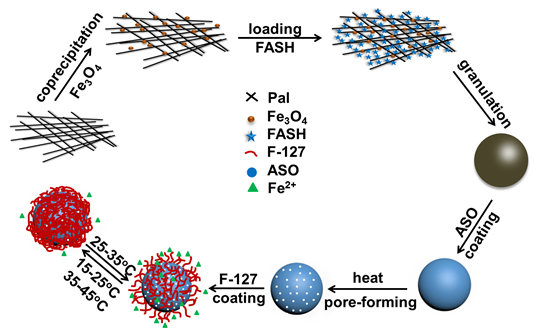
Schematic illustration of fabrication procedure and mechanism of TCIF. (Image by CHI Yu)

86-10-68597521 (day)
86-10-68597289 (night)

52 Sanlihe Rd., Xicheng District,
Beijing, China (100864)
Copyright © 2002 - Chinese Academy of Sciences


