
The plant hormone abscisic acid (ABA) regulates many key processes in plants and serves as an endogenous messenger in biotic and abiotic stress responses. The sites of ABA perception have intrigued plant biologists for many years. Recent breakthrough on identification and characterization of PYR/PYLs as ABA receptors is helpful to understand the perception, signaling and transportation of ABA in plant.
Prof. CHAN Zhulong from Plant Water Stress Response Group at Wuhan Botanical Garden has reported transcriptional profiling of Arabidopsis ABA pathway core components after abiotic stress, biotic stress and plant hormone treatments based on publicly available microarray. The results showed that stress conditions and exogenous ABA treatment generally increased ABA key metabolism and catabolism transcript levels, including NCED3 (key gene regulates ABA biosynthesis) and CYP707As (key genes regulate ABA catabolism), indicating that both abiotic and biotic stress treatments promoted ABA metabolism in planta. The expression levels of PYR/PYLs were down-regulated and these of PP2Cs were uniformly up-regulated after exogenous ABA application.
These results (less ABA receptors and more PP2Cs) were somewhat opposite to what they expected. According to the basic model of ABA signal pathway, in the presence of endogenous ABA, PYR/PYLs interact with PP2Cs and inhibit phosphatase activity, allowing SnRK2 activation and phosphorylation of target proteins. Therefore, it is reasonable if expression of ABA receptors increased in the presence of endogenous ABA. However, the results presented by Prof. CHAN indicated that interaction between PYR/PYLs and PP2Cs might not require transcriptional up-regulation of both PYR/PYLs and PP2Cs after stress or ABA treatment, but actually the increased ratio of PP2Cs:PYR/PYLs. As a result, expression levels of most ABA-responsive genes were up-regulated under stress conditions or by ABA treatment.
The current research provided new insight into the role of ABA signaling pathway during abiotic and biotic stress responses. It also indicated possible interaction among abiotic stress and biotic stress since both of them shared ABA signal pathway in Arabidopsis.
Article link: http://dx.doi.org/10.1016/j.ygeno.2012.06.004
CONTACT:
Prof. CHAN Zhulong
Tel: +86-27-87510823
Email: zhulongch@wbgcas.cn
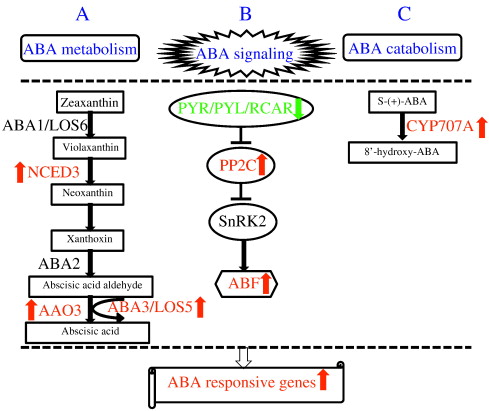
Exogenous ABA as well as stress conditions regulates ABA signal pathway core components (Image by CHAN Zhulong)

86-10-68597521 (day)
86-10-68597289 (night)

52 Sanlihe Rd., Xicheng District,
Beijing, China (100864)
Copyright © 2002 - Chinese Academy of Sciences


