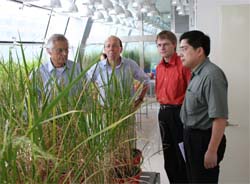
At the final-term evaluation meeting held on August 8 in Shanghai, an international panel composed of Chinese, German and US experts spoke highly of the research advance and management at the CAS/Max Planck Society (MPG) Partner Group on Plant Molecular Physiology and Signal Transduction.
CAS/MPG Partner Groups are designed to promote network building between qualified Chinese scientists with German institutions by providing groups leaders and their teams, within a fixed period of up to five years, favorable conditions for them to continue and develop research with their corresponding partners at Max Planck institutes.
The Partner Group on Plant Molecular Physiology and Signal Transduction was created on August 1, 2000 at the CAS Shanghai Institute of Plant Physiology and Ecology. Over the past five years and under the leadership of Prof. Xue Hongwei, who worked as a postdoc at the Max Planck Institute of Molecular Plant Physiology (MPI-MP) from 1996 to 1998, the group has scored encouraging progress in scientific research, talent training, and international cooperation.
The Group has established a well-equipped research platform for studies in genetics, molecular biology and biochemistry, and a research system for functional genomics, proteomics and metabonomics. It also developed a research team staffed a whole spectrum of professionals ranging from principal investigators, senior technicians, to postdocs and graduate students. The team has made major achievements in functional genomics of plant seed development, functional mechanisms of plant hormones and signal transduction. Many of their work were published in international major journals, such as The Plant Cell, The Plant Journal, Plant Physiology, and Plant Molecular Biology. The group has undertaken a number of research projects with the support from, for instance, the National Program on Key Basic Research Projects, National High-tech Development Program and CAS Projects in Major Research Directions.
Experts from the Max Planck Society expressed their desire at the meeting to continue the cooperative research with CAS Shanghai Institute of Plant Physiology and Ecology in the fields of metabonomics, and plant reproduction and development.


