
Molecular oxygen is a key component of the air humans breathe in order to live. Oxygen is the third most abundant element in the Universe, after hydrogen and helium. Are there oxygen molecules beyond the Milky Way Galaxy?
For the first time, molecular oxygen has been spotted in another galaxy, the quasar Markarian 231, by an international team led by the researchers from Shanghai Astronomical Observatory (SHAO) of the Chinese Academy of Sciences. It is also the most molecular oxygen ever seen outside the solar system. This study was published in The Astrophysics Journal.
Previously, astronomers have found the molecular oxygen in two star-forming clouds within our Milky Way Galaxy, the Orion Nebula and the Rho Ophiuchi cloud. As oxygen atoms and water molecules are possibly frozen onto dust grains, little molecular oxygen are found in the interstellar medium. However, in Orion Nebula, shocks from bright newborn stars can rip water from the dust, freeing oxygen atoms and form molecules.
Recently, this international team led by WANG Junzhi from SHAO discovered the molecular oxygen in the nearest quasar, Markarian 231, located 581 million light years from the Milky Way Galaxy.
Based on deep observations using the IRAM 30-meter telescopes in Spain and the NOrthern Extended Millimeter Array (NOEMA) interferometer in France, the team saw radiation at the wavelength of 2.52 millimeters, a signature of the molecular oxygen’s presence, “in an external galaxy for the first time”.
“It is difficult to detect the signature of molecular oxygen with ground telescopes, as Earth’s atmosphere absorbs a lot of the wavelength that are needed to detect oxygen,” WANG explained, “The light from Markarian 231 has been redshifted to longer wavelengths and are not efficiently blocked by Earth’s atmosphere. The radio telescopes with very high sensitivity are able to detect it.”
The molecular oxygen spanning the outskirts of the galactic disk of Markarian 231 is the most abundant ever seen outside the solar system, with abundance more than 100 times greater than that in the Orion Nebula. One possible explanation for all the molecular oxygen is that Markarian 231 goes through a more vigorous version of the Orion Nebula’s oxygen-forming process.
The molecular oxygen may be a significant coolant of molecular gas in such regions affected by molecular outflows driven by the central black hole, which can create even more stars in the galaxy. “The first detection of extragalactic molecular oxygen provides an ideal tool to study molecular outflows on dynamic timescales of tens of millions of years,” WANG said.
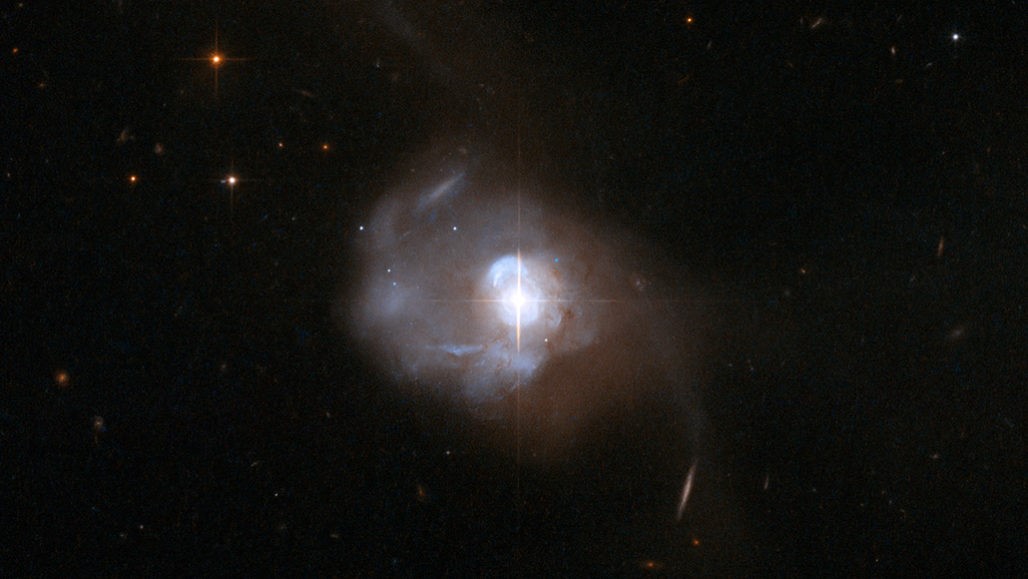
An image of the quasar Markarian 231 from the Hubble Space Telescope. Image credit: NASA, ESA, the Hubble Heritage Team (STScI/AURA)-ESA/Hubble Collaboration, and A. Evans (UVA/NRAO/Stony Brook Uni.)

Now, it turns out that the quasar nearest to Earth, located 600 million light-years away in a galaxy called Markarian 231, is actually built around two twirling black holes. It’s a first-of-its-kind type of find, and scientists think there could be a lot more quasars wit...
Astronomers with the Sloan Digital Sky Survey (SDSS) have created the first map of the large-scale structure of the Universe based entirely on the positions of quasars. Quasars are the incredibly bright and distant points of light powered by supermassive black holes.

86-10-68597521 (day)
86-10-68597289 (night)

52 Sanlihe Rd., Xicheng District,
Beijing, China (100864)
Copyright © 2002 - Chinese Academy of Sciences


