Newsroom


The "ScienceOne–Yuheng Carbon Accounting Large Model" (ScienceOne–Yuheng Model), described as the world's first panoramic carbon emission accounting system covering production, consumption, and natural sources, was officially launched on April 8 in Shanghai. This marks a significant technological breakthrough, addressing a critical global need for precise and comprehensive carbon accounting.
Accurate and high-resolution carbon accounting is fundamental for international climate compliance, global carbon pricing mechanisms, and achieving carbon peaking and neutrality targets. Developed by the Shanghai Advanced Research Institute (SARI) of the Chinese Academy of Sciences, the ScienceOne–Yuheng Model directly confronts the limitations of traditional carbon accounting, such as high knowledge barriers, fragmented data processing, prolonged calculation cycles, and insufficient resolution.
Leveraging generative artificial intelligence, the ScienceOne–Yuheng Model reconstructs the entire carbon accounting paradigm. This innovative approach enables dynamic tracking of global carbon flows and precise carbon tracing, significantly enhancing the scientific basis for global climate governance.
The model is built upon CAS's "ScienceOne" platform, adopting a three-layer architecture: a continually updated data layer comprising eight categories of proprietary datasets; an algorithm layer featuring independently developed multi-boundary carbon accounting methodologies and large language model-driven intelligent agents; and a computing layer that integrates high-performance in-house servers with external centers for optimized resource allocation.
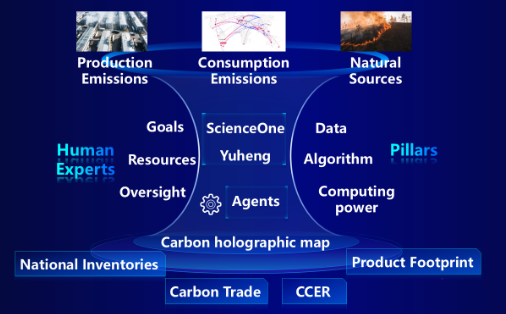
ScienceOne–Yuheng Carbon Accounting Large Model (Image by SARI)
A user-friendly interface, powered by a 32-billion-parameter domain-specific large language model, provides conversational and programming access to an intelligent database. The model currently features five specialized intelligent agents that support diverse functions, including industrial system simulation, carbon transfer accounting in trade, life cycle assessment (LCA), natural source accounting, and uncertainty analysis.
Notably, the LCA agent can autonomously manage the entire workflow for product carbon footprint accounting, from goal and scope definition to inventory analysis, calculation, and result interpretation.
Early applications of the model have produced high-resolution "holographic maps" of national carbon emissions. For instance, in 2022, the model's new accounting framework adjusted greenhouse gas emissions for China by -17.7%, the United States by +15.2%, and Japan by +7.2%, compared to traditional IPCC production-based accounting methods. This highlights the model's potential to offer a more accurate and comprehensive view of national contributions.
The ScienceOne–Yuheng Model has also indicated that the default emission factors under the EU Carbon Border Adjustment Mechanism (CBAM) may systematically overestimate emissions for certain Chinese products, underscoring the need for improved accounting precision and localized factors.
Furthermore, it quantifies the global emission reduction contributions of key green products, revealing that Chinese-exported wind turbines and photovoltaic products in 2024, despite generating an estimated 2 million tons of carbon during production, contributed approximately 350 million tons of global carbon emission reductions during their operational lifetimes.
Panoramic carbon accounting is set to become a core driver for advancing global climate governance toward greater precision and consensus. The CAS research team plans continuous iteration and enhancement of the ScienceOne–Yuheng Model, developing proprietary algorithms, datasets, and reports with independent intellectual property rights.
The model is anticipated to be a vital tool for various applications, including national greenhouse gas inventory compilation, carbon market development, green transformation of key industries, and informing responses to international carbon policies, thus contributing China’s expertise to establishing a more equitable and scientifically grounded global carbon accounting and responsibility-sharing framework.
"The ScienceOne–Yuheng Model represents a paradigm shift in how we understand and manage global carbon emissions," said WEI Wei, vice president of SARI and lead scientist of the research team. "By providing unprecedented resolution and accuracy, we aim to equip policymakers, industries, and researchers worldwide with the tools needed to accelerate climate action and foster a more sustainable future."