Research


Northwest China (NWC) locates in the central part of mid-latitude Eurasian continent. Bounded by the Altai Mountains to the north and the Tibet Plateau to the south, this district is one of the most arid areas at the same latitude. Precipitation anomalies in NWC could impact local society and economy.
Researchers from the Institute of Atmospheric Physics (IAP) of the Chinese Academy of Sciences investigated possible reasons leading to interannual variations of winter precipitation in Northwest China. Their study was published in Journal of Climate.
"Many studies have attributed its interannual precipitation variability to the so-called dry circulation, with a quasi-zonal out-of-phase height anomalies pattern over Japan and central Asia. But the mechanism for the dry circulation remains unclear," said Dr. YIN Xiaoxue, first author of the study.

The team released a radiosonde in Dunhuang observation station on October 23, 2019 (Image by ZHENG Yuqiong)
Using data from observations and reanalysis, they found the dry circulation related to the winter precipitation in NWC was mainly modulated by the ENSO and mid-latitude North Atlantic (MNA) SST.
ENSO and MNA SST can cause NWC winter precipitation variation independently through atmospheric teleconnections. In addition, significant precipitation anomalies also occur when concurrent but oppositely signed SSTs anomalies in the two regions are observed.
For example, warm ENSO phase and negative MNA SST could drive a PNA-EU like teleconnection, which causes anomalous southwesterly and southeasterly winds synergistically and enhanced winter precipitation in NWC.
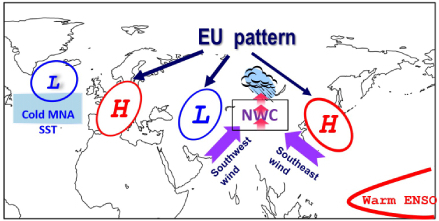
The diagram of large-scale circulations and NWC winter precipitation anomalies associated to the cold MNA and warm ENSO phases (Image by YIN Xiaoxue)
The reinforced negative correlations between ENSO and MNA SST after the mid-1990s give rise to the interdecadal changes in the relationship between ENSO and MNA SST with NWC winter precipitation variability. "The strength of the correlation between ENSO and MNA SST should be taken into account when we try to understand and predict the NWC winter precipitation variability," said Prof. ZHOU Liantong, corresponding author of the study.