Newsroom


A research team led by Prof. QU Zhe from the Hefei Institutes of Physical Science of the Chinese Academy of Sciences (CAS), in collaboration with Prof. LIU Enke from the Institute of Physics of CAS, has found a new way to control the magnetic reversal in a special material called Co3Sn2S2, a Weyl semimetal.
"This discovery could help switch the magnetization of devices that rely on magnetic properties," said Prof. QU, "such as hard drives and spin-based technologies."
The results were published in Materials Today Physics.
Co3Sn2S2 is a magnetic Weyl semimetal with a unique structure, in which its magnetic properties are linked to its topological features. The exchange bias (EB) effect, which is important for the stability of magnetic devices, has been observed in this material, but the exact mechanisms behind it are still unclear.
In this study, the researchers found that by adjusting the maximum external magnetic field (Hmax) and the thermal history, they could control the magnetic reversal of the material. When Hmax was high enough, the material's coercive fields became symmetric, and the EB-like behavior disappeared.
They proposed that local magnetic states play a key role in the tunable magnetic reversals: below certain flipping fields, these states help to form reverse magnetic domains that lower the coercive field. When Hmax exceeds a critical value, these states align with the magnetization direction and no longer affecting the reversal process.
This discovery offers a new explanation for the asymmetric hysteresis loop in Co3Sn2S2, which is different from the usual EB effect.
"By adjusting the maximum external magnetic field, we can control the magnetic reversal of the material and its magnetic-topological properties, effectively tuning the symmetry of the hysteresis loop," said Dr. ZENG Qingqi, a member of the team.
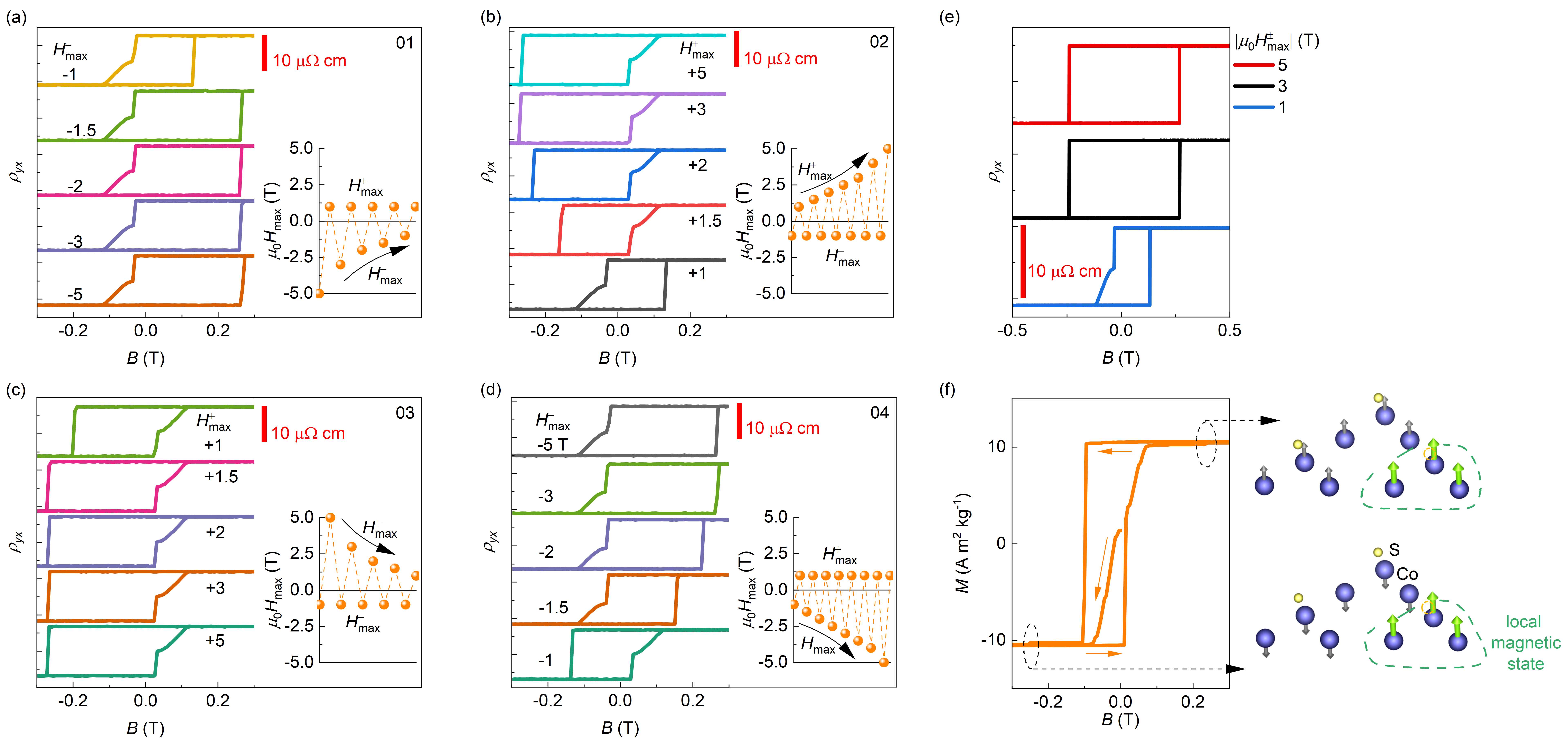
(a–d) Tunable asymmetric Hall loops at 5 K (magnetic histories are shown in insets); (e) Symmetric loops under high enough external magnetic field; (f) Sketch of the influence of positively aligned local magnetic state to magnetic reversals. (Image by ZENG Qingqi)