Newsroom


Multi-axis differential optical absorption spectroscopy (MAX-DOAS) is a remote sensing technique for measuring vertical profiles of trace gases and aerosols.
According to a paper recently published on Atmospheric Chemistry and Physics, researchers led by Prof. XIE Pinhua from the Hefei Institutes of Physical Science (HFIPS) of the Chinese Academy of Sciences, in collaboration with Prof. Wagner Thomas from Max Planck Institute for Chemistry (MPIC) of Germany, have evaluated the profile retrievals of aerosols and trace gases for MAX-DOAS measurements under different aerosol scenarios to help obtain better understanding of MAX-DOAS measurements under high pollution levels.
For different aerosol pollution scenarios, the researchers assessed the performances of two inversion algorithms. Three vertical profiles shapes described in different parameters, including Exponential, Boltzmann and Gaussian shapes, were used to represent the state of the aerosol.
"The two algorithms, one is based on optimal estimation, and the other uses a parameterized approach to retrieve the near-surface values of aerosol extinction and trace gas," said TIAN Xin, lead author of the study.
Compared with previous studies, much larger ranges of aerosol optical depth (AOD) and nitrogen dioxide (NO2) vertical column densities (VCDs) were covered in this research.
The researchers found that the NO2 profile was systemically dependent on the NO2 VCD, but less dependent on the aerosol profiles. For low NO2 VCDs, a strong relative overestimation of the retrieved NO2 profile was found and vice versa. The large systematic deficiencies between the input and retrieval results can be improved by optimizing the covariance matrix of the a priori uncertainties for the optimal estimation algorithm.
This work was supported by the National Natural Science Foundation of China.
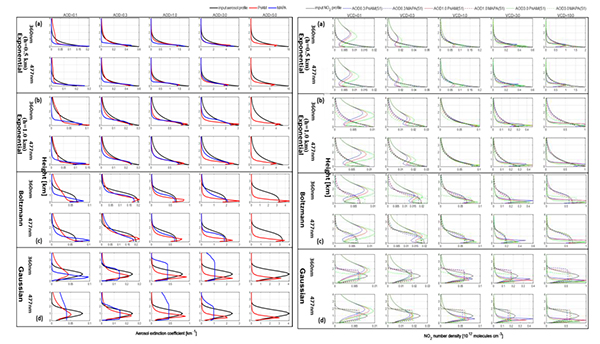
Comparison of the profiles retrieved by two inversion algorithms for 360 nm (first line) and 477 nm (second line) and the corresponding input profiles at different aerosol scenarios. The aerosol profile (a) and NO2 profile (b) were shown. The red and blue curves indicate the results from optimal estimation and parameterized, respectively. (Image by TIAN Xin)