Newsroom


In the molecular ions prepared by femtosecond laser, scientists has observed laser-like radiations, coherence enhanced nonlinear effects, and many interesting quantum phenomena. All of these studies show that molecular ions are a versatile quantum platform to study quantum coherence in the strong-field regime.
Recently, researchers from the Shanghai Institute of Optics and Fine Mechanics (SIOM) of the Chinese Academy of Sciences (CAS) observed rotational coherence in an excited state of CO+.
They demonstrated that this coherence could be recorded in the resonance enhanced vacuum ultraviolet (VUV) radiation, which is manifested as the periodic modulations of VUV radiation with the delay of two-color laser pulses. Results were published in Optics Letters on Aug. 06.
In this study, the researchers implemented 2+1 multiphoton resonant excitation in the strong-field-ionized CO molecules using near-infrared and ultraviolet pump pulses, which gives rise to VUV coherent radiation.
When they scanned the relative delay between two pulses, the rotational-resolved VUV radiations show periodic modulations lasting as long as 500 ps. Fourier analysis reveals that these modulations correspond to rotational beat frequencies of the first excited state of CO+, which is the result of multi-channel interference during the resonant excitation process.
They found that high resolution of Fourier transform spectra up to 0.067 cm-1 allows them to obtain fine energy levels of the excited state of CO+. The theoretical calculation is in good agreement with the experimental observation.
The result opens up promising applications of rotational coherence spectroscopy in the accurate determination of molecular constants and ultrafast dynamics of molecular ions.
This work was supported by the National Natural Science Foundation of China, the Key Research Program of Frontier Sciences of CAS, the Shanghai Municipal Science and Technology Major Project, the Program of Shanghai Academic Research Leader, and the Youth Innovation Promotion Association of CAS.
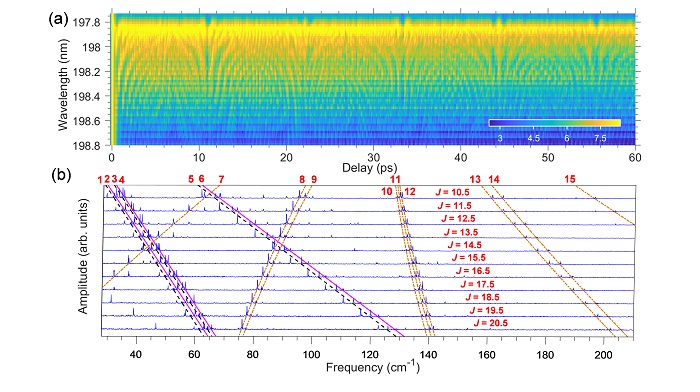
(a) The rotational-resolved VUV emission spectra as a function of the time delay between two pump pulses. (b) Fourier transform spectra for the experimentally measured time-dependent VUV emission from different rotational levels and the theoretically calculated rotational beat frequencies of the first excited state of CO+. (Image by SIOM)