
Newsroom


A new study published in Global Change Biology reveals that nitrogen (N)-rich mineral-associated organic matter (MAOM) decomposes more rapidly than expected, challenging the prevailing view that microbe-derived nitrogen-containing compounds are strongly sorbed to mineral surfaces and hence resistant to degradation.
The study, led by Prof. FENG Xiaojuan's team from the Institute of Botany of the Chinese Academy of Sciences, deliberately constructed 13C-labelled microbe- and plant-derived MAOM with varying molecular compositions and organic carbon (OC) loadings. Three independent microcosm experiments were conducted to investigate how the intrinsic properties of MAOM influence its persistence in soils.
The researchers found that N-rich MAOM is highly decomposable, partly because N-rich microbial residues preferentially accumulate on minerals via organo-organic interactions, reducing their binding strength to minerals and increasing their susceptibility to degradation.
Moreover, the high decomposability of OC retained through organo-organic interactions potentially poses an upper limit of carbon retention in MAOM, providing an alternative explanation for carbon saturation other than mineral surface availability.
These findings call for a revision of the current conceptual framework of MAOM persistence to better integrate the role of N compounds and their binding modes in regulating MAOC turnover and dynamics.
This study has important implications for soil carbon sequestration potentials and the dynamics of MAOM under global changes.
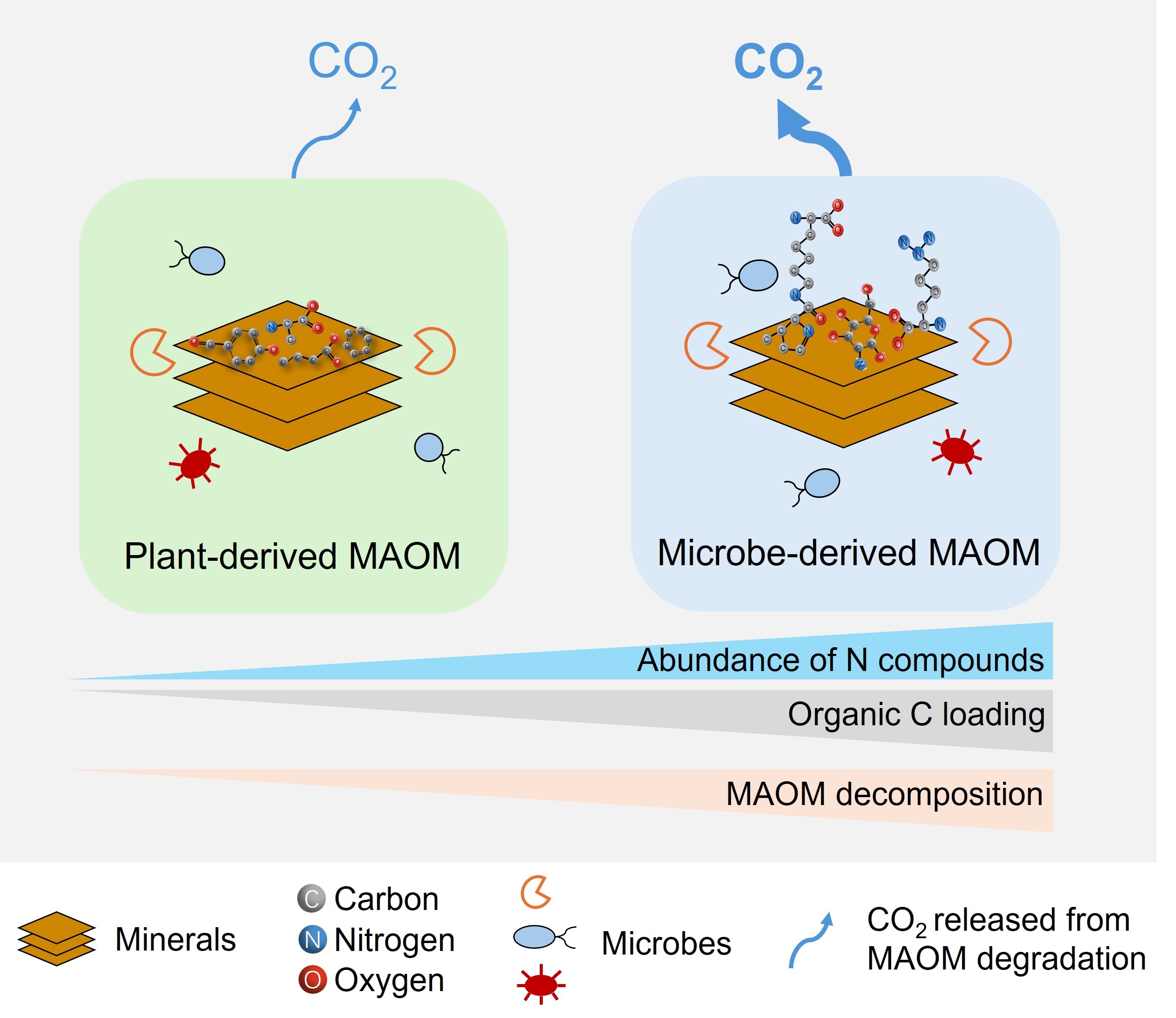
Conceptual figure illustrating mineral-associated organic matter (MAOM) decomposition related to N compounds and organic carbon (C) loadings. (Image by JIA Juan)
