Newsroom


A research team led by Prof. LI Xinjian from the Institute of Biophysics of the Chinese Academy of Sciences has developed a fluorescent probe that enables high-throughput screening of small-molecule stimulator of interferon gene (STING) Ligands, offering a promising strategy for cancer immunotherapy.
Their findings, published on July 15 in Cell Reports Methods, introduce the Fluorescence Indicator for STING Ligand (FiSL) platform and identify honokiol, a small-molecule, as a promising orally active STING agonist.
STING signaling pathway plays a pivotal role in antitumor immunity, as well as in the initiation, progression, and metastasis of cancer. Small-molecule STING agonists are widely regarded as a promising class of immunotherapeutic agents. However, efforts to develop such compounds have been hindered by the absence of efficient, scalable screening tools.
To overcome this bottleneck, the researchers designed FiSL—a fluorescence-based probe that sensitively detects the binding of candidate molecules to STING. Leveraging this tool, they identified honokiol as a potent STING agonist. Honokiol is an active ingredient in the traditional Chinese medicine formula Banxia Houpu Decoction, which is traditionally used to resolve phlegm, regulate qi, and relieve stagnation.
Animal experiments showed that orally administered honokiol can be rapidly delivered to tumor tissues, activate antitumor immunity, and significantly prolong survival in various solid tumor-bearing mouse models (including colorectal cancer, melanoma, and breast cancer), with no obvious toxic side effects.
This work introduces FiSL as a versatile platform for STING-targeted drug discovery and reveals honokiol as a novel, orally active STING agonist, according to the researchers stated. This opens a new path for developing plant-derived immunomodulators in precision oncology.
This study is expected to provide a novel immunotherapeutic strategy for cancer patients and open up new avenues for the modernization of traditional Chinese medicine.
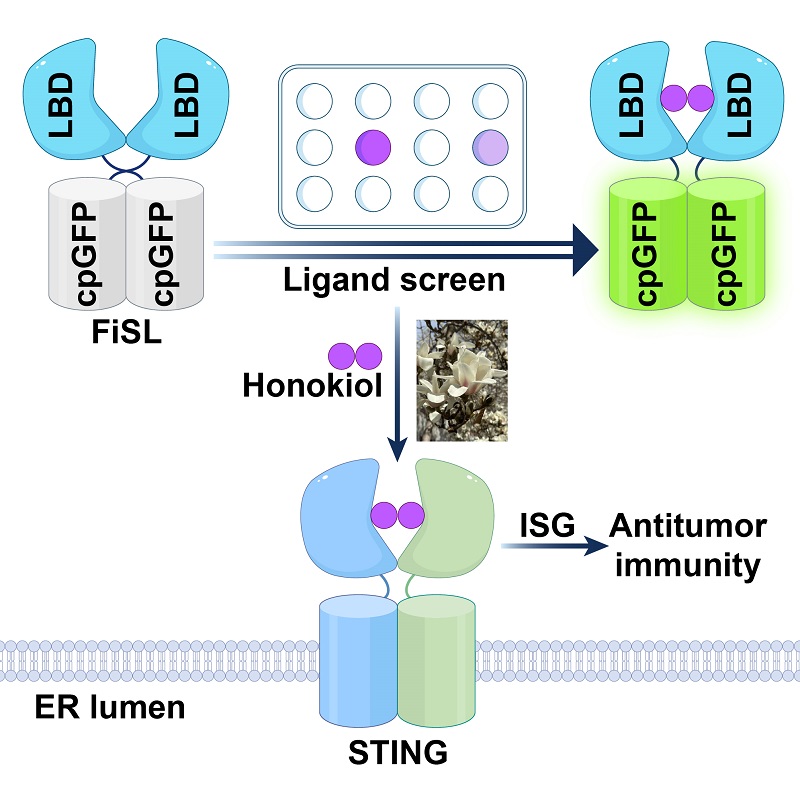
Development of the STING ligand fluorescent probe FiSL and its application in antitumor drug screening. (Image by LI Xinjian's group)