Newsroom


A collaborative study by the Institute of Biophysics and the Shanghai Institute of Materia Medica of the Chinese Academy of Sciences has revealed a natural compound that could counteract bone loss caused by physical inactivity or microgravity.
Published in The FASEB Journal on July 1, the study for the first time elucidates the bioactive substance, molecular mechanism, and target through which Lycium barbarum (L. barbarum), a traditional Chinese medicinal herb, exerts its bone-strengthening effects by promoting bone formation and alleviating disuse bone loss, shedding light on the scientific foundation of the traditional efficacy of "strengthening bones."
Disuse bone loss is a metabolic bone disease caused by prolonged physical inactivity, such as long-term bed rest in patients or extended space missions under microgravity experienced by astronauts. The underlying pathological mechanisms remain incompletely understood, and there are currently no targeted therapeutic drugs available. Historical texts like the Compendium of Materia Medica (Ben Cao Gang Mu) have long attributed bone-strengthening properties to L. barbarum, but the biological basis behind this claim has remained elusive until now.
Using hindlimb-unloaded mice and pre-osteoblast MC3T3-E1 cells under simulated microgravity as models, the researchers found that L. barbarum water extract (LBE), L. barbarum polysaccharide (LBP), and a purified polysaccharide fraction LBPP all exhibited protective effects against bone loss in the mouse model.
These components significantly mitigated disuse bone loss by enhancing bone mineral density and improving microstructural parameters, while reversing the microgravity-induced inhibition of osteoblast differentiation. These findings identify LBPP as the key pharmacologically active component responsible for promoting bone formation in L. barbarum's action against disuse bone loss.
Both in vivo mouse experiments and in vitro cell studies demonstrated that LBE, LBP, and LBPP can promote bone formation. Further molecular interaction assays confirmed that LBPP directly binds to Noggin, an inhibitor of bone morphogenetic proteins (BMPs), thereby activating the BMP/Smads signaling pathway and promoting osteogenesis to counteract disuse bone loss.
This study reveals the clinical potential of L. barbarum in mitigating bone loss caused by microgravity or prolonged bed rest. LBPP emerges as a promising natural compound for preventing and treating disuse bone loss related to aging, immobility, or spaceflight.
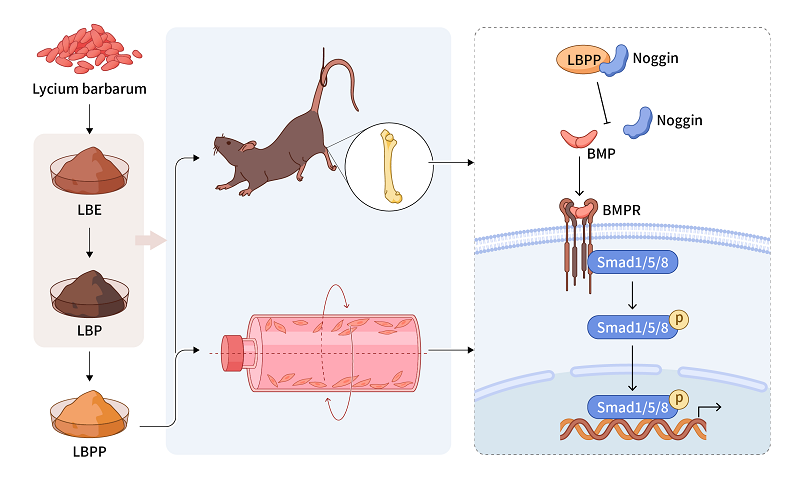
Schematic Illustration of L. barbarum Polysaccharide Promoting Bone Formation to Alleviate Disuse Bone Loss and Exert Bone-Strengthening Effects (Image by CHEN Chang's group)