
Newsroom


Western equine encephalitis virus (WEEV), a mosquito-borne alphavirus, can cause fatal encephalitis in humans and equines. WEEV strains exhibit significant differences in their preferences for host cell receptors. This variability in receptor usage suggests that WEEV may have evolved receptor-shift mechanisms to facilitate infection and invasion across diverse host species. However, the specific molecular mechanisms behind this adaptation have remained unclear.
In a new study published in Cell Reports on May 20, researchers from the Institute of Biophysics of the Chinese Academy of Sciences and Tsinghua University, has uncovered that WEEV exploits distinct binding strategies to attach to host cells.
In this study, using cryo-electron microscopy (cryo-EM), the researchers resolved detailed structures of multiple WEEV strains interacting with two distinct receptors: protocadherin 10 (PCDH10) and very low-density lipoprotein receptor (VLDLR).
The findings reveal that WEEV uses entirely different binding strategies depending on the receptor it targets. PCDH10 and VLDLR form separate and distinct interfaces with the virus, highlighting a structural basis for the virus ability to switch receptors. This receptor plasticity is believed to be a key factor in WEEV's capacity to infect both humans and equines, and potentially other species.
A detailed structural analysis showed that the EC1 domain of PCDH10 embeds deeply within the cleft formed by adjacent E2-E1 heterodimers of the viral glycoprotein trimer. This domain interacts extensively with E2, E1, and a neighboring E2' glycoprotein. The researchers discovered that a single mutation—L149Q—in the E2 glycoprotein of the Imperial 181 strain significantly impairs its ability to bind human-derived PCDH10.
In contrast, avian-derived PCDH10 contains a Q107R mutation that offsets for the impact of the L149Q mutation in the viral E2 glycoprotein, thereby maintaining stable interactions between the virus and the avian receptor.
Therefore, the selective recognition of PCDH10 receptors from different species by WEEV strains is jointly determined by key amino acid sequence variations in both the viral glycoprotein and the host receptor.
The study also found that the VLDLR binds the WEEV McMillan strain through two consecutive low-density lipoprotein receptor class A (LA) repeats, with LA1-2 to LA5-6 all exhibiting detectable binding capabilities. This interaction primarily relies on the basic lysine side chains on the viral surface that interact with the conserved acidic calcium-binding sites in the LA domains.
The results indicate that the multi-repeat LA binding mode of VLDLR depends on specific basic amino acid residues on the viral surface. These critical residues can be gained or lost during viral evolution, explaining the differing abilities of various WEEV strains to utilize VLDLR. This also highlights the considerable variability in VLDLR-like receptor-dependent viral entry and provides important clues for the development of antiviral strategies.
By resolving the high-resolution structures of different WEEV strains bound to two distinct types of receptors, this study elucidates the structural basis and specificity determinants of receptor switching in WEEV. These findings significantly advance our understanding of alphavirus host adaptation, cross-species transmission, and the development of antiviral interventions.
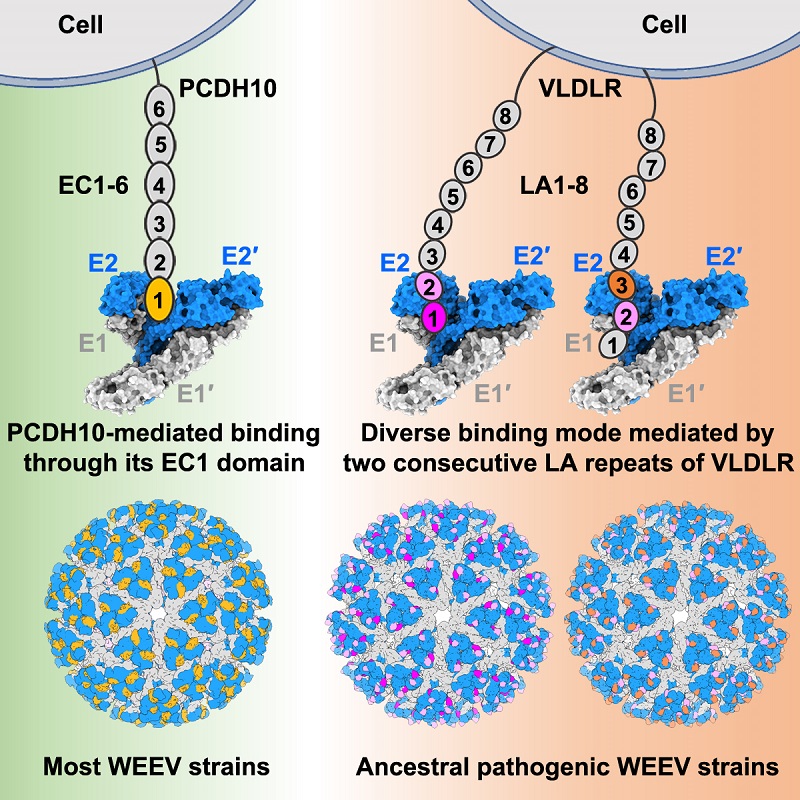
The selective recognition of different receptors by various WEEV strains (Image by ZHANG Xinzheng's group)

