
Newsroom


Disorders of consciousness (DoC) occur when patients lose autonomous awareness and the ability to interact following severe brain injury. As one of the clinical interventions for DoC, deep brain stimulation (DBS) has been shown to effectively modulate neuronal activity in the central thalamus, reshape brain networks, and promote the recovery of consciousness. However, the precise mechanisms by which thalamic neuronal firing influences DoC remain poorly understood, which has largely limited further improvements in clinical treatment outcomes.
A research team from the Institute of Biophysics of the Chinese Academy of Sciences, in collaboration with Beijing Tiantan Hospital, Capital Medical University, has systematically analyzed thalamic neuronal activity recorded from 29 patients with DoC. They integrated these data with clinical scale assessments and multimodal neuroimaging to explore how dual firing modes of central thalamic neurons correlate with consciousness levels and recovery trajectories.
Published in The Innovation on February 25, this study elucidates the unique role of thalamic neuronal electrophysiology in DoC.
The researchers identified ten electrophysiological features, including the number of activated neurons, firing frequency, and variability, to evaluate thalamic neuronal activity. They found that patients in a vegetative state (VS) exhibited fewer activated thalamic neurons, with longer and more unstable burst firing patterns and significantly reduced burst firing intensity compared to those in a minimally conscious state (MCS).
To comprehensively integrate these differential features, the researchers innovatively developed a neuronal index, which demonstrated significant differences between the two patient groups and effectively reflected their levels of consciousness.
Patients who recovered consciousness displayed stronger tonic firing activity, higher variability in neuronal interspike interval, a greater number of activated neurons, and more irregular yet higher-frequency multi-neuronal firing patterns in the central thalamus.
A significant finding of the study was the identification of effective connectivity from the central thalamic CM/Pf nuclei to the anteromedial prefrontal cortex (aMPFC) as a critical indicator of functional recovery. This connectivity, referred to as ECCM/Pf-aMPFC, was key in distinguishing recovery outcomes among patients.
By integrating metrics such as tonic firing frequency, interspike interval variability, and ECCM/Pf-aMPFC, the team constructed a predictive model for patient recovery, which demonstrated high predictive accuracy for functional outcomes.
This study not only deepens our understanding of the thalamic mechanisms underlying disorders of consciousness but also provides critical theoretical support for optimizing personalized DBS parameters.
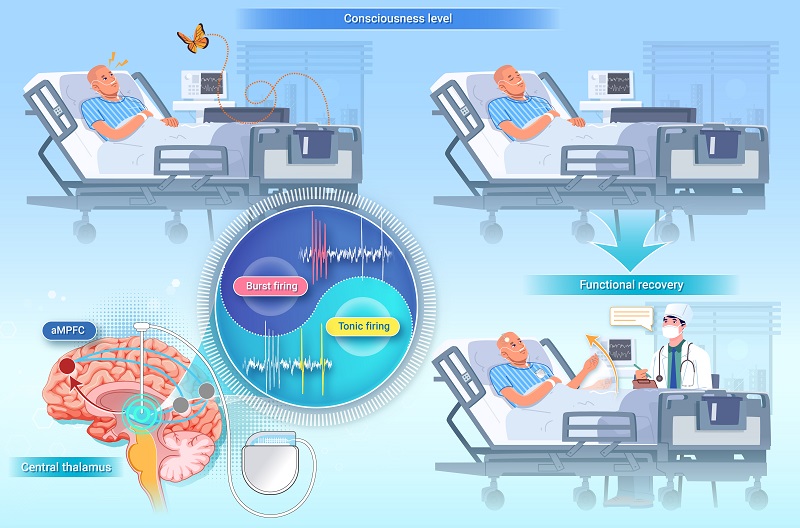
Differential Roles of Thalamic Neuronal Activity in Consciousness Levels and Recovery
(Image by YANG Yan's group)
