
Newsroom


In a study published in PNAS on March 21, Prof. SUN Fei's team from the Institute of Biophysics of the Chinese Academy of Sciences, in collaboration with researchers from Pohang University of Science and Technology, Harvard Medical School, and City University of Hong Kong, has revealed the crucial role of ADP-Ribosylation Factor (ARF) proteins in vesicle fission.
This discovery fills a significant gap in understanding how these small GTPases contribute to the final stage of intracellular vesicle formation.
Vesicle formation is an essential cellular process that ensures the proper localization of proteins and lipids within the cell. While the role of ARF proteins in vesicle budding has been extensively studied, their involvement in vesicle fission, the process of releasing fully formed transport vesicles, has remained unclear.
In this study, the researchers utilized cryoelectron microscopy and helical reconstruction techniques to successfully capture the unique helical lattice structure formed by ARF6 protein on the lipid membrane surface. The ARF6 tetramer serves as the fundamental assembly unit, stabilized primarily by hydrophobic interactions and electrostatic interactions within the tetramer, while inter-tetramer interactions rely on electrostatic forces to form a stable helical structure.
Molecular dynamics simulations further validated the assembly stability of the ARF6 tetramer and revealed that its stable association with the lipid membrane is achieved through the synergistic action of the N-terminal myristoyl chain (MYR) and amphipathic helices (AH).
The study also discovered that mutations targeting the ARF6 lattice interaction interfaces and the N-terminal AH specifically blocked its function in mediating endocytic recycling transport. These findings confirm the essential roles of these interaction interfaces and helices in the endocytic recycling process. Functional experiments showed that GTP hydrolysis of ARF6 triggers neck scission, leading to the formation of small vesicles and completing vesicle fission.
Given the high homology between ARF1 and ARF6, the researchers conducted COPI complex vesicle reconstitution experiments, demonstrating that the assembly mechanism of ARF is the core driver of vesicle fission. The study confirmed that mutations targeting the ARF lattice interaction interfaces significantly impaired vesicle fission, corroborating prior research that ARF1 dimerization is essential for vesicle fission and that the dimer interface precisely aligns with the tetramer interface region in the helical lattice.
This work not only elucidates the detailed molecular mechanism of ARF proteins in vesicle fission, filling a critical knowledge gap in the final stage of vesicle formation, but also provides new insights for future research on the regulation of intracellular material transport.
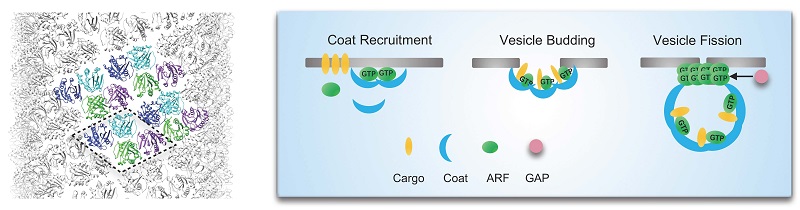
Molecular Mechanism of ARF6-Mediated Vesicle Fission: The left side shows the helical lattice structure of membrane-bound ARF6, while the right side illustrates the vesicle formation process (Image by SUN Fei's group)
