Newsroom


A new study published on February 12 in Nature provides new insights into the neural mechanisms governing aggression. The study, a collaboration between the Institute of Biophysics of the Chinese Academy of Sciences, and the Icahn School of Medicine at Mount Sinai, uncovers how estrogen receptor alpha (Esr1) neurons in the cortical region of the amygdala (COApl) play a critical role in regulating the transition between aggressive and pro-social behaviors in male mice.
Aggressive behavior is a complex, evolutionarily conserved trait that consists of two phases: an appetitive phase (motivation to initiate aggression) and a consummatory phase (execution of aggressive actions). While previous research has identified key brain regions involved in aggression—including the ventromedial hypothalamus (VMHvl), lateral habenula (LHb), posterior amygdala (PA), and posterior zona incerta (pSI)—the neural processes driving the shift from motivation to action in aggression have remained unclear.
Using the Swiss-Webster (SW) mouse strain, the researchers identified high-aggressive mice (AGG) and non-aggressive mice (NON) through the "resident-intruder" behavioral paradigm. They then developed a novel behavioral paradigm to measure aggression motivation and reward, using a modified Skinner box to train mice to press a lever to open an electric door, giving them the opportunity to attack other mice.
They found that SW mice were highly motivated by this task, indicating strong aggression drive, which was further enhanced when the aggression was satisfied. This was evidenced by a rapid increase in lever-press frequency, a reduction in the latency to attack, and a significant increase in attack duration.
Using whole-brain clearing technology (iDISCO+) and c-Fos neuronal labeling, the researchers identified a key cluster involved in aggression: the posterolateral cortical amygdala (COApl).
Fluorescent in situ hybridization experiments and fiber-optic recordings of neuronal activity revealed that COAplEsr1-expressing neurons specifically in male mice represent the transition between the appetitive and consummatory phases of aggression.
This study highlights the role of COAplEsr1 cells in modulating aggression in male mice by responding to social stimuli, thereby enhancing their salience and facilitating attack behavior.
These findings provide important insights into the neural circuits underlying aggression and social behaviors, with potential implications for understanding aggression in humans and developing targeted therapeutic approaches for related psychiatric disorders.
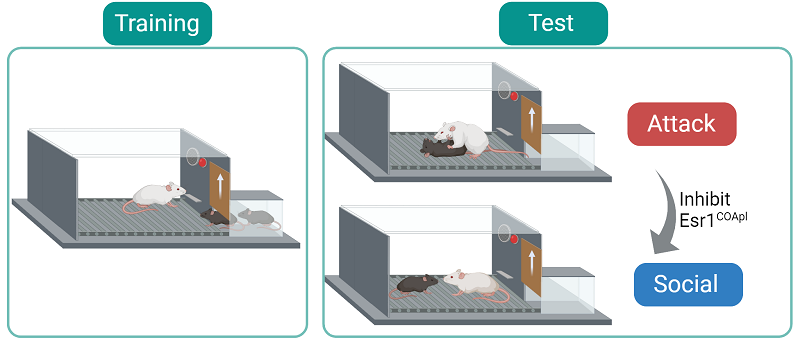
Left: Aggression reward training paradigm; Right: Inhibiting COAplEsr1 neurons leads to a significant decrease of attacking, and increase of social investigation. (Image by LI Long's group)