Newsroom


Recently, a Chinese research team has systematically investigated the brain morphometric characteristics related to volitional quality.
The team, led by Dr. WEI Gaoxia from the Institute of Psychology of the Chinese Academy of Sciences, has recruited 16 national-level athletes who engage in short track speed skating and 18 healthy controls matched with age and gender.
The researchers used magnetic resonance imaging (MRI) to scan all participants' brain and administrated the Scale of Volitional Quality to compare their morphometric and behavioral differences between two groups.
Volition has been considered as a psychological construct, being used to describe one's endogenous mental act of forming, maintaining, and implementing an intention or goal, which has a great emphasis on the sense of agency. However, little research has revealed the neural mechanisms of volitional quality due to the difficulties of empirical research.
Elite athletes are a group of experts with extraordinary physical abilities and mental attributes. Winter sports are sports that have great requirements for physical endurance and independent decision-making capabilities to navigate the snow and ice equipment. Therefore, they provide a unique opportunity to investigate the volitional quality.
"Professional athletes exhibited excellent volitional qualities, as well as thicker cortexes in the left precuneus, the left inferior parietal lobule, and the right superior frontal gyrus, which are the core brain regions involving the sense of agency," said Dr. WEI.
In addition, the mean cortical thickness of the left inferior parietal lobe was significantly correlated with the independence of volitional quality. These findings suggest that sports training is an ideal model for better understanding the neural mechanisms of volitional behaviors in the human brain.
This work entitled "'No Pain No Gain': Evidence from a Parcel-Wise Brain Morphometry Study on the Volitional Quality of Elite Athletes" was published online in Brain Sciences on July 7.
It was funded by the National Natural Science Foundation of China and the CAS Key Laboratory of Mental Health, Institute of Psychology, as well as the Open Research Fund of the CAS Key Laboratory of Behavioral Science, Institute of Psychology.
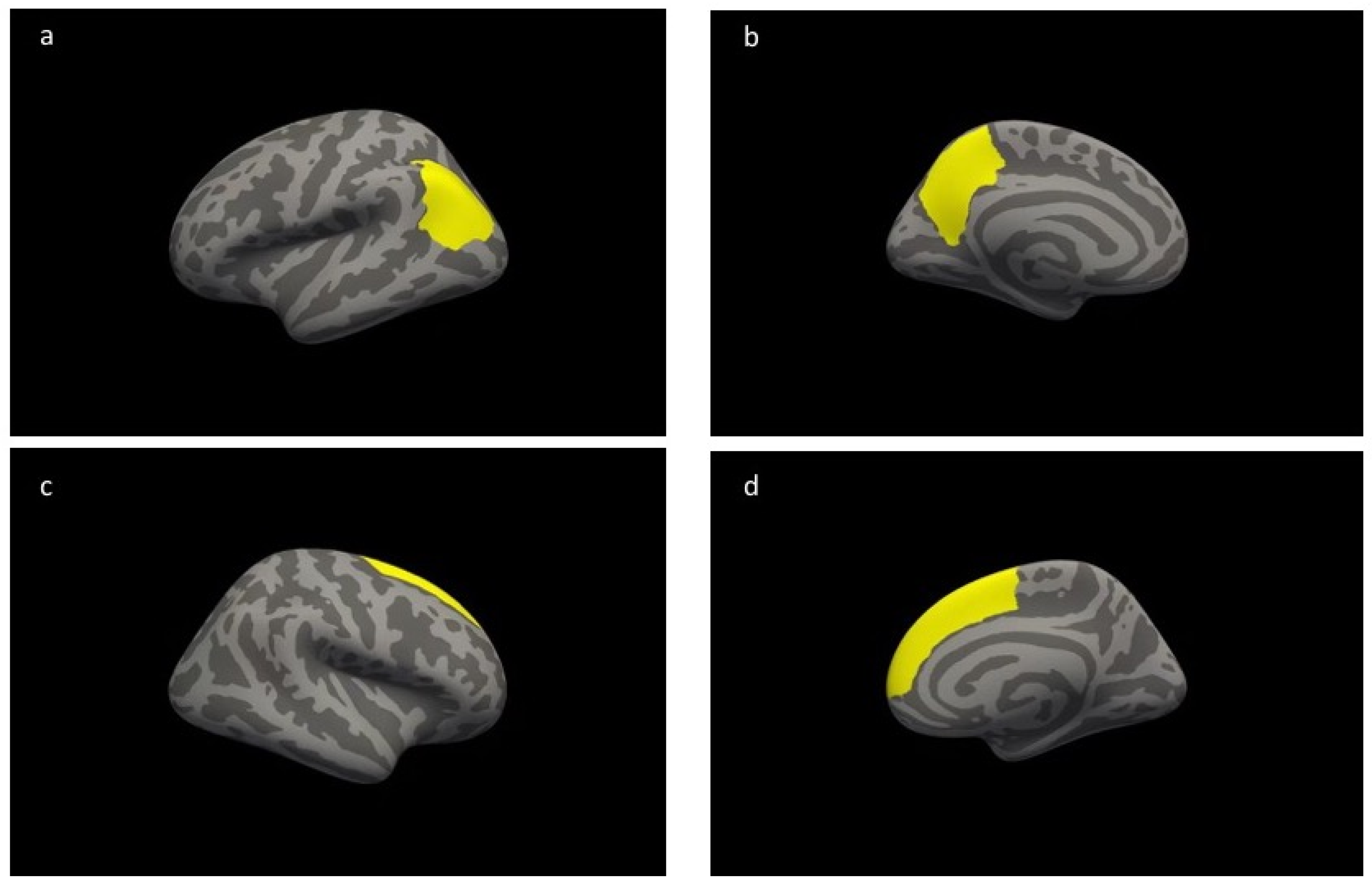
Compared with the control group, the athlete group showed greater cortical thickness in the colored brain regions based on the parcel-wise analysis: (a) indicates the left inferior parietal lobe, (b) indicates the left precuneus, and (c,d) the lateral view of the inferior view of the right superior frontal lobe. (Image by Dr. WEI Gaoxia)