Newsroom


The family Trochidae is the largest trochoid group in terms of numbers of genera and species, with over 1000 species and nearly 100 genera in 10 recognized subfamilies.
In recent decades, the fauna of this family has received extensive taxonomic attention in the western Pacific region. However, these studies were mainly focused on or near continental shelf/slope, with the fauna from oceanic regions, such as seamounts, being poorly explored.
Researchers from the Institute of Oceanology of the Chinese Academy of Sciences recently discovered two new trochid species from seamounts in the tropical western Pacific. Their findings were published in Deep-Sea Research Part I.
The two species were collected from the upper bathyal zone by the ROV FAXIAN during expeditions to two seamounts near the Mariana Trench.
The researchers used the integrated taxonomic approach incorporating morphological, anatomical, and molecular analyses to identify these two species and assigned them to appropriate higher taxa. Then they constructed phylogenetic relationships between the new taxa with their related species based on the mitochondrial COI, 16S rRNA, and nuclear 28S rRNA genes.
The study revealed that the two species are new to science and represent a new genus that belongs to the family Trochidae. However, the new genus does not fit well with any existing subfamily. A new subfamily, Carinotrochinae Zhang, Zhang & Zhang, 2020, and a new genus, Carinotrochus Zhang, Zhang & Zhang, 2020, were proposed to accommodate these two species.
Carinotrochus marianaensis Zhang, Zhang & Zhang, 2020, the type species, was associated with coral debris at a depth of 865 m, and Carinotrochus williamsae Zhang, Zhang & Zhang, 2020, was discovered crawling on a hydroid Stegolaria sp. that was attached to a dead bamboo coral at a depth of 1332 m.
Molecular data also revealed that other two undescribed species, reported from Vanuatu and New Caledonia respectively, should also be included in this genus.
The result of the molecular clock analysis indicated that Carinotrochinae subfam. nov. split from its shallow-water sister subfamily Trochinae roughly 80 Mya during the Late Cretaceous.
The complex and robust bottom currents and mesoscale flow dynamics play a crucial role in dispersal and speciation of Carinotrochus species, such as Antarctic Intermediate Water, Upper Circumpolar Deep Water, and Lower Circumpolar Deep Water.
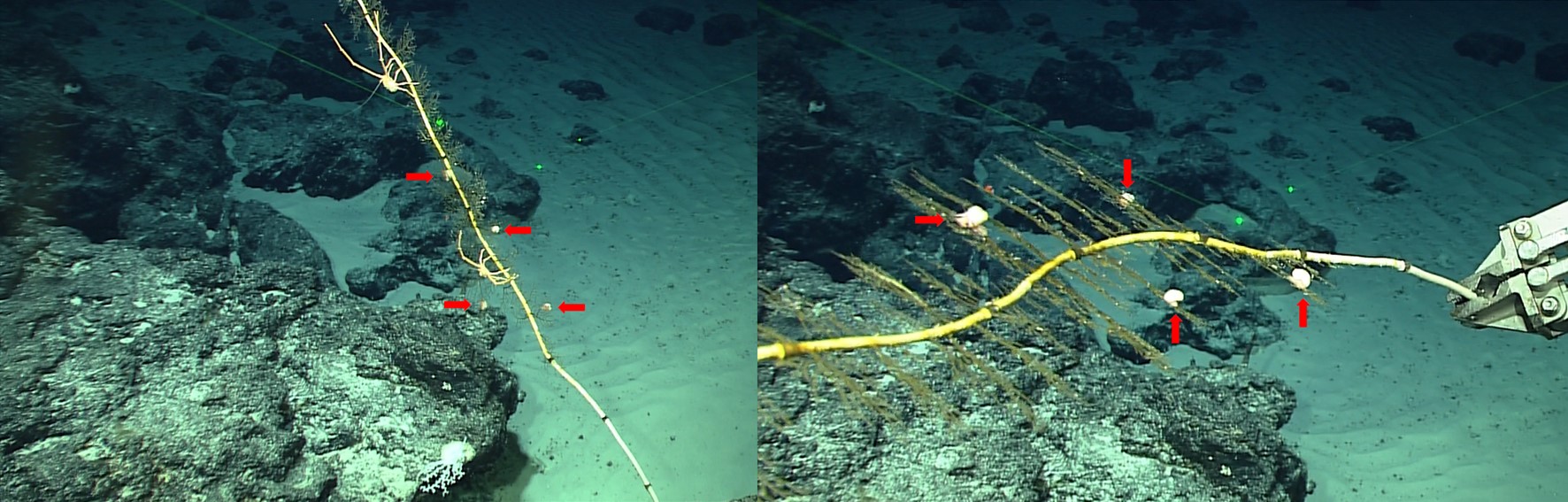
Carinotrochus williamsae sp. nov. in situ crawling on hydroid Stegolaria sp (Image by IOCAS)
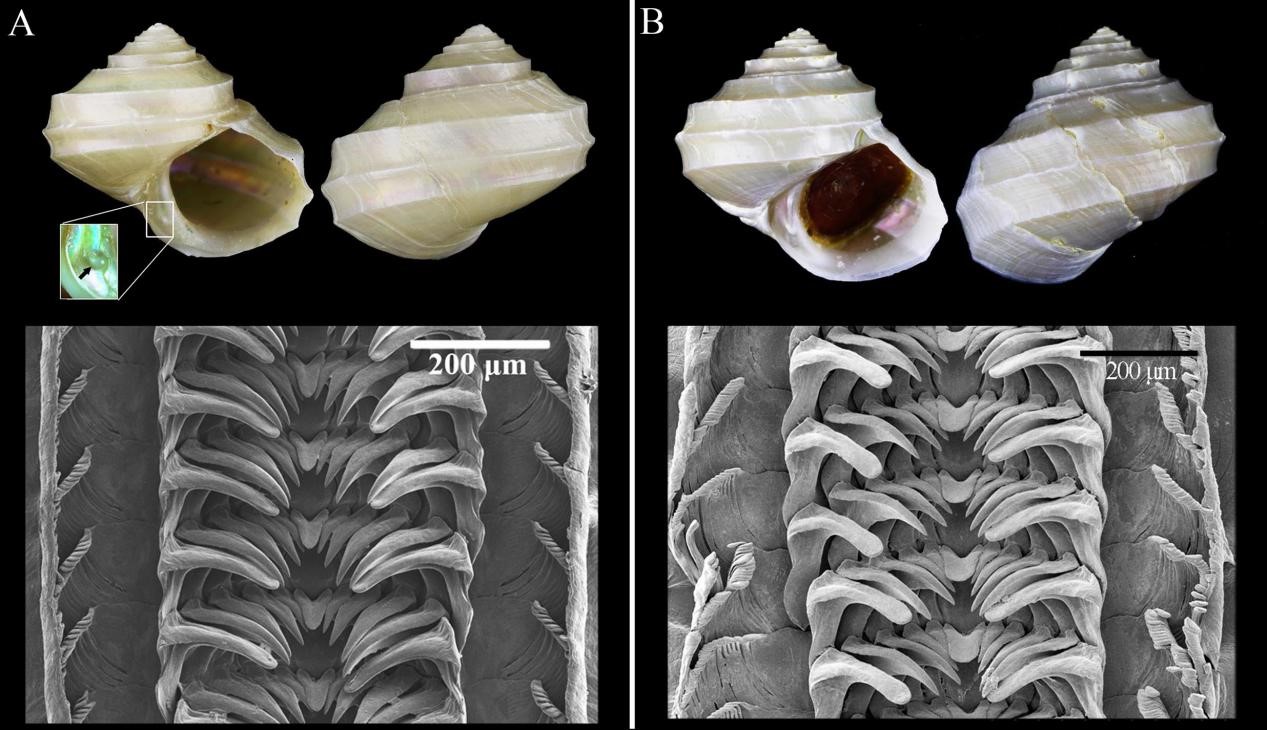
Shells and radulae of Carinotrochus marianaensis (A) and Carinotrochus williamsae (B) (Image by IOCAS)