
Newsroom


A new study published in Nature Geoscience has revealed that the global ocean's chemical makeup is undergoing a transformation, with key nutrient ratios critical to marine life shifting away from the long-accepted Redfield Ratio over the past decades.
Using the largest global dataset of ocean stoichiometry to date—compiling over 56,000 particulate organic samples and nearly 389,000 dissolved nutrient measurements collected from surface waters to 1,000 meters deep between 1971 and 2020—researchers found systematic deviations in the molar ratios of carbon (C), nitrogen (N), and phosphorus (P), three elements essential for marine ecosystems.
First proposed in the mid-20th century, the Redfield Ratio posits a fixed 106C:16N:1P balance in marine organic matter, a cornerstone of understanding ocean nutrient cycles, plankton productivity, and carbon flow. But the new study, led by researchers from the Institute of Earth Environment of the Chinese Academy of Sciences, in along with scientists from institutions including Central China Normal University, Spain's National Research Council, Yale, Princeton, and the University of Southern California, shows that balance is shifting.
Over the past 50 years, both organic and dissolved C:N:P ratios have shifted steadily, with clear spatial and temporal patterns, the study reveals. Globally, phytoplankton's C:P and N:P ratios have risen—signaling growing phosphorus limitation in marine ecosystems—while surface waters show increasing carbon enrichment, reflected in higher C:N and C:P ratios.
Notably, the study identified a critical turning point around 2007: After that year, previously rising C:N and N:P ratios in phytoplankton began a gradual decline. The researchers link this shift to increased human-driven phosphorus inputs—from agriculture, wastewater, and industrial runoff—altering nutrient dynamics in some regions.
The team also uncovered distinct depth-related patterns. As ocean depth increases, dissolved C:N and C:P ratios drop, while N:P ratios rise. This is likely due to carbon's preferential loss as organic matter sinks and decomposes, paired with nitrogen and phosphorus remaining in dissolved inorganic forms. Shifts in microbial communities—from surface phytoplankton to deeper heterotrophic bacteria—also play a role.
Despite broader shifts, phytoplankton's C:N ratio has stayed remarkably stable over 50 years. The researchers attribute this to "stoichiometric homeostasis," a biological mechanism where plankton regulate nutrient uptake and cell composition to counter environmental changes. This stability highlights marine organisms' adaptability, even as shifts are driven by both physiological responses and community restructuring.
The findings challenge the long-held assumption of fixed ocean C:N:P ratios. The researchers argue that Earth system and climate models must adopt dynamic, variable stoichiometric structures rather than static ratios—warning that ignoring such shifts could skew estimates of ocean carbon uptake, nutrient limitations, and climate feedbacks.
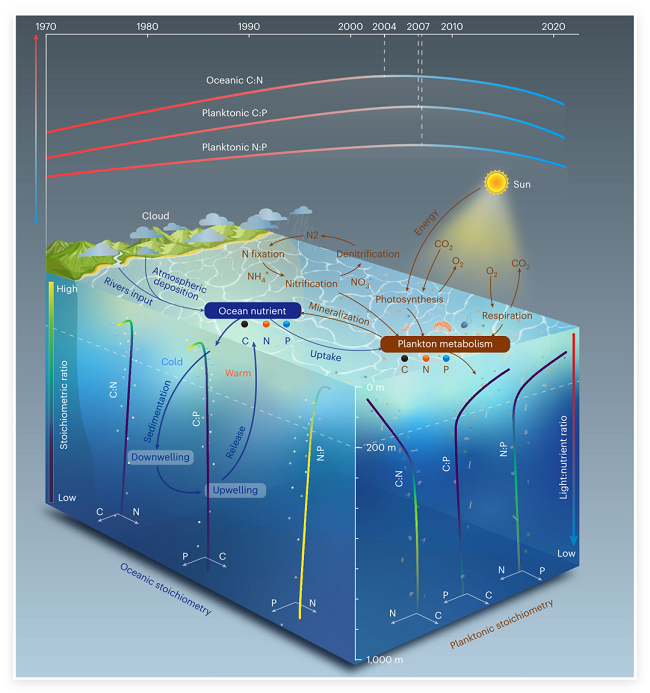
Conceptual diagram of the spatiotemporal variation in marine carbon, nitrogen, and phosphorus stoichiometry. (Image by LIU Ji)
