
Newsroom


A new study, published in Atmospheric and Oceanic Science Letters, highlights that climate extremes are increasingly occurring simultaneously, and their combined effects pose a growing threat to public health across China.
As global warming accelerates, extreme weather and climate events are becoming more frequent, severe, and prolonged. Climate change not only disrupts the climate system but also increases the likelihood of compound extreme events—situations in which multiple hazards, such as heatwaves, flooding, and air pollution, occur at the same time or in rapid succession. These compound events often cover larger areas, last longer, and cause more significant damage than isolated incidents. Crucially, their health impacts are more pronounced in ways that traditional climate-health assessments frequently overlook.
This study, led by Dr. TANG Haosu from the University of Sheffield and Prof. HUANG Gang from the Institute of Atmospheric Physics of the Chinese Academy of Sciences, synthesizes research from the past decade to examine how these overlapping climate hazards affect human health and why they require urgent attention.
The study begins by defining and classifying different types of compound events. It then explores how these events have evolved, what drives them, and how they are expected to intensify in a warming world. It identifies three particularly hazardous types of compound extremes: continuous day-night hot extremes, temperature-humidity compound events, and high-temperature-ozone compound events. These events often intersect and amplify health risks through multiple exposure pathways, especially for vulnerable populations such as the elderly and those with pre-existing conditions.
To better assess and manage these risks, the researchers introduced a new framework for evaluating the health impacts of compound extreme events and proposed practical response strategies. The team has outlined five key research priorities: identifying the risk chains of compound events; addressing the limitations of observational records and coupled model performances; understanding the drivers behind compound extreme events; finding optimal pathways for carbon reduction and air quality improvement; and promoting interdisciplinary, multi-regional, and cross-sectoral collaboration.
"Most health risk assessments have focused on one type of hazard at a time," said Dr. TANG. "But in reality, people are increasingly exposed to multiple extremes simultaneously, and these compound events interact in ways that intensify health threats."
By highlighting this growing yet underrecognized challenge, the study provides an important foundation for future research and policies aimed at strengthening public health resilience in a warming world.
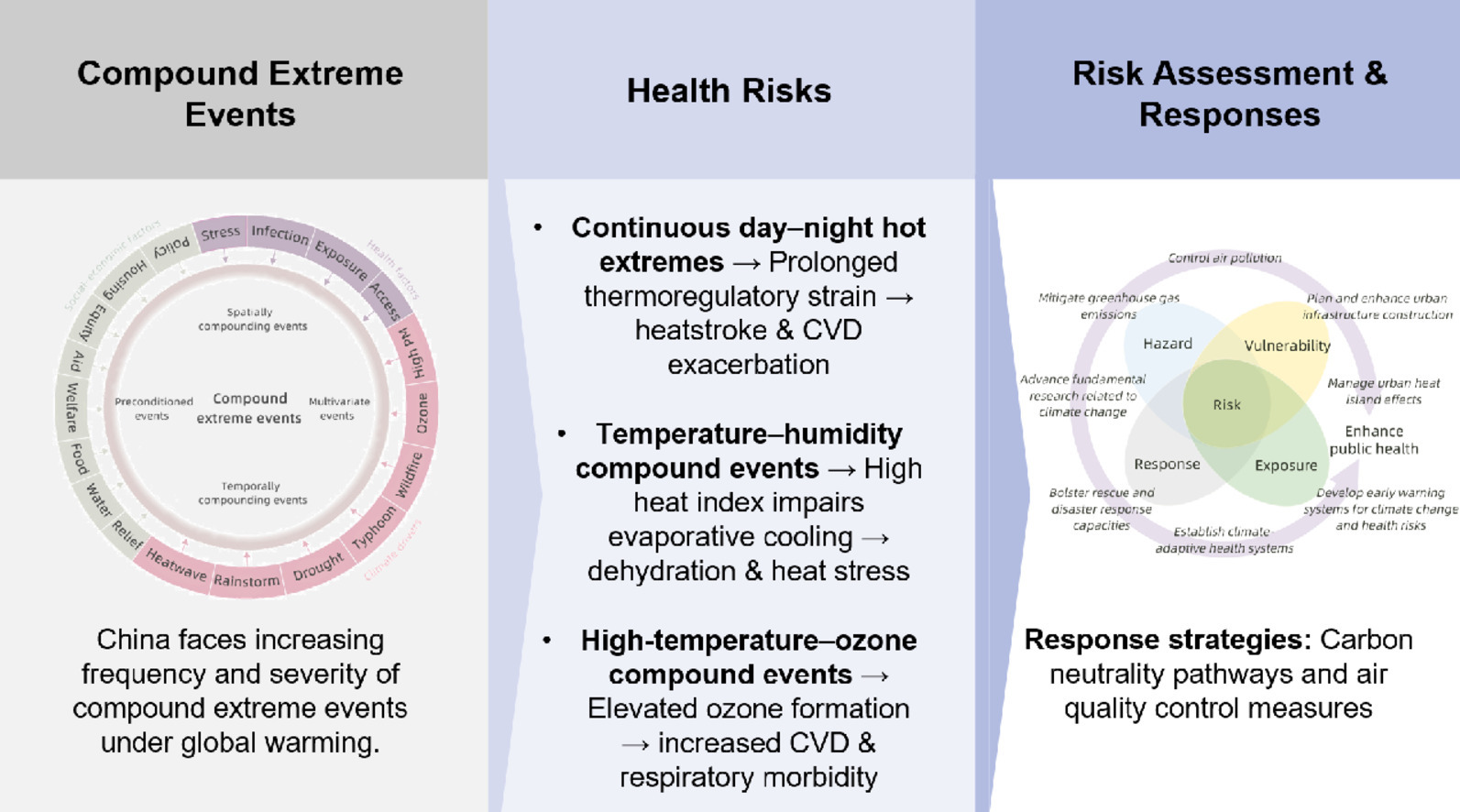
Compound extreme events and associated health risks in China, along with assessment and response strategies. (Image by Dr. TANG Haosu)
