Newsroom


A research team from the Aerospace Information Research Institute of the Chinese Academy of Sciences has evaluated the performance of three algorithms used to measure solar-induced chlorophyll fluorescence (SIF), a key indicator of plant photosynthesis. Their findings reveal limitations in the current methods while identifying one algorithm as a promising tool for improving accuracy in ecological and agricultural observation.
This study was published in Journal of Remote Sensing.
The researchers assessed three SIF retrieval algorithms: band shape fitting (BSF), three-band Fraunhofer line discrimination (3FLD), and singular vector decomposition (SVD). They used tower-based spectral and flux measurements from two sites in China. Among the three, the BSF algorithm emerged as the most reliable, demonstrating a strong correlation with actual photosynthesis patterns (The determination coefficients R² = 0.85).
In this study, data was collected from towers at two heights—25 meters and four meters—at the research sites. The SIF measurements were compared with data on vegetation photosynthesis and near-infrared reflectance (NIRvR). Although all three algorithms were tested, the BSF algorithm consistently outperformed the others, particularly during peak sunlight hours. The BSF algorithm distinguished atmospheric effects from SIF signals without the need for specialized atmospheric corrections, making it effective during periods of intense sunlight.
A key finding of the study is the reduced reliability of SIF measurements at noon, highlighting a critical gap that underscores the need for improved methods to track photosynthetic activity throughout the day. The BSF algorithm’s ability to maintain accuracy under these conditions positions it as a valuable tool for advancing research in vegetation dynamics.
The researchers also pointed out the potential for improved atmospheric corrections to further enhance the accuracy of SIF measurements. Additionally, the refined algorithms could eventually be adapted for satellite remote sensing, offering a more effective approach to global vegetation observation.
The study’s findings hold promise for applications in ecology, agriculture, and climate change research, providing a more reliable method for tracking plant photosynthesis throughout the day.
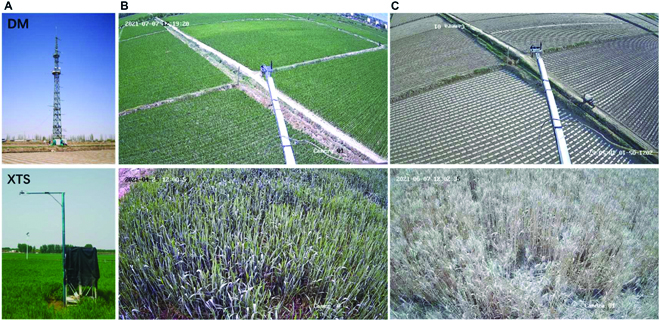
Photos of the towers (left), green crops (middle), non-fluorescent surface (bare soil or senescent wheat without chlorophyll) (right) at the DM (top) and XTS (bottom) sites. (Image by AIR)