Newsroom


'Zao Huang' figs, known for their golden skin and high sugar content, are highly valued and widely cultivated in Xinjiang. Prenylated flavonoids (PFs) found in figs are novel nutraceuticals with significant bioactivity and safety profiles. Investigating the unique structures and bioactivity of these PFs could enhance their commercial value and broaden their applications in functional foods.
Recently, a research team led by Prof. Haji Akber AISA from the Xinjiang Technical Institute of Physics and Chemistry of the Chinese Academy of Sciences, proposed a high-resolution mass spectrometry strategy combined with feature-based molecular networking (FBMN) to facilitate the comprehensive isolation of PFs. The isolated flavonoids underwent thorough pharmacological evaluation and analysis of their structure-activity relationships.
This study was published in Food Chemistry.
In this study, the researchers targeted and isolated 50 PFs through FBMN analysis, including ten new structures. The team also obtained five pairs of enantiomers using chiral separation, determining their absolute configurations for the first time.
Additionally, the researchers found that antioxidant and anti-inflammatory effects may work together in the treatment of tuberculosis. Notably, the patterns of prenylation significantly influenced the modulation of anti-tubercular activity.
The study introduces a methodology for characterizing PFs and highlights their potential value in two main areas: the development of functional foods enriched with antioxidant phenolics and the discovery of novel therapeutic agents through optimizing anti-inflammatory and anti-mycobacterial compounds.
This research was financially supported by the National Key R&D Program of China, the Tian-Shan Talent Program, among others.
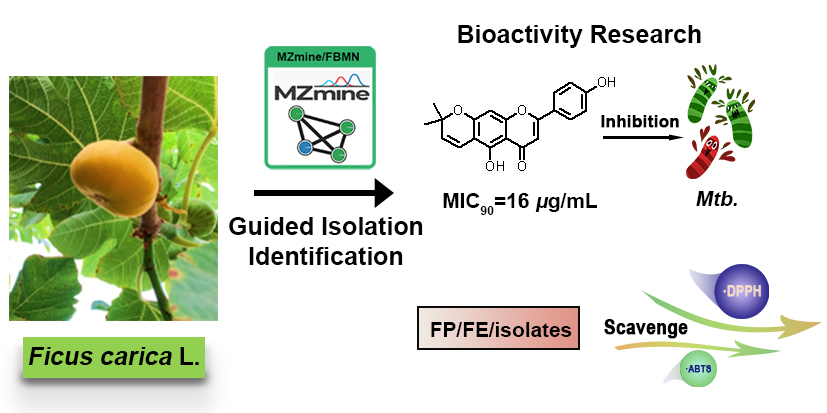
Targeted characterization of bioactive prenylated flavonoids from figs (Image by Prof. Haji Akber AISA' group)