Newsroom


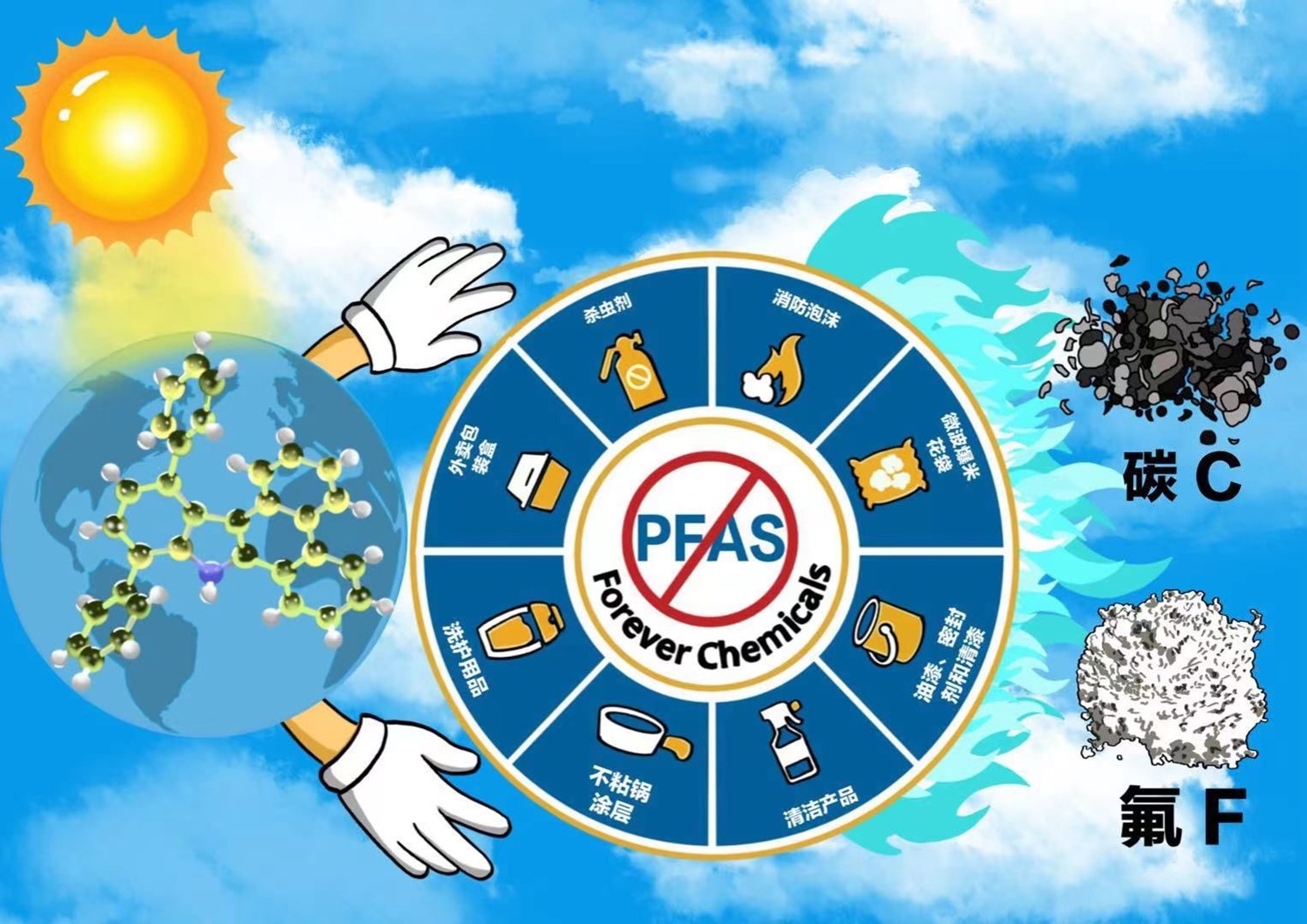
Polytetrafluoroethylene (PTFE) is widely used in many fields due to its excellent thermal and chemical stabilities. However, its high stability makes it difficult to degrade and recycle. High-energy consumption methods are commonly used to treat PTFE, while defluorination degradation under low temperature conditions requires strong reducing agents.
Photocatalysis can compensate for the shortcomings of traditional methods under mild conditions, however, the defluorination rate of PTFE is less than 5%.
In a study published in Angewandte Chemie International Edition, a team led by Prof. KANG Yanbiao from the University of Science and Technology of China (USTC) of the Chinese Academy of Sciences developed a supercapacitor (SC)-assisted electrophotocatalysis for the efficient defluorination of PTFE and poly- and perfluoroalkyl substances (PFASs) at low temperatures, providing more possibilities for solving environmental problems caused by PTFE and PFASs.
Prof. KANG's team has been dedicated to studying the activation and cleavage of inert carbon-heteroatom bonds, and has developed a highly efficient photocatalytic system based on twisted carbazole structures. CBZ6 as the photoreductant has excellent single-electron transfer capabilities. The cleavage and transformation of inert carbon-heteroatom bonds in stable molecules such as PTFE have been achieved.
However, in this process, due to the hydrophobic and oleophobic nature of PTFE, along with its insolubility in almost all organic solvents and high usage, the reaction system becomes a multi-phase reaction system mixed with various solids and liquids. For photo-reactions, many insoluble solids reduce the permeability of light, which leads to extremely high requirements for the light source and dispersion degree of the system. This situation is unfavorable to carrying out large-scale reactions.
To address these issues, the researchers developed a electrophotocatalysis system assisted by SCs. They used electrochemical methods to generate catalytically active species, replacing the poorly soluble reducing agents in photocatalytic reactions. By effective electron injection to the carbon–fluorine bond of PTFE, the reduction defluorination of PTFE was established under mild conditions, with the help of synergistic effect of photochemistry and electrochemistry.
The electro-photoreduction catalytic system effectively avoided excessive using of co-reductants in the standalone photocatalytic reduction system. The scale of the reaction was expanded from milligram level to gram level. This catalytic system also showed good applicability to the defluorination of other small molecules containing PFASs.
In addition, SCs have fast charging speed, high working efficiency, high energy ratio, ultra-high temperature resistance, and long cycle life. Therefore, they can be used outdoors with sunlight as the light energy source to achieve the defluorination reaction of PTFE.
Various testing methods including Raman spectroscopy, X-ray photoelectron spectroscopy, and Fourier transform infrared spectroscopy were employed to characterize the solid products of PTFE defluorination. It was confirmed that there are aliphatic structures, aromatic structures, and oxygen-containing functional groups in these products, and they also possess regular carbon structures (Raman G peak) and irregular carbon structures (Raman D peak).
This study provides a new perspective for solving environmental problems caused by the hard degradation of PTFE and PFASs.