Newsroom


Methylcyclopentadiene (MCPD) is an important monomer in the production of RJ-4 fuel, a high-energy-density rocket fuel, and it is also widely used in the synthesis of various valuable products.
Currently, MCPD is mainly obtained from the by-products of petroleum cracking tar at a very low yield of ~ 0.7 kg ton-1 and high price of ~10,000 USD ton-1. The exploration of highly efficient processes to convert renewable biomass to MCPD is stimulated by energy and environment problems.
Recently, a group led by Prof. LI Ning and Prof. ZHANG Tao from the Dalian Institute of Chemical Physics (DICP) of the Chinese Academy of Sciences (CAS) synthesized bio-based MCPD via direct hydrodeoxygenation of 3-methylcyclopent-2-enone (MCP) derived from cellulose.
Their study was published in Nature Communications on Jan. 4.
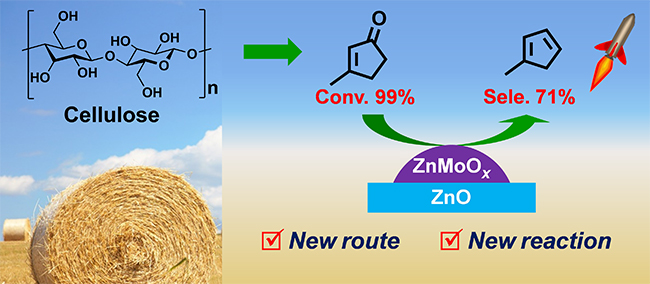
Direct hydrodeoxygenation of MCP to MCPD on the partially reduced Zn-Mo oxide catalyst (Image by WANG Ran and LIU Yanting)
The researchers found that selective hydrodeoxygenation of MCP to MCPD could be achieved on the partially reduced Zn-Mo oxide catalyst.
The Zn-Mo oxide catalyst formed ZnMoO3 species during the reduction of ZnMoO4, which might preferentially adsorb C=O bond in the presence of C=C bond in vapor phase hydrodeoxygenation of MCP, leading to highly selective formations of MCPD with a carbon yield of 70%.
"This is a following work of our previous report about the synthesis of 2,5-hexanedione by the direct hydrogenolysis of cellulose and the intramolecular aldol condensation of 2,5-hexanedione to MCP," said Prof. LI.
This study opens up a horizon for the production of dienes with unsaturated ketone by a direct hydrodeoxygenation process. It was supported by the National Natural Science Foundation of China, Innovation Research Fund Project of DICP, and the DNL Cooperation Fund, CAS.