Newsroom


A research group led by Prof. QING Guangyan from the Dalian Institute of Chemical Physics (DICP) of the Chinese Academy of Sciences (CAS) recently constructed a bioinspired nanochannel device and realized the precise recognition and discrimination of sialylated glycan linkage isomers. This work was published in Chemical Science.
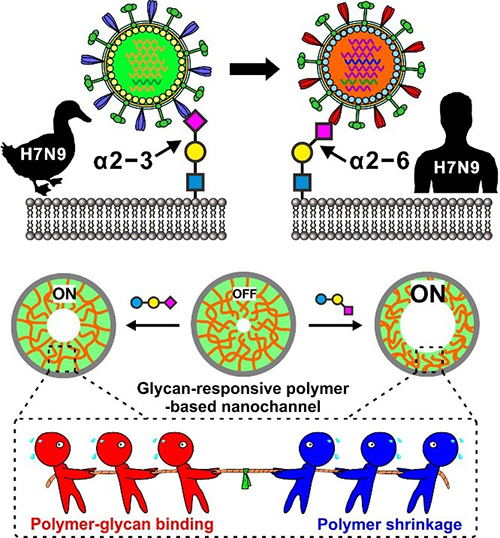
Design of the biomimetic nanochannels for glycan recognition. (Image by LI Minmin)
Sialylated glycans attached to cell surface mediate diverse cellular processes such as immune responses, pathogen binding, and cancer progression. Precise determination of sialylated glycans, particularly their linkage isomers that can trigger distinct biological events and are indicative of different cancer types, remains a challenge, due to their complicated composition and limited structural differences.
Prof. QING and his co-workers introduced the bioinspired nanochannel as its sensitive perturbation of ion flux to the recognition of glycans with subtitle difference in structure. They reported a glycan-responsive polymer-modified nanochannels device, which demonstrates the capacity of recognizing and discriminating sialic acid from other neutral monosaccharides, different sialic acids, and even sialylated glycans with α2-3 and α2-6 linkage.
In-depth studies revealed a competition between the polymer shrinkage caused by electrostatic attraction and shrinkage-resistance from the strong binding of the polymer with glycan molecules, which contributed to the varying extend of shrinkage of the graft polymer in nanochannels, and the different "OFF-ON" change in ion flux and the detectable current signals.
This work broadens the application of nanochannel systems in bioanalysis and biosensing, and opens a new route to glycan analysis.
According to the similar strategy, the group also designed and developed the Ca2+-self-controlled bioinspired Ca2+ nanochannels (NPG Asia Materials, 2019) and the cyclic adenosine monophosphate (cAMP)-controlled ion nanochannels (J. Mater. B., 2019). These works further highlight the potential of biomolecule-responsive polymer for the construction of bioinspired ion nanochannels.