
Newsroom


White-light LEDs (WLEDs) have been the current hot topic for new generation illumination sources. In borate-based phosphors, the common method to obtain white-light emission is doping rare earth metal ions. However, due to the scarcity of the rare earth, it is indispensable to develop new white-light emitting inorganic borates that are more economical and environmentally friendly.
A research group led by Prof. MAO Jianggao from the Fujian Institute of Research on the Structure of Matter (FJIRSM) of the Chinese Academy of Sciences reported the first defect-induced crystalline inorganic borate in single-component white-light phosphors, Ba2[Sn(OH)6][B(OH)4]2, with Commission Internationale de l'Eclairage (CIE) chromaticity coordinates of (0.42, 0.38), an ultrahigh color rendering index (CRI) of 94.1, and an appropriate correlated color temperature (CCT) of 3083 K.
Ba2[Sn(OH)6][B(OH)4]2 owns the highest CRI among single-component white-light emitting inorganics. Compared with the doped borates, this material is free from the burden of elemental scarcity. Furthermore, white-light emitting LED device of Ba2[Sn(OH)6][B(OH)4]2 was realized successfully.
Researchers found that in the structure of Ba2[Sn(OH)6][B(OH)4]2, the borate and stannate groups were fully protonized. To date, borostannates refer to the compounds combining borates and stannates by B-O-Sn linkages, whereas Ba2[Sn(OH)6][B(OH)4]2 represents the first metal borate-stannate mixed anion compounds without B-O-Sn linkages. Besides, Ba2[Sn(OH)6][B(OH)4]2 exhibited good semiconducting properties.
The results indicated Ba2[Sn(OH)6][B(OH)4]2 a promising candidate for future solid-state lighting application, and confirmed the intriguing possibility of employing borates as multi-functional materials, such as phosphors, semiconductors, second harmonic generation materials, and biological materials.
Such a promising material will provide a new approach in the development of white‐light emitting applications. Further research on this system could lead to the development of more economical and environmentally friendly materials with similar or better luminescent properties.
The study entitled "White‐Light Emission from a Semi‐Conductive Borate‐Stannate" was published in Angewandte Chemie.
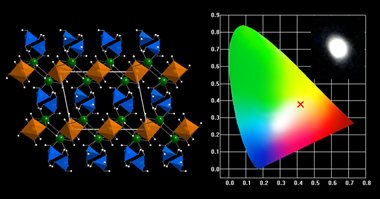
The structure and white-light emission of Ba2[Sn(OH)6][B(OH)4]2 (Image by Prof. MAO’s group)
