
Newsroom


Researchers from the Aerospace Information Research Institute of the Chinese Academy of Sciences (AIRCAS) and their collaborators have developed a mathematical model that uses morphometric parameters to rapidly estimate the degradation state and age of lunar impact craters. They applied the model to 140 impact craters in the Chang'e-6 landing area.
The work was recently published in Icarus.
Lunar impact craters gradually become shallower, and their walls less steep, as micrometeorites bombard the surface over long periods. Estimating the degradation state of individual craters and dating them are important for studying the evolution of the lunar surface. Traditional crater dating based on the topographic diffusion model requires repeated simulations and comparisons of crater profiles, making it computationally complex and costly.
To address this challenge, the researchers combined diffusion-based topographic degradation simulations with symbolic regression to build a model that estimates degradation state from crater diameter and the depth-to-diameter ratio.
Using several published models of fresh crater profiles, the team simulated degradation sequences for simple craters with initial diameters of 0.4–5.0 km, then applied symbolic regression to derive a compact equation linking present-day crater diameter and depth-to-diameter ratio to the standardized degradation measure K1000.
Crater ages can then be estimated using an appropriate degradation-rate calibration. Experimental results show that this simple model can effectively reproduce the changes in degradation state obtained by conventional diffusion simulations under the same assumptions about initial crater shape.
The study also analyzed uncertainties in degradation-state estimates arising from three sources: measurements of crater shape, equation fitting residuals, and assumptions about initial crater profiles.
The team applied the model to 140 craters larger than 480 m in the Chang'e-6 landing area. The resulting maximum degradation state was 14,830 ± 645 m2. Combined with the 2.83 Ga age of the returned farside basalt samples, this yields a degradation rate of 5.24 ± 0.22 m2/Myr (square meters per million years), broadly consistent with previous estimates for lunar mare surfaces.
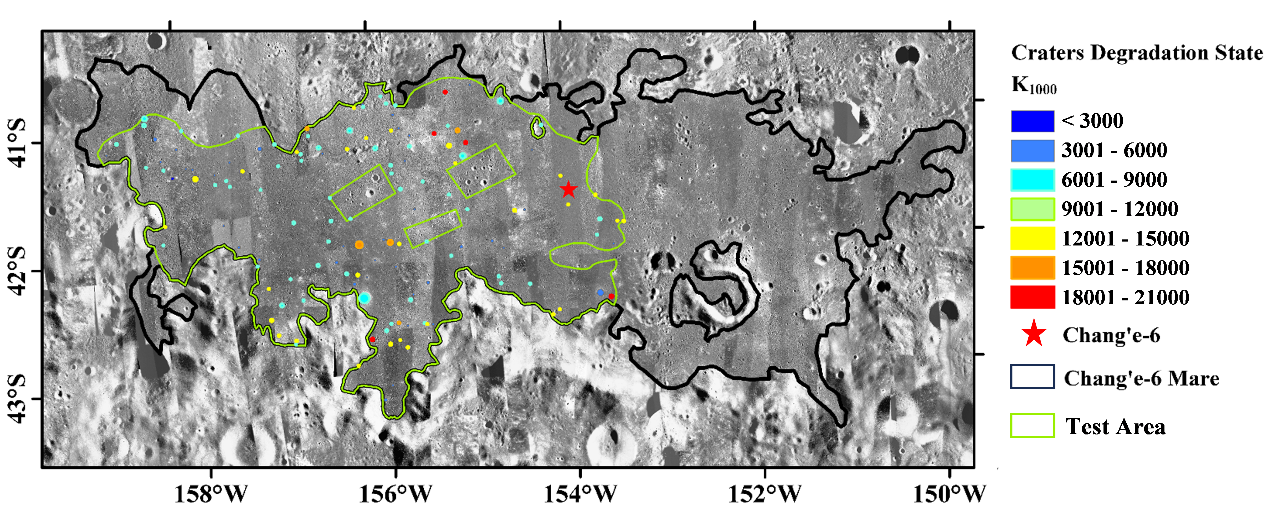
Degradation states of 140 craters in the Chang'e-6 landing area calculated using the mathematical model developed in this study. (Image by AIRCAS)
