
Newsroom


Researchers at the Xinjiang Technical Institute of Physics and Chemistry (XTIPC) of the Chinese Academy of Sciences (CAS) have developed a solar-powered electrocoagulation–membrane filtration (SPEC-MF) system to reduce membrane fouling during the treatment of oily and complex organic wastewater.
The study was published in the Journal of Membrane Science on November 12.
Membrane-based water treatment has broad potential for treating oily and complex organic wastewater owing to its high separation efficiency, ease of operation and environmental friendliness. However, organic matter-induced membrane fouling reduces flux and selectivity and shortens membrane lifespan, posing a key barrier to practical application.
Conventional cleaning is mainly performed after fouling occurs and can entail high chemical consumption, membrane degradation, process interruptions and limited responsiveness to water-quality fluctuations. Physical cleaning often fails to remove internal pore blockages, while chemical cleaning can restore flux but accelerates membrane aging.
Therefore, mitigating the initial adhesion of pollutants and developing low-energy, sustainable anti-fouling membrane filtration strategies remain important directions in membrane separation.
To address these issues, the Separation Materials and Technology Research Team at the Xinjiang Energy and Chemical Engineering Laboratory of XTIPC constructed an electrically conductive membrane cathode based on basalt fabric and designed an in situ coupled SPEC-MF system.
The membrane cathode uses basalt fabric as the substrate, sequentially loaded with carbon nanotubes and silver nanowires to construct a highly conductive network, and is then ultrathin-encapsulated with polydimethylsiloxane (PDMS) to form the PDMS-AgNWs-CNT@BF membrane cathode.
The PDMS protective layer is only about 30 μm thick and maintains excellent electrical conductivity while protecting the conductive silver nanowire network and improving material durability. The final membrane achieved a conductivity of 1.49×10⁴ S/m, comparable to that of the unencapsulated AgNWs-CNT@BF (1.66×10⁴ S/m).
In the SPEC-MF system, the membrane cathode serves both as a filtration and separation membrane and as an electrocoagulation cathode. The system suppresses the initial adhesion of pollutants to the membrane surface and mitigates fouling through several mechanisms, including physical size exclusion, electrostatic repulsion between the membrane surface and negatively charged pollutants under an electric field, and in situ cleaning via bubble formation.
The team used a benzene/Tween-80-stabilized oil/water emulsion as a model wastewater and introduced humic acid, sodium alginate, bovine serum albumin, or a mixture of these substances to simulate different fouling systems. They conducted five cycles of "separation–cleaning" experiments. In the first cycle, both single membrane filtration and SPEC-MF achieved COD removal rates exceeding 92%, indicating that the membrane cathode itself has good oil/water separation capability.
Across multiple cycles and different pollutant conditions, SPEC-MF consistently outperformed single membrane filtration, with a smaller decline in COD removal efficiency and better long-term stability and anti-fouling potential. Characterization of the membrane surface and fouling layer further supported the proposed anti-fouling mechanism.
This work integrates highly conductive basalt fabric, an ultrathin PDMS protective layer and solar-powered electrocoagulation–membrane filtration in a single unit, combining physical sieving with electrochemical anti-fouling. It offers a new approach to the efficient, low-energy treatment of oily and complex organic wastewater.
This work was supported by National Natural Science Foundation of China, Xinjiang Talent Development Fund, Tianchi Doctor Program of Xinjiang Uygur Autonomous Region, Natural Science Fund for Distinguished Young Scholars of Xinjiang, and National Foreign Young Talents Program-Department of Foreign Expert Services of the Ministry of Science and Technology, China.
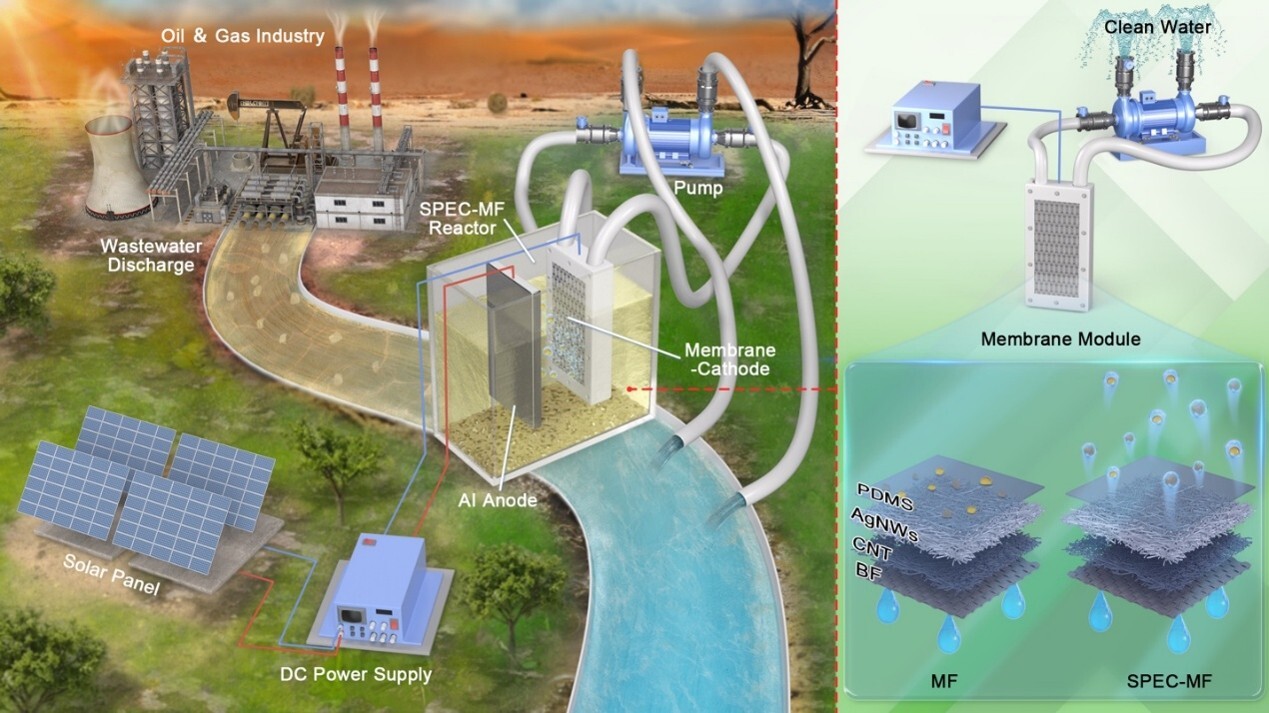
Application prospects of the in situ coupled SPEC-MF system, and the module and structure of the basalt-fabric conductive membrane cathode that serves as the electrocoagulation cathode and filtration media. (Image by XTIPC)
Abudukeremu Kadier
Xinjiang Technical Institute of Physics and Chemistry
E-mail: abudukeremu@ms.xjb.ac.cn


