
Newsroom


Researchers from the South China Botanical Garden (SCBG) of the Chinese Academy of Sciences (CAS) have developed the Genomic Database for National Key Protected Wild Plants (GDNPP) to bring together genomic resources for China's nationally protected wild plants.
Based on a systematic review of 381 publications, the database covers 291 species, including 626 reference genome assemblies from 234 species and 232 population genomic studies involving 147 species.
The study, titled "GDNPP: An integrated genomic database for national key protected wild plants in China", was published in Plant Diversity on November 18.
Wild plants play a vital role in maintaining ecosystem stability and biodiversity, but human activities and climate change pose growing threats to rare and endangered species. Effective conservation requires not only protecting surviving individuals but also preserving the genetic diversity and adaptive potential of wild populations.
Advances in genomics and population genetics have improved our understanding of species endangerment, genetic diversity and conservation strategies. However, genomic data remain scattered across publications and public databases, while inconsistent curation and limited cross-referencing hinder their integration and reuse.
To address this challenge, a research team led by Professor KANG Ming at SCBG developed the GDNPP to integrate genomic resources for China's nationally protected wild plants.
To make these resources easier to access and reuse, the researchers curated genomic records, removed duplicates, assessed assembly quality and standardized gene annotations. Reference genomes were further linked to population genomic studies, along with sampling information, analytical methods and key findings, enabling users to access genomic resources by species.
GDNPP provides six modules: Home, Phylogeny, Species, Tools, Download, and General. The interactive phylogenetic tree covers all species listed in China's List of National Key Protected Wild Plants and highlights differences in genomic data availability across taxonomic groups.
The Species module enables users to filter species by taxonomy, protection status and geographic distribution, with links to corresponding genome assemblies and population genomic studies. The Tools module provides genome browsing, sequence alignment, gene searches and functional enrichment analysis. Together, these features support the retrieval, analysis and comparison of genomic resources across species.
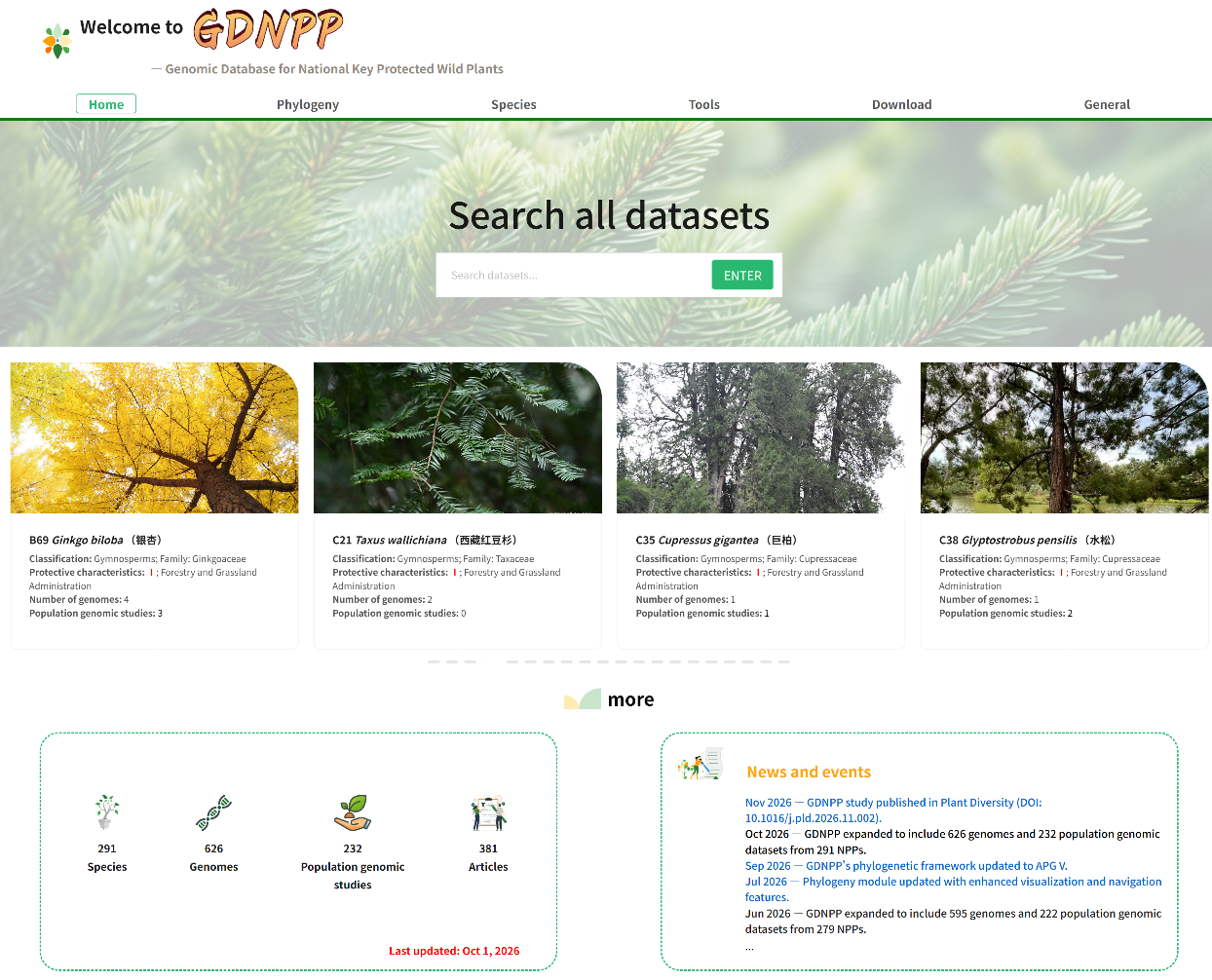
Overview of GDNPP. (Image by FENG Chao)
Further analysis showed uneven geographic and taxonomic coverage of genomic resources for China's nationally protected wild plants. Nearly three-quarters of the species recorded in GDNPP occur in five provinces—Yunnan, Guangxi, Guizhou, Sichuan and Guangdong—and these regions largely overlap with China's biodiversity hotspots.
Coverage also varies across taxonomic groups, with sequenced species concentrated in a few orders, such as Asparagales and Rosales, while some orders remain unrepresented. Moreover, more than 20 sequenced species still lack chromosome-level genome assemblies. These findings highlight gaps in genomic coverage and can help prioritize future sequencing and improvements to genome assemblies.
GDNPP focuses on maximizing the conservation value of existing population genomic data. The researchers identified more than 30 nationally protected plant species, including Ormosia henryi and Coptis chinensis, whose previous population studies relied on reference-free approaches, genomes from closely related species or fragmented conspecific assemblies. With high-quality conspecific reference genomes now available, reanalyzing these datasets could improve assessments of genetic diversity, deleterious variant accumulation and population history.
GDNPP also lays a foundation for long-term genetic monitoring of rare and threatened plants. By recording the sampling dates reported in existing population genomic studies, the researchers propose using historical datasets as baselines for repeated sampling of the same populations.
These comparisons could track changes in genetic diversity, inbreeding and deleterious variant accumulation over time, helping researchers identify priority populations, evaluate the effectiveness of conservation efforts and develop long-term conservation strategies.
GDNPP supports the sharing and reuse of genomic resources for China's nationally protected wild plants and promotes their application in conservation. This work contributes to the goals of the Kunming–Montreal Global Biodiversity Framework, particularly the conservation of genetic diversity.
OUYANG Kunyue, a doctoral student at the SCBG, is the first author of the study, with SCBG's Professor KANG and Associate Professor FENG Chao as the corresponding authors. Associate Professor TANG Jianmin of the Guangxi Institute of Botany is a co-author of the study.
The work was supported by the Guangdong S&T Program, the National Key R&D Program of China, and the Guangdong Special Support Program, along with contributions from collaborating institutions and colleagues.
