
Newsroom


Solar spicules are slender jets commonly found in the chromosphere. They lift relatively cool plasma from the lower solar atmosphere, carry energy upward, and in some cases rotate as they evolve. Small-scale vortices also occur frequently between convection-driven granules in the photosphere. Two questions remain incompletely answered: how these photospheric vortices help form spicules, and how much mass and energy the rising jets carry into the corona.
To address this gap, a research team at the Yunnan Observatories of the Chinese Academy of Sciences (CAS) has used three-dimensional radiative magnetohydrodynamic simulations to trace the formation of a rotating, spicule-like jet back to a photospheric vortex. The work was carried out in collaboration with researchers at the University of Science and Technology of China and the University of Sheffield in the United Kingdom.
The study, published in Astronomy & Astrophysics on Nov. 10, shows that the vortex twists the magnetic field and, together with the small-scale magnetic reconnection it induces, drives the jet, and quantifies the mass and energy that the jet transports into the lower corona.
Using the MURaM code, the team ran three-dimensional radiative magnetohydrodynamic simulations in an open magnetic-field configuration, with a computational domain extending from the upper solar convection zone to the lower corona. Several spicule-like jets associated with vortex motions emerged in the simulations. The researchers selected a representative event lasting about 10 minutes and traced its formation. Before the jet appeared, a photospheric vortex twisted the magnetic field lines. The rotating structure then extended upward into higher atmospheric layers, forming a "magnetic tornado." The jet gradually rose within this structure, rotating about the same axis.
At the tornado's periphery, the twisted magnetic field lines developed locally downward-directed components and reconnected with upward-directed fields, both in the surrounding background and in the vortex core, thereby changing their connectivity. Thin current sheets and bidirectional outflows appeared at different stages of the event—characteristic signatures of magnetic reconnection. As the tornado rose and rotated, the reconnection sites moved with it, and multiple fine jet structures corresponded to the upward outflows from these sites.
But what drove the plasma upward? Force analysis at different heights showed that pressure gradients provided the main upward driving force in the photosphere and lower chromosphere. In the upper chromosphere, the Lorentz force became dominant, with the strongest upward magnetic forces concentrated around the tornado's periphery.
The team calculated the mean mass flux density and electromagnetic energy flux density in the jet region over the event's lifetime and found net upward mass transport at every height analyzed. At about 4,000 km above the solar surface, the mean upward mass flux density was approximately 10-7 kg m-2 s-1, and the mean upward Poynting flux density was about 525 W m-2. Decomposing the electromagnetic energy flux showed that magnetic shearing and twisting played the dominant role in transporting energy upward.
During jet formation, continuous perturbations of the plasma and magnetic field excited several types of magnetohydrodynamic waves. The team estimated the energy flux carried by each wave mode during the mature stage, when the jet's morphology was relatively stable. In the lower corona, about 3,000–4,500 km above the solar surface, the energy flux densities of Alfvén, fast-mode and slow-mode waves stood in a ratio of roughly 10:7:3, with Alfvén waves accounting for approximately half of the combined energy flux of the three modes.
The study links the combined action of photospheric vortices and magnetic reconnection in driving jets to the mass and energy that those jets transport into the lower corona, providing a theoretical basis for understanding the role of such small-scale jets in coronal heating and in supplying mass to the solar wind.
The research was supported by the CAS Strategic Priority Research Program, the National Natural Science Foundation of China and other sources.
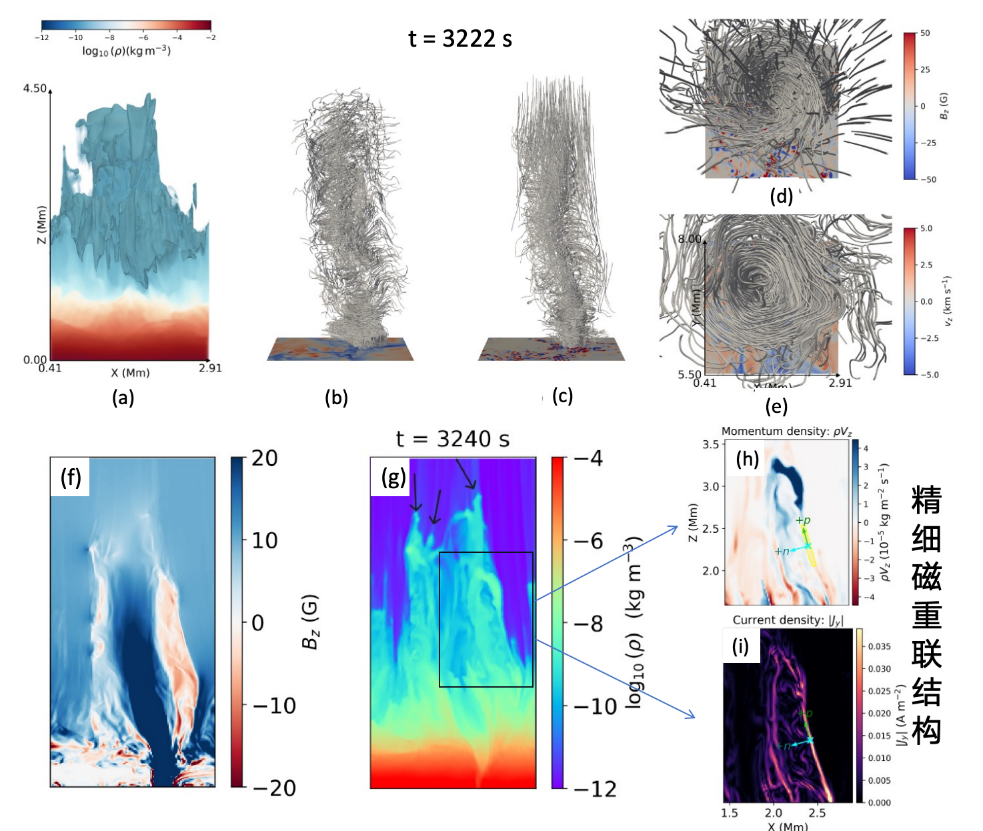
The upper row shows the three-dimensional structure of the rotating spicule-like jet and magnetic tornado. (Image by GONG Liufan)
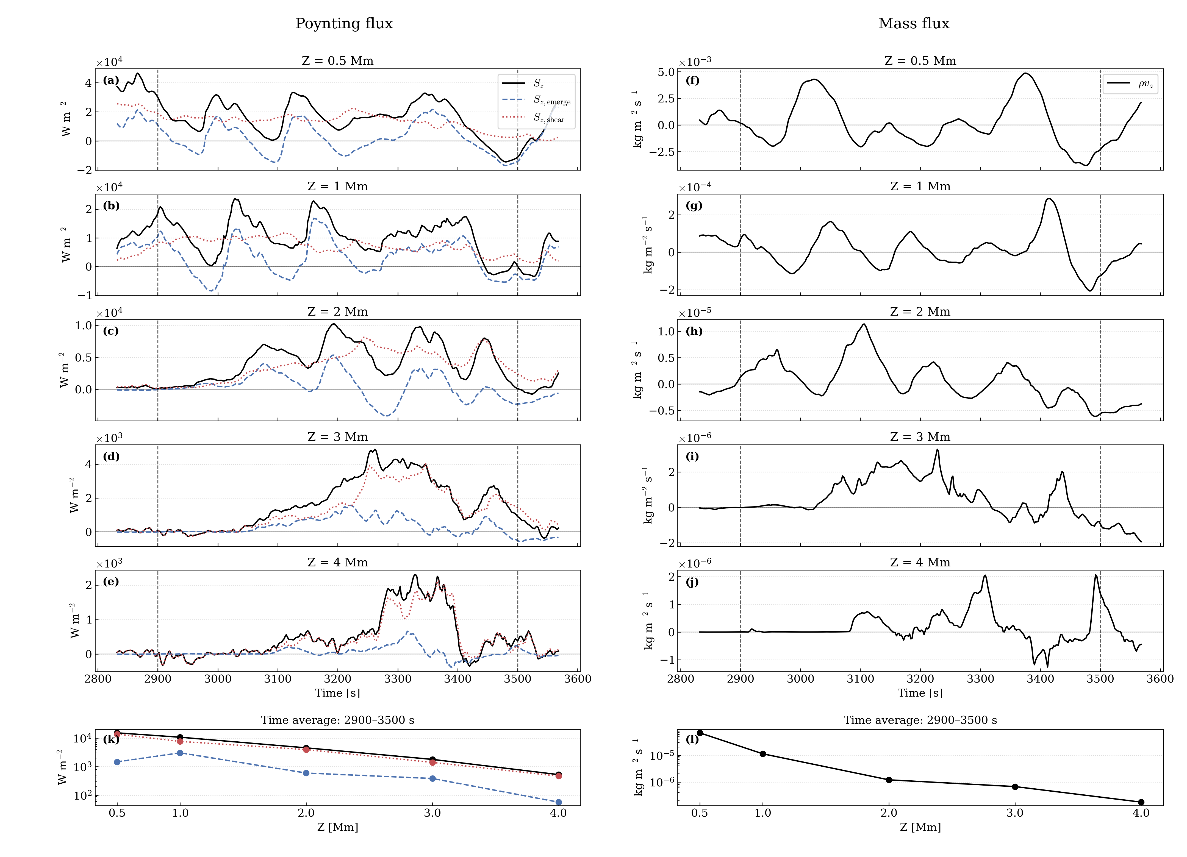
Variations in the mean vertical Poynting flux density and mass flux density with time and height. (Image by GONG Liufan)
