
Newsroom


A research team led by Professor FANG Yonghua at the Hefei Institutes of Physical Science of the Chinese Academy of Sciences has developed a new system for detecting trace amounts of hydrogen.
The system improves detection sensitivity by reducing background interference, enabling it to directly detect hydrogen at a concentration of one part per million (ppm).
The findings were recently published in Sensors and Actuators B: Chemical. The team has also published a related review of spectroscopic methods for hydrogen detection in Microwave and Optical Technology Letters.
Hydrogen monitoring is important for power equipment, energy systems and chemical industries. However, detecting small amounts of hydrogen remains challenging because hydrogen absorbs infrared light only weakly. Photoacoustic stimulated Raman spectroscopy (PA-SRS) offers an alternative, but unwanted signals generated at the measurement cell windows can interfere with detection.
In this study, the researchers developed a differential PA-SRS system that combines two techniques to reduce background interference. One reduces optical interference, while the other helps suppress unwanted acoustic signals.
The system uses two parallel resonant tubes and two microphones to distinguish the hydrogen signal from unwanted acoustic disturbances. By comparing the signals recorded by the microphones, it strengthens the target signal while canceling out much of the background noise. The researchers also use specially arranged optical components to reduce unwanted signals caused by laser reflections inside the cell.
Tests showed that the new design significantly improved detection performance. Compared with a conventional differential H-type cell with uncoated windows, it achieved a signal-to-background ratio about 180 times higher. The system directly detected hydrogen at one ppm with a measurement time of just five seconds, and its estimated detection limit was 0.25 ppm.
According to the researchers, the system has potential applications in hydrogen leak monitoring and fault diagnosis in power equipment, where detecting very low hydrogen concentrations is critical.
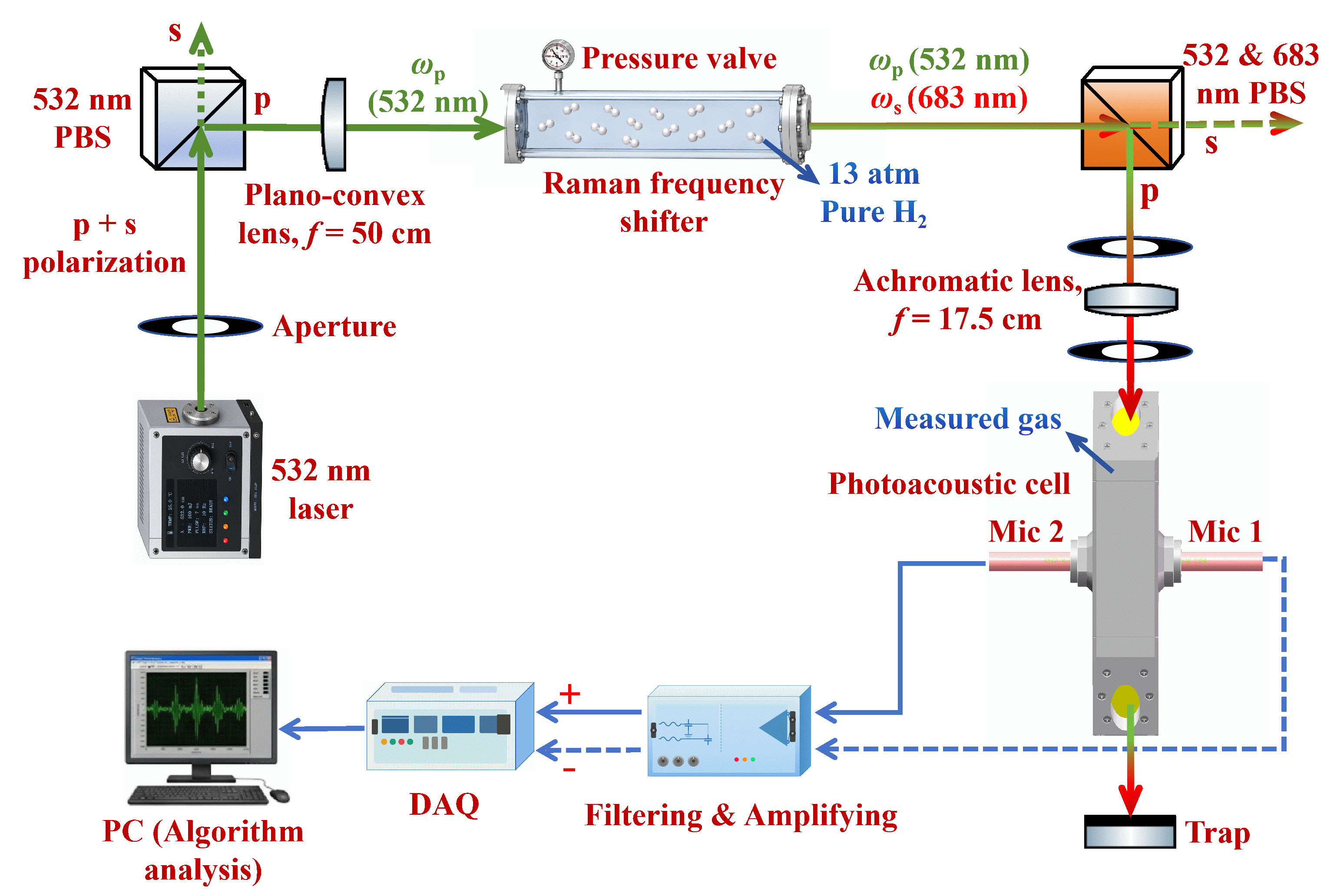
Polarization-Optimized Differential PA-SRS Hydrogen Detection System. (Image by LI Zhengang)

