
Newsroom


A study published in Nature Protocols on November 17 presents a detailed experimental workflow for programmable chromosome manipulation in plants.
The workflow was developed by a research group led by GAO Caixia at the Institute of Genetics and Developmental Biology of the Chinese Academy of Sciences.
Pan-genomic studies have revealed that large-scale structural variants play important biological roles. Precise manipulation of chromosomal DNA, including insertions, replacements, deletions, inversions and translocations at the kilobase-to-megabase scale, is a key technology for crop breeding and synthetic biology.
Site-specific recombinases (SSRs) can mediate precise recombination of very large DNA fragments, making them promising tools for chromosome manipulation. However, their native systems have several limitations, including a lack of programmability, low recombination activity, an obligate tetrameric structure that is difficult to engineer, and the persistence of residual recombination sites (RSs) in the final products. These limitations have hindered their direct application in genome editing.
In earlier work, the group established a systematic pipeline for engineering site-specific recombinases. The pipeline comprises: reprogramming of RS insertion positions and orientations using an efficient prime-editing system; developing a high-throughput method for rapid RS optimization; engineering of the recombinase using the AiCE method to enhance recombination activity; and a scarless-editing strategy that eliminates residual RSs left after recombination.
Building on these advances, the group developed a programmable and precise chromosome manipulation method that enables efficient, scarless DNA editing at the kilobase-to-megabase scale. The newly published protocol provides detailed instructions for carrying out this method.
The workflow comprises three stages, taking researchers from in silico design to validated plant lines. During the design stage, PCE Targets Designer can be used to design RS-pegRNAs for inserting recombination sites and Re-pegRNAs for removing residual sites. Target-site selection is guided by an integrated assessment of PAM availability, cleavage-site spacing, RNA secondary structure and off-target scores.
At the validation stage, pegRNA expression vectors are assembled by one-step PCR and co-transformed into protoplasts with the editor construct; next-generation sequencing of amplicons and droplet digital PCR (ddPCR) then quantify editing efficiency and screen candidate targets before stable transformation.
At the plant-production stage, binary vectors for plant transformation are assembled by Golden Gate cloning. Deletions, inversions and chromosomal translocations are carried out by one-step transformation, whereas large-fragment insertions and replacements are best performed by sequential transformation of the editor and the exogenous donor DNA. Vector construction and efficiency assessment are expected to be completed within 5–9 days, and edited plants can be obtained within 3–5 months.
Beyond the individual steps, the workflow offers two broader advantages. The same design principles and assays provide a systematic means of benchmarking the efficiency of related editing tools, while the modular setup can be continuously refined as prime editors and site-specific recombinase systems advance. Together, these features offer a reproducible framework for structural-variant research and precision crop breeding.
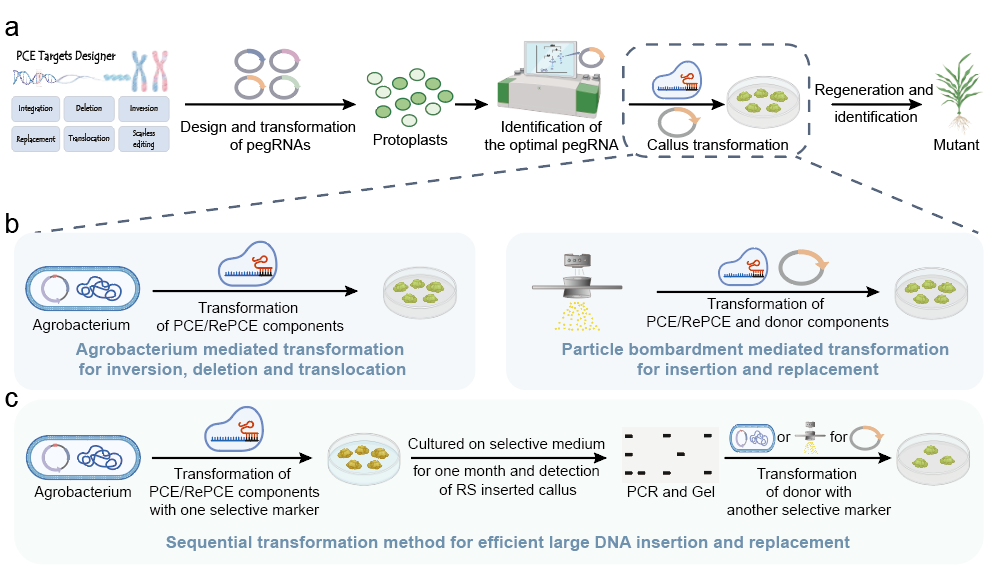
Experimental workflow for programmable chromosome engineering in plants (Image by IGDB)
