
Newsroom


Researchers have reconstructed a surge–detachment sequence at Dehdal Glacier in the Pamir Mountains of Tajikistan, revealing how a period of rapid glacier acceleration culminated in two successive large-scale ice-detachment events.
The findings also show that the interval between this event and the glacier's previous documented surge was just 9-10 years, considerably shorter than the earlier intervals of approximately 20-45 years.
The study was led by Prof. LI Junli from the Xinjiang Institute of Ecology and Geography (XIEG) of the Chinese Academy of Sciences, in collaboration with researchers from China, Tajikistan, and Switzerland. Dr. Mustafo Safarov, a Special Research Assistant at XIEG, is the first author of the study.
The findings were published in The Cryosphere on November 10.
Glacier surging and ice detachment are distinct but potentially linked forms of glacier instability. Although surge-type glaciers are widespread in High Mountain Asia, how rapid glacier acceleration can lead to large-scale ice detachment remains poorly understood, particularly in small, debris-covered glaciers. Such events can rapidly reshape mountain valleys and pose potential hazards to downstream infrastructure.
To investigate these processes, the research team combined 128 cloud-free PlanetScope satellite images acquired between June 2025 and January 2026 with multi-temporal uncrewed aerial vehicle (UAV) surveys, digital elevation models (DEMs), and field observations. Together, these datasets allowed the researchers to track changes in glacier geometry and surface velocity, as well as reconstruct the sequence of successive detachment events.
Dehdal Glacier, located in the Peter I Range of the northwestern Pamirs, experienced two major low-angle ice-detachment events in September and October 2025. During the first event, the debris-covered lower glacier tongue broke away from the main glacier, with the detached ice extending approximately 3.9 km downstream from the August 2025 reference terminus. A second detachment in late October extended the downstream ice deposits by a further 0.8 km, bringing their total extent to about 4.7 km.
Satellite-derived surface velocity measurements revealed widespread glacier acceleration during the event. Between October 17 and 30, 2025, the maximum interval-averaged surface velocity of the dynamically connected glacier reached approximately 44.2 meters per day.
Analysis of UAV-derived elevation models from 2019 to 2023 revealed that substantial ice-mass redistribution had already occurred before the event, including surface thickening in the central glacier tongue and thinning in other sections. Subsequent PlanetScope observations documented surface deformation before the first detachment, renewed advance of the connected glacier tongue, and widespread acceleration coinciding with the second detachment.
Together, these observations support the interpretation that the glacier underwent a surge-detachment sequence, rather than experiencing an isolated detachment event.
Historical records further indicate that the interval between the previous documented surge in 2015-2016 and the 2025 events was only 9-10 years, considerably shorter than the earlier intervals of approximately 20-45 years. By January 2026, the glacier had largely stabilized, although the detached ice deposits remained on the valley floor. The volume of deposited ice was estimated at approximately 4-5 million cubic meters.
The study provides new insights into the dynamic instability of small, debris-covered mountain glaciers and highlights the value of combining high-frequency satellite observations with UAV measurements to monitor glacier hazards. It also demonstrates how glacier acceleration associated with surging, followed by ice detachment, can substantially reshape downstream river valleys.
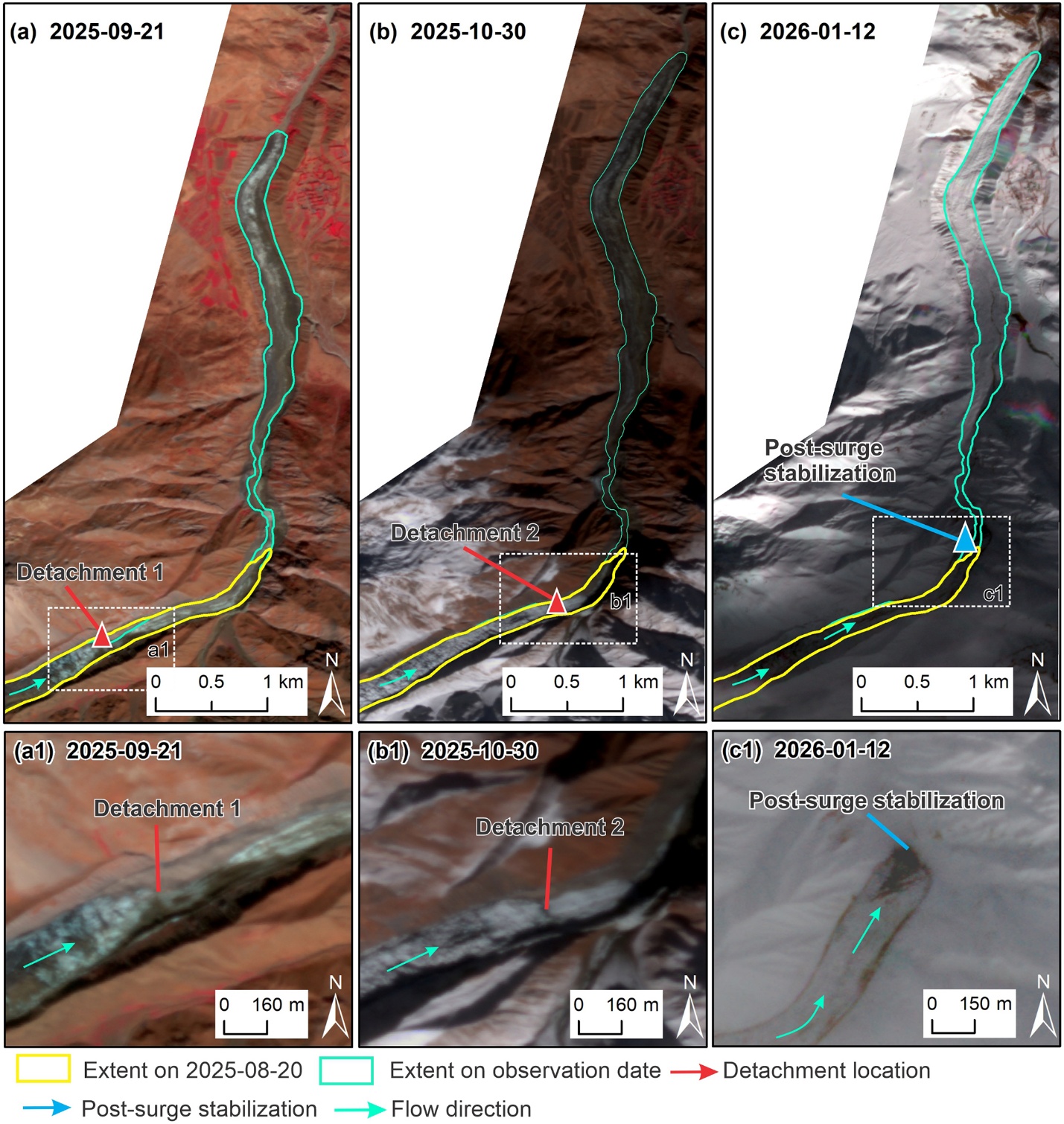
Evolution of Dehdal Glacier during the 2025-2026 surge-detachment sequence, showing two successive ice-detachment events and subsequent glacier stabilization. (Image by Safarov et al.; satellite imagery © Planet Labs PBC)
