Newsroom


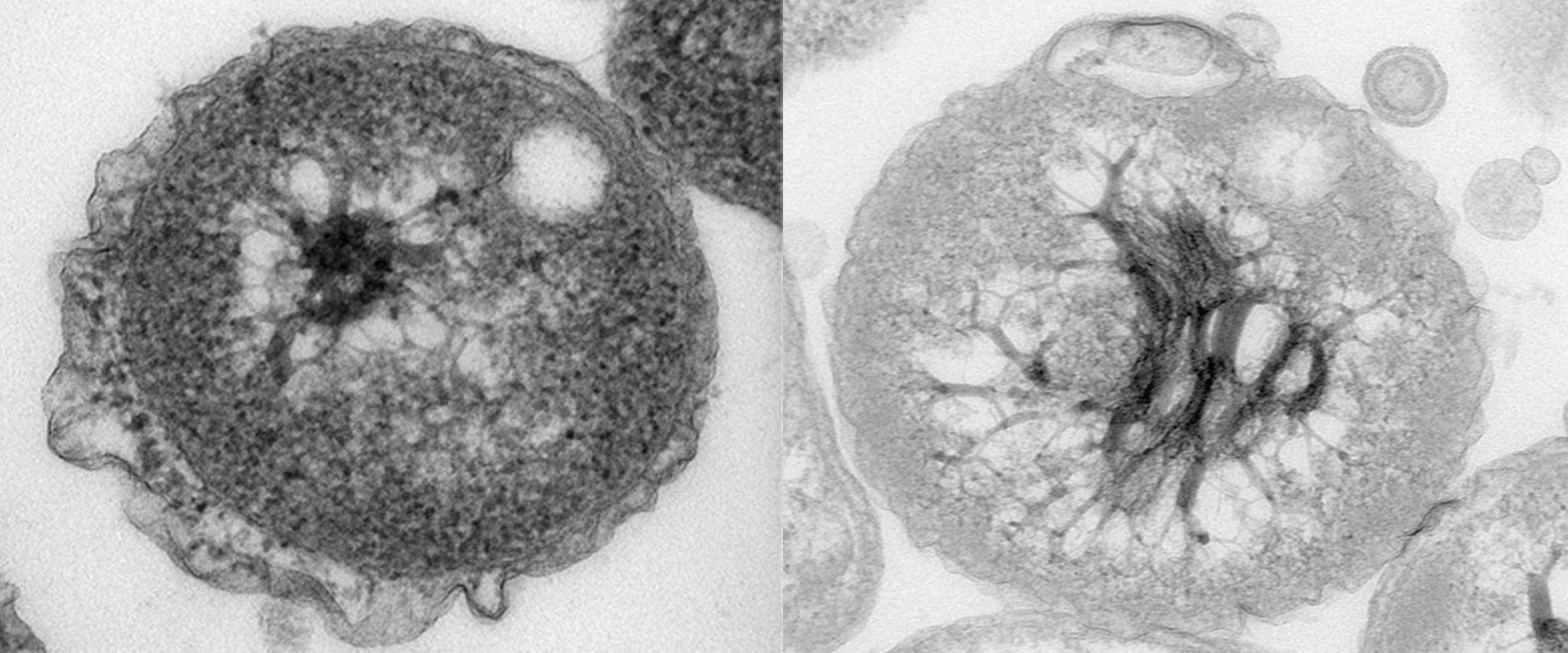
A new study reveals a previously unknown bacterial immune mechanism in which the signaling molecule 2′,3′-cGAMP triggers the splitting of the bacterial membrane into two distinct bilayers, leading to the death of infected cells and preventing further phage propagation.
Led by WANG Chongyuan from the Shenzhen Institute of Advanced Technology (SIAT) of the Chinese Academy of Sciences, in collaboration with Southern University of Science and Technology, the study was published in Molecular Cell on Nov 5.
Bacteriophages, or viruses that infect bacteria, are major drivers of bacterial evolution. In response to phage infection, bacteria have evolved a range of defense mechanisms, including the cyclic-oligonucleotide-based antiphage signaling system (CBASS), an innate immune system that detects viral infection and activates cellular defenses.
However, how CBASS signaling triggers bacterial cell death to stop phage propagation, and how phages counteract this defense, remain poorly understood.
In this new study, the researchers found that following phage infection, phage-derived DNA, together with changes in intracellular nucleotide availability, helps release CdnB from its autoinhibited state. Activated CdnB then uses ATP and GTP as substrates to produce the second messenger 2′,3′-cGAMP. This molecule binds to the SAVED domain of the effector protein Cap14, driving its transition from a homodimer into a zipper-like, two-layered filamentous assembly.
This structural rearrangement induces substantial changes in Cap14's transmembrane region, splitting the originally continuous bacterial lipid bilayer into two separate bilayers. The resulting loss of membrane integrity triggers the death of infected cells and prevents the release of progeny phages, thereby limiting infection and protecting neighboring bacterial cells.
The study also reveals how bacteriophages counteract this immune response. The T4 phage protein Acb2 directly binds and sequesters 2′,3′ -cGAMP, reducing the amount of free signaling molecule available to activate Cap14. By blocking downstream immune signaling, Acb2 enables the phage to evade CBASS-mediated defense.
Unlike conventional counter-defense strategies that rely on enzymatically degrading immune signals, this mechanism allows the phage to neutralize them by acting as a molecular "sponge".
Furthermore, the researchers found that removing the C-terminal autoinhibitory domain of CdnB enables it to continuously synthesize 2′,3′-cGAMP.
Together, these findings reveal a previously uncharacterized mechanism of bacterial antiviral defense that differs from membrane pore formation, phospholipid hydrolysis, and nucleic acid degradation.
They also provide new insights into the evolutionary relationship between bacterial CBASS systems and the mammalian cGAS–STING innate immune pathway, and offer a molecular basis for exploring novel immune-modulating tools and potential therapeutic applications.