
Newsroom


Accurate species delimitation is fundamental to biodiversity conservation, yet it remains a persistent challenge in species-rich plant groups, particularly conifers, where convergent evolution, gene flow, and incomplete lineage sorting often obscure species boundaries.
A research team led by Prof. WANG Xiaoquan from the Institute of Botany of the Chinese Academy of Sciences has revealed the phylogenetic relationships and genomic vulnerability of the Pinus kwangtungensis complex, a group of endangered white pines distributed in subtropical China and Vietnam.
The study was published in Molecular Phylogenetics and Evolution on Nov 10.

Pinus kwangtungensis (Guizhou, China). (Image by LIU Chang)
The Pinus kwangtungensis complex comprises three nominal species: P. kwangtungensis, P. wangii, and P. dalatensis. The complex is mainly distributed in subtropical China and Vietnam, where its habitats are highly fragmented and many populations are confined to isolated limestone mountaintops. P. wangii and P. kwangtungensis are listed as Class I and Class II nationally protected wild plants in China, respectively.
To address these challenges, the research team conducted transcriptome sequencing of 138 individuals from 20 populations covering the entire distribution range of the complex. Using a large number of SNP loci screened from population transcriptomes, together with a unique combination of cytoplasmic DNA markers in Pinaceae (paternally inherited chloroplast genes and maternally inherited mitochondrial genes), they reconstructed the evolutionary relationships among the lineages, assessed genomic vulnerability, and established conservation units.
Unexpectedly, the study found that the boundaries of the three nominal species in the complex were all incorrectly defined. Instead, the complex should be divided into three genetic lineages: EAST, WEST, and PDAL. The EAST lineage includes the eastern populations of P. kwangtungensis. The WEST lineage comprises populations traditionally recognized as P. wangii and the western populations of P. kwangtungensis. The PDAL lineage consists of the Hainan Island population of P. kwangtungensis and P. dalatensis and was formed through hybridization between the EAST and WEST lineages.
Notably, adjacent populations of the EAST and WEST lineages show no obvious morphological differences, yet have undergone significant genetic differentiation. This suggests that species boundaries defined solely by morphological characteristics can be obscured by convergent evolution, introgressive hybridization, or incomplete lineage sorting. The high genetic differentiation among the three lineages suggests that the evolutionary diversity of this complex has been significantly underestimated.
Population history modeling suggests that the EAST and WEST lineages diverged during the middle Miocene (approximately 15.64 Ma), possibly in response to the strengthening of the East Asian monsoon and regional tectonic uplift. Furthermore, about 68,000 years ago, during the late Pleistocene, the EAST and WEST lineages came into secondary contact and hybridized to form the PDAL lineage. Repeated land bridge connections during the late Pleistocene may have facilitated the dispersal of the PDAL lineage to Hainan Island and Vietnam.
The study further assessed the genomic vulnerability of different populations under future climate scenarios. Model predictions indicate that populations at the western edge of the distribution range, on Hainan Island, and in Dalat, Vietnam, are particularly vulnerable under these scenarios. The researchers recommend that, for the conservation of the P. kwangtungensis complex, the EAST and WEST lineages should be treated as two independent evolutionarily significant units (ESUs), while the Hainan Island population of the PDAL lineage should be managed as a separate management unit, with particular attention to the high-risk populations mentioned above.
Traditional conservation practices often use nominal species as conservation units. This study not only deepens our understanding of the evolutionary history of the P. kwangtungensis complex but also emphasizes the critical role of accurate species delimitation in effective biodiversity conservation.
Under the combined effects of gene flow, hybridization, and climate change, biodiversity conservation urgently needs to shift from a "nominal species" approach to an "evolutionary lineage"-oriented framework, enabling more accurate identification of conservation units, assessment of genetic risks, and development of differentiated conservation strategies.
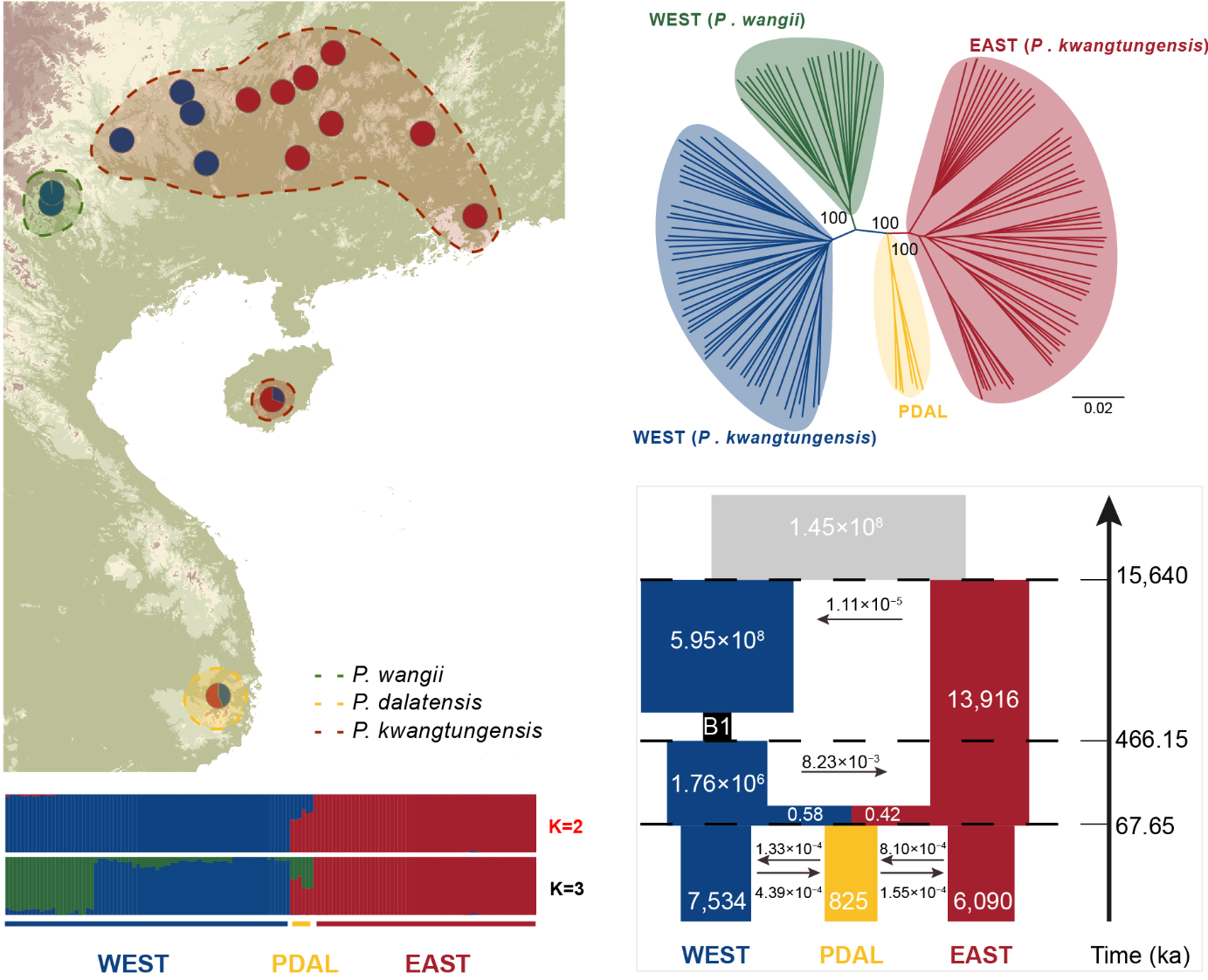
Diversification and reticulate evolution in the Pinus kwangtungensis complex. (Image by LIU Chang)

