
Newsroom


Researchers at the Institute of Biophysics of the Chinese Academy of Sciences have developed an AI-assisted method for determining the three-dimensional structures of proteins embedded in membranes. The method, called isSPA-vesicle, was developed by a team led by Prof. ZHANG Xinzheng.
The study was published in PNAS on November 16.
The researchers used isSPA-vesicle to reconstruct membrane proteins ranging from 130 kilodaltons (kDa) to 2 megadaltons (MDa) across two classes of enveloped viruses and three types of synthetic liposomes. They obtained highly detailed structures of two representative virus proteins—influenza A virus hemagglutinin at a resolution of 2.7 Å and the prefusion spike protein of human coronavirus OC43 at 3.1 Å.
Membrane protein structures are strongly influenced by their lipid environment. Vesicles provide membrane curvature and the ability to establish ion gradients across the membrane, thereby mimicking physiological conditions. Despite advances in native membrane sample preparation, however, high-resolution structural analysis of vesicle-embedded proteins has been challenging due to the limited efficiency and resolution of conventional single-particle analysis (SPA) and subtomogram averaging (STA).
In isSPA-vesicle, since vesicles in solution can exhibit anisotropic shapes that approximate spheres or ellipsoids, the researchers trained an AI model to estimate membrane geometric parameters and calculate normal vectors based on fitted ellipsoidal surfaces. The resulting geometric information enabled post hoc filtering of particles identified by the isSPA framework. Particles were selected based on angular differences between their orientations and local membrane normal vectors, and free particles not associated with vesicles were excluded.
The results showed that isSPA-vesicle can accurately determine particle positions and orientations even when membrane densities overlap, compared with SPA workflows using Topaz or conventional template matching (TM) for particle picking. Its performance is independent of the molecular weight of the soluble domains, allowing the identification of a greater number of valid particles.
Compared with the original isSPA framework, isSPA-vesicle efficiently removes membrane-unbound particles and lowers the minimum molecular weight of proteins that can be analyzed. On the AcrB validation dataset, isSPA-vesicle achieved a reconstruction resolution of 3.1 Å, better than the other three evaluated methods achieved.
Their results demonstrate the potential of isSPA-vesicle as a simple and efficient tool for the high-resolution structural reconstruction of membrane proteins in physiological lipid bilayers.
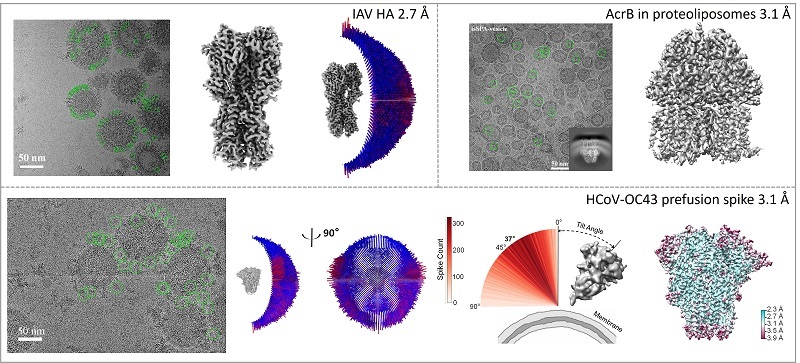
Representative applications of isSPA-vesicle, including data processing and reconstruction results for influenza A virus hemagglutinin (HA), AcrB in proteoliposomes, and the prefusion spike protein of HCoV-OC43. (Image by ZHANG Xinzheng's group)
