
Newsroom


Multi-principal element alloys (MPEAs) are structural materials with strong mechanical properties, good resistance to radiation damage, and broad compositional flexibility. These features make them promising candidates for next-generation nuclear, aerospace, and fusion applications. Their development has been hindered, however, by the cost of evaluating point-defect transport and self-healing across a vast range of compositions.
Now, a research group led by Prof. GUAN Pengfei from the Ningbo Institute of Materials Technology and Engineering (NIMTE) of the Chinese Academy of Sciences, in cooperation with researchers at Xi'an Jiaotong University, has established local lattice distortion (LLD)—deviations of atoms from their ideal positions in a crystal lattice—as a general descriptor of the mobility of vacancies (missing atoms) and interstitials (extra atoms between regular lattice sites) in MPEAs. The findings could help researchers design alloys with better self-healing properties.
The study was published in PNAS on November 20.
The researchers first built a high-fidelity machine-learning model of atomic interactions, known as an interatomic potential, for body-centered cubic Zr–Ti–Nb alloys. The model reproduces density functional theory (DFT) results and outperforms conventional interatomic potentials.
Simulations showed that LLD markedly accelerates vacancy migration while suppressing that of interstitials, thereby narrowing the disparity between their diffusivities. This relationship was also validated in face-centered cubic V–Co–Ni and Ni–Pd systems, indicating that the effect works across different chemistries and crystal structures.
Composition–structure maps revealed that high-LLD regions correspond to small activation-energy differences, suggesting LLD could help researchers identify alloys in which vacancies and interstitials can readily recombine, repairing radiation-induced damage.
"This work offers a new path for designing radiation-resistant alloys for extreme environments," said GUAN. "We can now screen candidates without expensive calculations for every composition.”
The study was supported by the National Natural Science Foundation of China, the Suzhou Laboratory Open Research Fund, the National Youth Talent Program, and the Ningbo "AI + New Materials" Basic Research Talent Center.

Local lattice distortion helps designing self-healing multi-principal element alloys (Image by NIMTE)
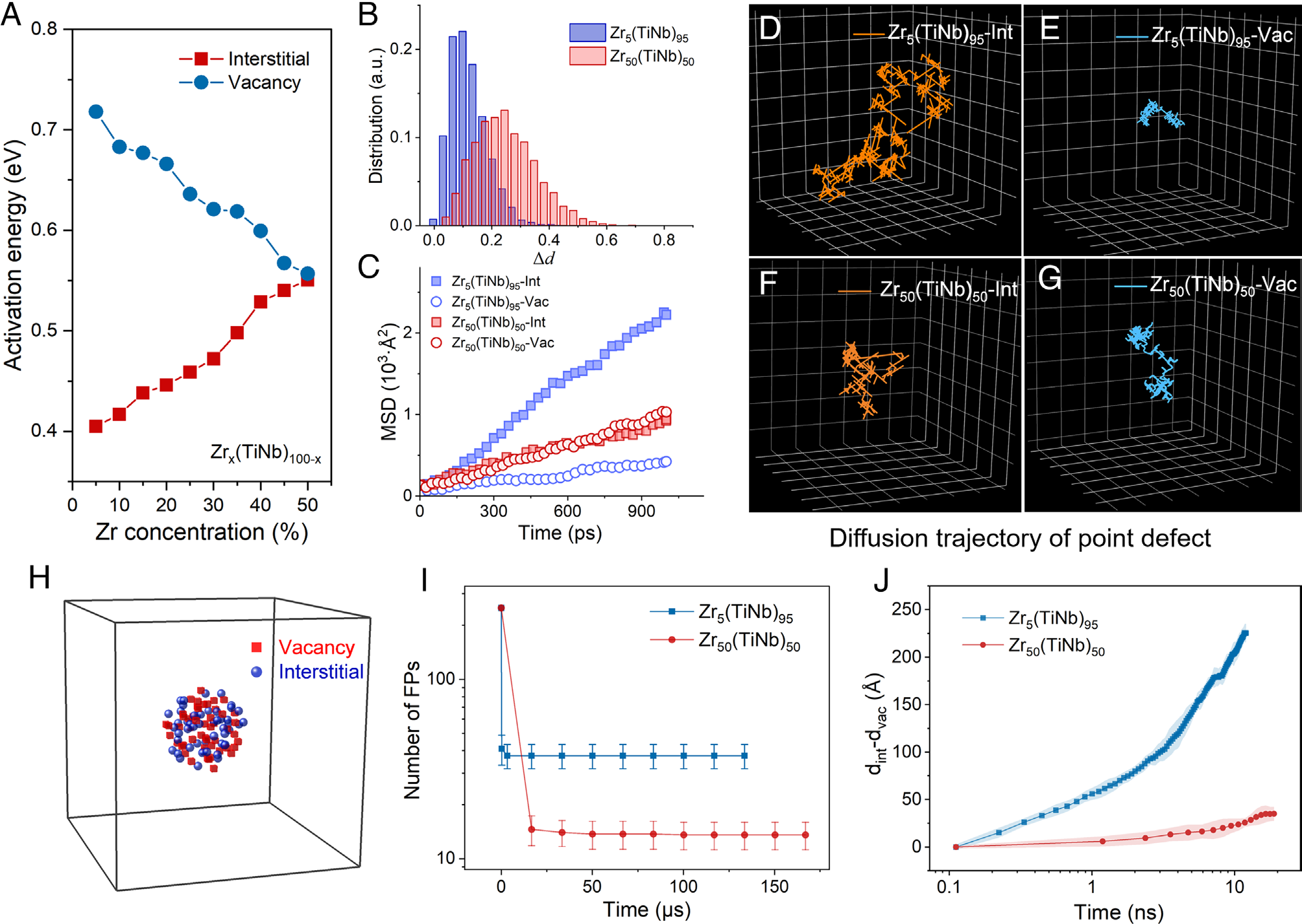
Lattice distortion narrows the difference in vacancy and interstitial mobility, promoting the recombination of irradiation-induced defects (Image by NIMTE)
