
Newsroom


A research team from the South China Botanical Garden (SCBG) of the Chinese Academy of Sciences has uncovered a molecular regulatory mechanism that contributes to the development of curved floral organs associated with the distinctive lips of orchids, offering new insights into the development and evolution of floral forms in orchids.
The study was published in New Phytologist on November 6.
Slipper orchids (Paphiopedilum) are highly valued ornamental plants, admired for their distinctive flowers and long flowering periods. Their characteristic pouch-shaped lips are not only a defining ornamental feature but also play an important role in deceptive pollination strategies.
Previous studies have shown that MADS-box transcription factors play important roles in determining floral organ identity in orchids. However, the developmental mechanisms underlying the formation of the distinctive pouch-shaped lip remain poorly understood. In particular, how transcription factors regulate cellular growth to produce this specialized floral structure is still unclear.
To investigate these questions, the researchers compared wild-type Paphiopedilum henryanum with a peloric mutant whose lateral petals develop lip-like features. They combined observations of floral development with scanning electron microscopy, transcriptome sequencing, gene expression analysis, and virus-induced gene silencing to explore the cellular basis and molecular regulation of floral organ curvature.
The two types of plants showed no obvious morphological differences during early floral development. The differences emerged at Stage 4, when the floral organs entered a period of rapid growth. At this stage, the mutant's lateral petals began to curve inward, gradually developing pouch-shaped structures resembling the lip of the wild type.
Further cellular analyses revealed that the curvature of lips and lip-like petals was closely associated with differences in epidermal cell numbers between their adaxial and abaxial surfaces. By contrast, the average area of individual epidermal cells remained largely unchanged. This suggests that differences in cell numbers between the two surfaces, rather than changes in cell size, may contribute to the bending of floral organs.
Key Candidate Involved in Lip Morphogenesis
Through transcriptome analysis, the researchers identified PhAGL6-2, a MADS-box transcription factor gene, as a key candidate involved in lip morphogenesis. Its expression was particularly high in lips and lip-like petals, with distinct spatial and temporal patterns during the critical stages of floral development.
Gene-silencing experiments showed that reducing PhAGL6-2 expression caused abnormal curvature in petals and sepals and disrupted the balance of epidermal cell numbers between their adaxial and abaxial surfaces. These results support a role for PhAGL6-2 in regulating floral organ curvature in orchids.
The researchers then investigated how PhAGL6-2 is regulated and identified PhYAB4 as an upstream transcription factor. Yeast one-hybrid assays, electrophoretic mobility shift assays, and dual-luciferase reporter assays showed that the PhYAB4 protein directly binds to an AGTGTG cis-regulatory element in the promoter of PhAGL6-2, thereby activating its transcription.
Functional analyses further showed that silencing PhYAB4 significantly reduced PhAGL6-2 expression. It also led to more pronounced curvature in petals and sepals, abnormal outgrowths of the lip, and partial disruption of floral symmetry.
Together, these results indicate that the PhYAB4 protein contributes to floral organ development by directly activating PhAGL6-2. It may also affect lip morphology and floral symmetry through additional downstream regulatory pathways.
By linking transcriptional regulation with differences in epidermal cell numbers and the resulting curvature of floral organs, the study sheds light on the molecular networks underlying lip development in slipper orchids. It also provides new insights into the developmental and evolutionary mechanisms behind floral diversity in orchids and identifies potential molecular targets for improving ornamental traits and breeding new orchid varieties.
Dr. YIN Yuying, a postdoctoral researcher at SCBG, is the first author of the paper. Associate Professor FANG Lin and Professor ZENG Songjun, both from SCBG, are the co-corresponding authors.
The research was supported by the National Key Research and Development Program of China, the Natural Science Foundation of Guangdong Province, and the Innovation Team of Modern Agriculture Industry Technology System in Guangdong Province, among other funding sources.
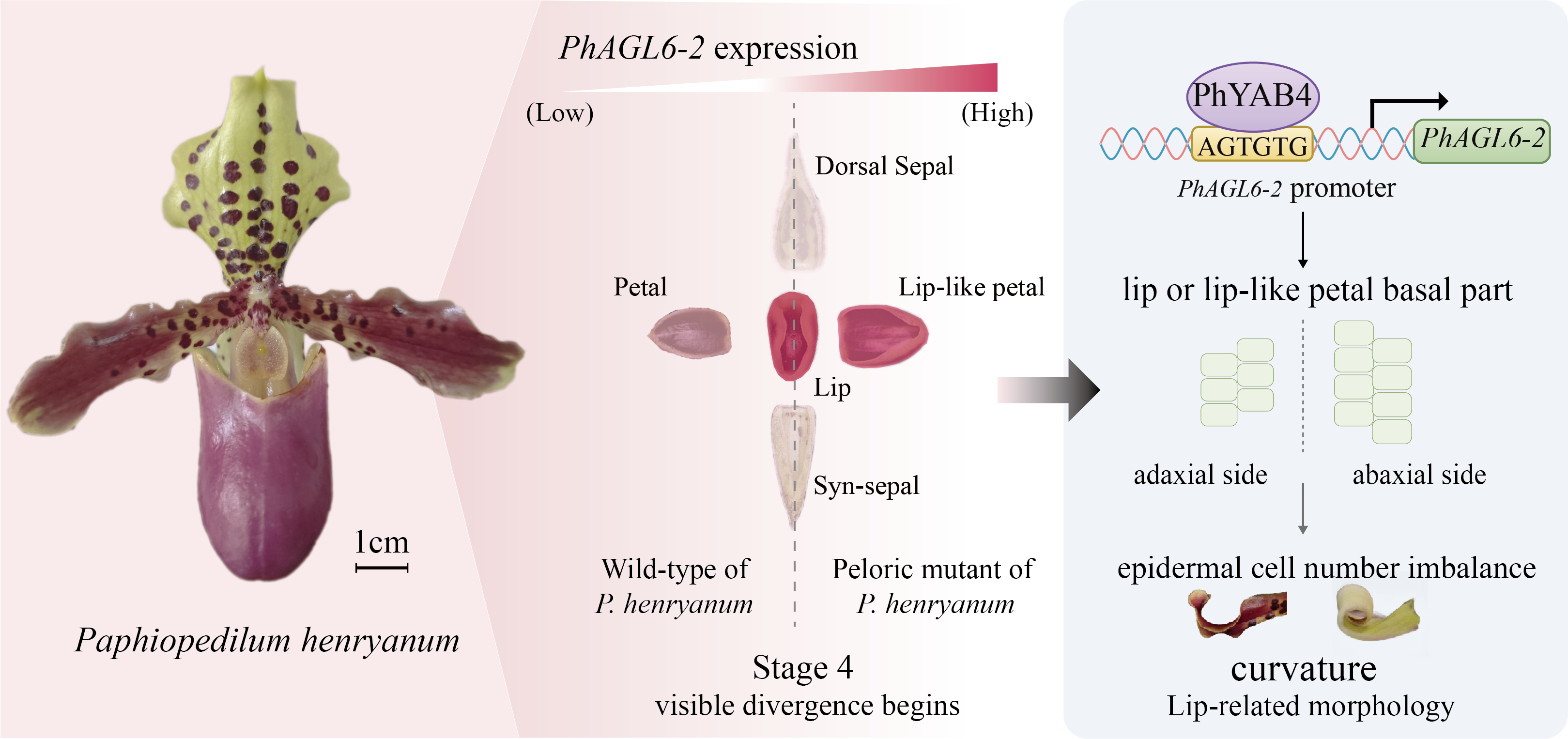
Schematic model illustrating the role of the PhYAB4–PhAGL6-2 transcriptional regulatory module in lip-related floral organ curvature morphogenesis in Paphiopedilum henryanum. (Image by FANG Lin)


