
Newsroom


Using high-resolution observations from the New Vacuum Solar Telescope (NVST), a research team from the Yunnan Observatories of the Chinese Academy of Sciences (CAS) has systematically studied the kinematic properties of dynamic fibrils around a sunspot and the mechanisms that drive them. The study was published in The Astrophysical Journal on Nov. 10.
Dynamic fibrils are small-scale, elongated structures in the solar chromosphere whose motions are closely tied to magnetohydrodynamic wave processes. Understanding their kinematic properties and driving mechanisms is important for probing energy transport and heating in the solar atmosphere.
The team studied NOAA active region 13182 using high-resolution Hα data obtained by NVST on January 10, 2023, together with extreme-ultraviolet images and vector magnetic field data from the Solar Dynamics Observatory (SDO).
The researchers identified 176 dynamic fibrils. Of these, 132 exhibited single-parabolic motion and 44 exhibited multi-parabolic motion. The mean deceleration, maximum velocity, maximum length and duration were 120 ± 43 m s-2, 15.9 ± 4.5 km s-1, 1.13 ± 0.48 Mm and 270 ± 63 s, respectively. The analysis revealed moderate-to-strong correlations among the kinematic parameters. In particular, deceleration showed a significant positive correlation with maximum velocity (ρ = 0.71), consistent with shock-driven models. The spatiotemporal relationship between one multi-parabolic event and the running penumbral waves, together with the similarity between the dominant oscillation periods of the event and the waves (287 s and 263 s, respectively), points to a physical connection between dynamic fibrils and slow magnetoacoustic waves.
Further analysis showed that dynamic fibrils in regions with more vertical magnetic fields had larger decelerations and shorter periods, whereas those in regions with more horizontal magnetic fields behaved in the opposite way. This difference may stem from the effect of magnetic field inclination on the acoustic cutoff frequency, which regulates the propagation of slow magnetoacoustic waves. Multiwavelength observations also reveal signatures of dynamic fibrils from the chromosphere through the transition region to the corona, indicating their potential contribution to energy transport and heating in the solar atmosphere.
This study presents a systematic analysis of the kinematic properties of dynamic fibrils around a sunspot and their relationship with slow magnetoacoustic waves. It provides new observational evidence for understanding the formation of small-scale solar chromospheric activity and the transport of energy in the solar atmosphere, and highlights the value of high-resolution NVST observations for studying fine structures on the Sun.
This work was supported by the CAS Strategic Priority Research Program, the National Key R&D Program of China and other programs.
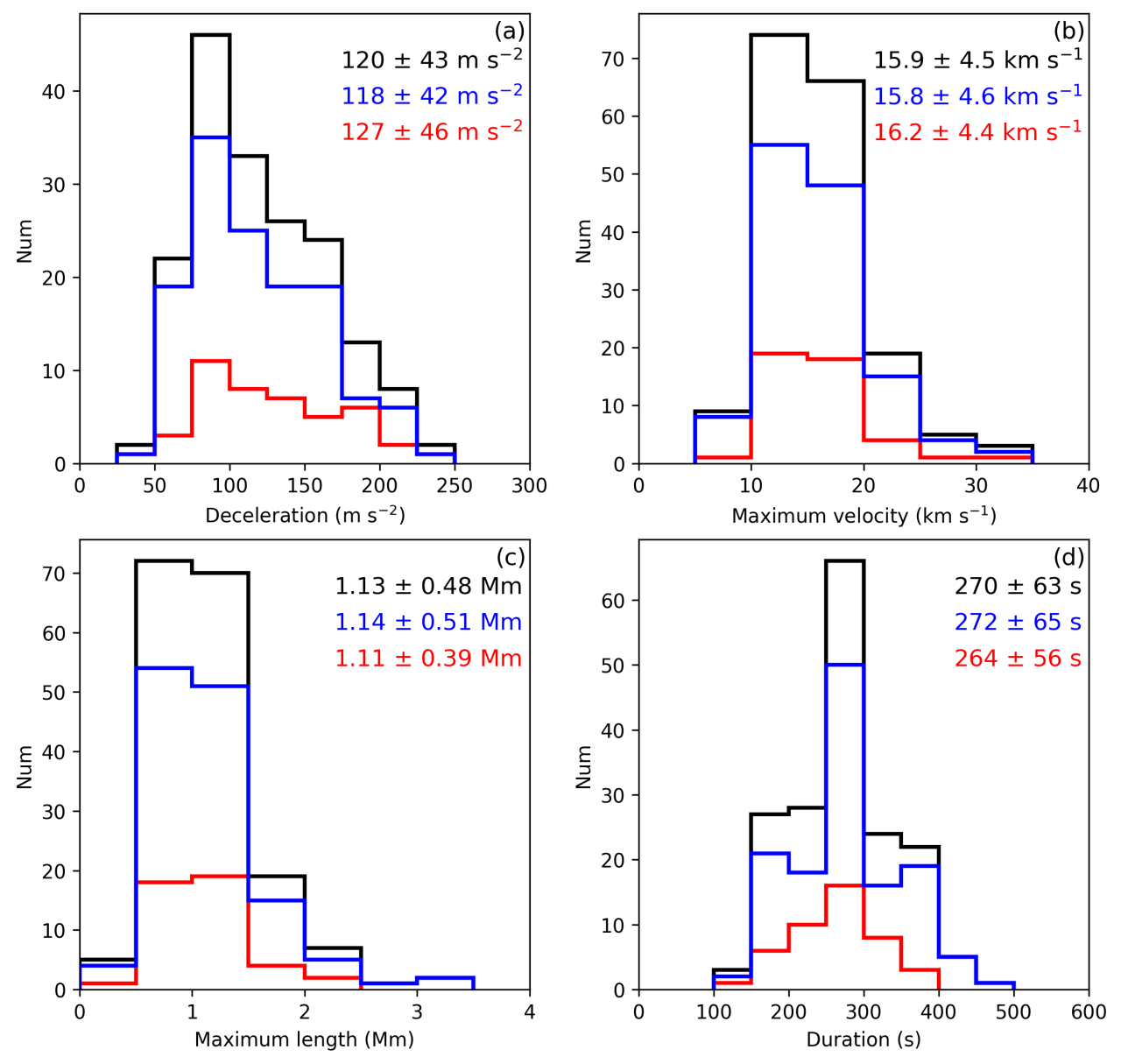
Histograms of the kinematic properties of dynamic fibrils. (Image by WU Guotang)
