
Newsroom


Frogs, salamanders and caecilians — the three groups of living amphibians — together number more than 9,000 species. On average they are the smallest of all four-limbed vertebrates, and some are extremely small: Brachycephalus toads measure less than seven millimetres from snout to vent. Their ancient relatives were very different animals. Most temnospondyls, the extinct group from which modern amphibians (lissamphibians) arose, were aquatic or semi-aquatic predators one to five metres long.
A new study led by researchers from the Institute of Vertebrate Paleontology and Paleoanthropology (IVPP) of the Chinese Academy of Sciences (CAS) has found that a dramatic reduction in body size at the origin of living amphibians was coupled with the emergence of traits linked to new ecological adaptations, allowing the animals to occupy novel regions of the adaptive landscape that were largely inaccessible to their larger ancestors. The work was recently published in National Science Review.
Scientists have long suspected that miniaturization played a role in amphibian origins. Dissorophoids, the closest extinct relatives of lissamphibians, were already smaller than other temnospondyls and showed juvenile traits such as short snouts and large orbits — the result of shifts in developmental timing known as heterochrony. But early dissorophoids still lacked the distinctive anatomy of modern amphibians, hinting that further miniaturization, and deeper morphological change, came later.
To test that idea, the researchers analysed body size together with skull and skeletal traits in 577 living and fossil species spanning the lissamphibian total group — Temnospondyli — and compared competing models of how those traits evolved.
The analyses reveal a history of booms and busts. Body-size diversity stayed low for roughly the first 10 million years of Temnospondyli evolution, beginning in the Early Carboniferous, then rose sharply over about 30 million years. It held steady from the early Late Carboniferous to the Late Permian, increased again in the Early and Middle Triassic, and fell substantially from the Late Triassic into the early Late Jurassic. Since then it has remained low and stable to the present.
Crucially, the models show that by the Late Carboniferous, lissamphibians had moved into a distinct adaptive zone of their own, with a much smaller optimal body size and relaxed evolutionary constraints compared with other temnospondyls. The result was a broad but lower range of body sizes, matching the range seen in amphibians today. The colonization of different size-related adaptive zones during successive phases of Temnospondyli history, the study finds, was a major driver of how body-size diversity changed through time.
The shift to small size coincided with the emergence of new body shapes and skull geometry. In frogs and salamanders (Batrachia), skulls became shorter and broader, several bones at the back of the skull were lost, and the jaw joint moved forward. These changes probably sped up jaw movements and widened the gape, helping the animals swallow prey quickly. Combined with suction feeding and projectile tongues, they turned batrachians into efficient hunters of small prey.
Caecilians took a different route. These mostly burrowing animals push through soil head first, and the analyses detected strong selective pressure for longer snouts. Their forward-shifted jaw joint increases the leverage of a key jaw muscle, delivering a powerful bite across a wide range of gape angles and allowing them to break up larger prey.
The researchers suggest that a further factor helped: the dramatic metamorphosis inherited from the common ancestor of living amphibians. Because this transformation compresses the development of land-adapted features into a short phase, evolution can readily adjust its timing. Some species remain aquatic as adults by retaining larval traits, while others skip the free-living larval stage through direct development and emerge with features suited to life on land.
The findings may point to a broader rule in vertebrate history. Similar bouts of rapid shrinking accompanied the rise of mammals from their therapsid ancestors and of birds from non-avian dinosaurs. The authors argue that miniaturization is closely tied to ecological innovation, and that a handful of such events helped give rise to the most species-rich vertebrate groups alive today.
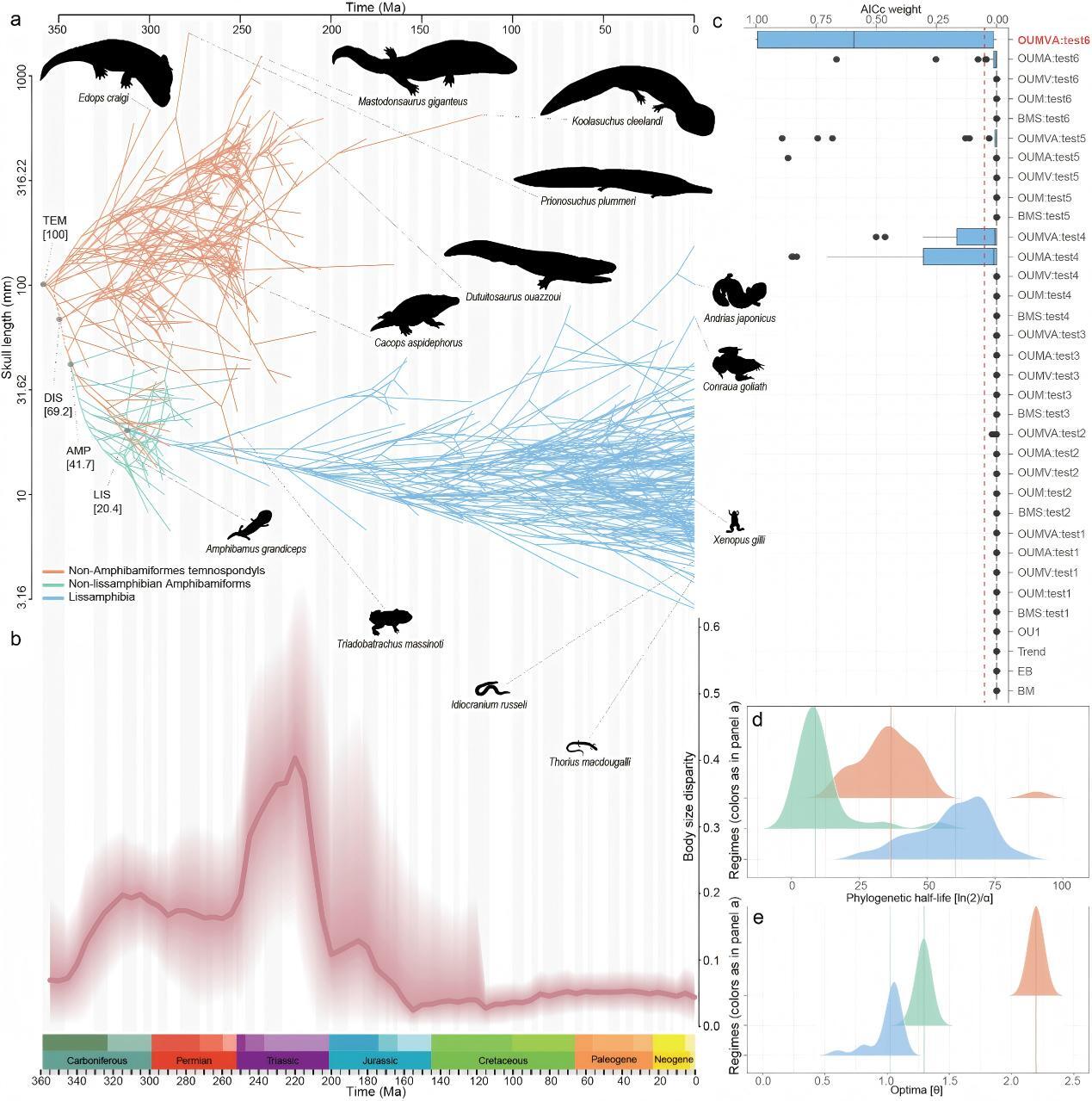
Pattern of body size evolution across the temnospondyls-lissamphibian transition. (Image by YU Yilun)

Evolution of jaw articulation across the temnospondyls-lissamphibian transition. (Image by YU Yilun)

Evolution of relative snout length across the temnospondyls-lissamphibian transition. (Image by YU Yilun)
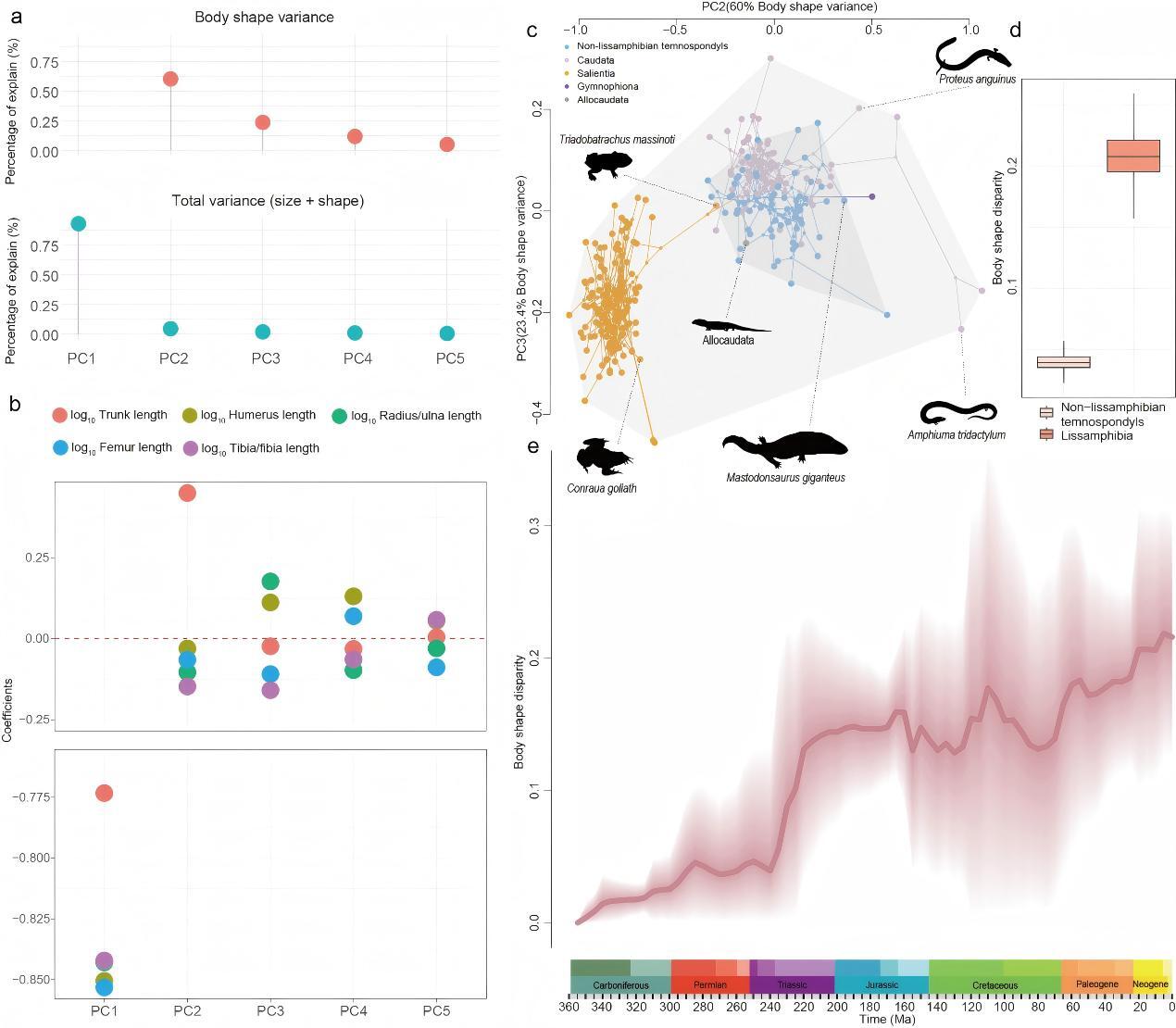
Comparison of body shape morphospace across the temnospondyls-lissamphibian transition (with limbless taxa dropped). (Image by YU Yilun)
