Newsroom


Combining drip irrigation during the growing season with autumn or winter irrigation can help control soil salinity and sustain high, stable crop yields in the arid regions of northwestern China, according to a new study.
The study, published in npj Sustainable Agriculture on November 5, was led by Prof. CHEN Yaning at the Xinjiang Institute of Ecology and Geography of the Chinese Academy of Sciences (XIEG), in collaboration with Chinese Academy of Engineering Academician YIN Feihu of the Xinjiang Academy of Agricultural and Reclamation Sciences, and Prof. WANG Zhenhua of Xinjiang Agricultural University.
Drip irrigation has been widely used in the arid regions of northwestern China for more than 30 years, helping improve agricultural water-use efficiency and support more intensive crop production. Yet the long-term effects of drip irrigation on soil salinity remain debated.
Some researchers argue that insufficient leaching and evaporation-driven salt accumulation can cause secondary salinization in irrigated oases, while others contend that drip irrigation moves salts away from crop roots and can maintain a dynamic balance between salt accumulation and the need to sustain stable crop yields.
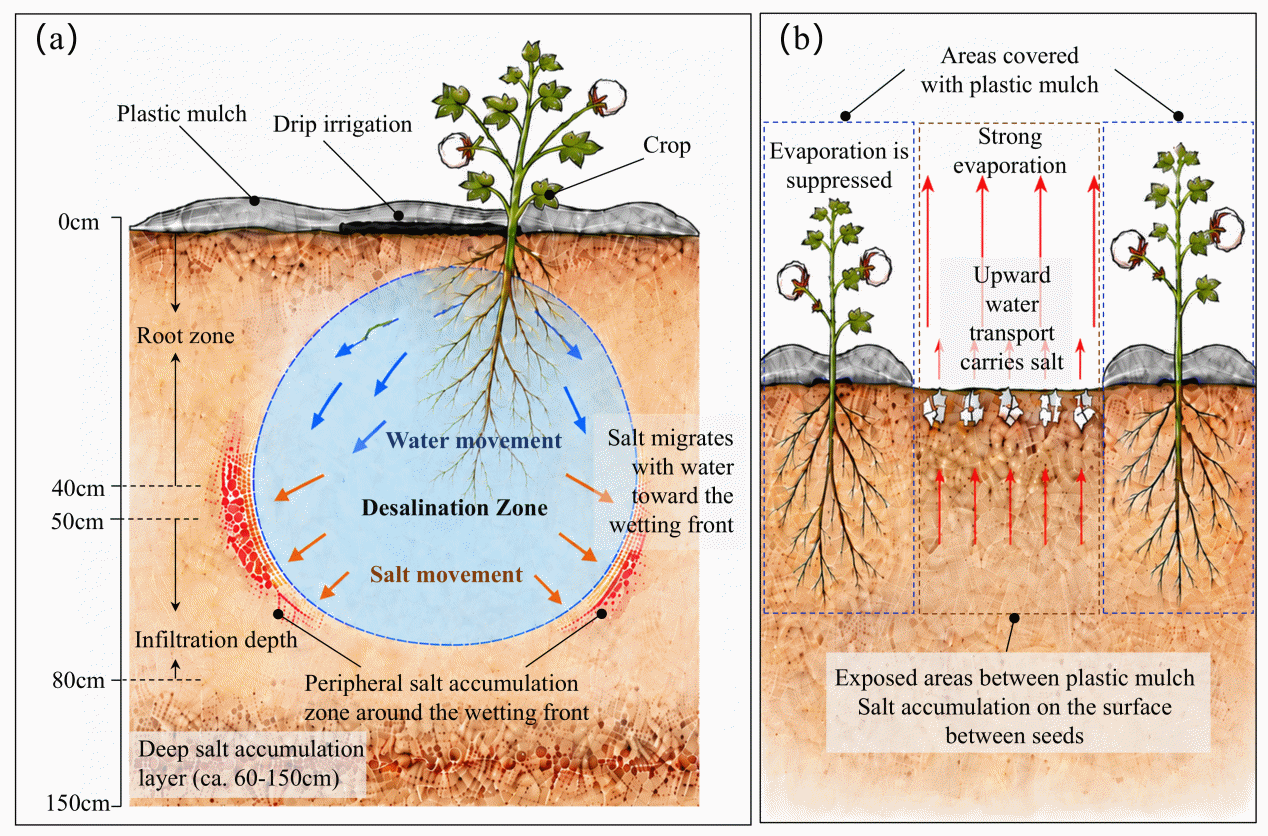
Soil water-salt transport processes in arid regions. (Image by XIEG)
Drawing on systematic case analyses, the researchers found that long-term drip irrigation can reduce salinity in the crop root zone even as salts accumulate elsewhere in the soil. Lower salinity around crop roots can ease salt stress during early growth.
At the same time, salts carried in irrigation water can accumulate at the outer edge of the wetted zone, while evaporation can cause salts to concentrate near the soil surface in the exposed inter-film zones. Where leaching is insufficient, such accumulation can increase the risk of secondary soil salinization.
Autumn or winter irrigation leaches salts during the non-growing season. Applying water at the soil surface allows it to infiltrate through the soil profile and pushes accumulated salts into deeper soil layers. The added water also redistributes through the soil during winter and spring freeze–thaw cycles.
Together, these processes help maintain a long-term soil water–salt balance in the root zone, supporting the long-term sustainability of drip irrigation and the stability of crop yields.
Limited reservoir storage also helped shape the use of winter irrigation for salinity control. Reservoirs with limited storage capacity can retain only part of the water available in winter for the following growing season. Using water that would otherwise go unused for autumn or winter irrigation makes better use of scarce water resources and provides a reliable opportunity to manage soil salinity.
According to the researchers, the study shows that coordinating irrigation across seasons can help farms maintain high yields under long-term drip irrigation. By pairing water-saving irrigation during crop growth with salt leaching during the off-season, the approach offers a practical model for irrigated agriculture in other arid regions.
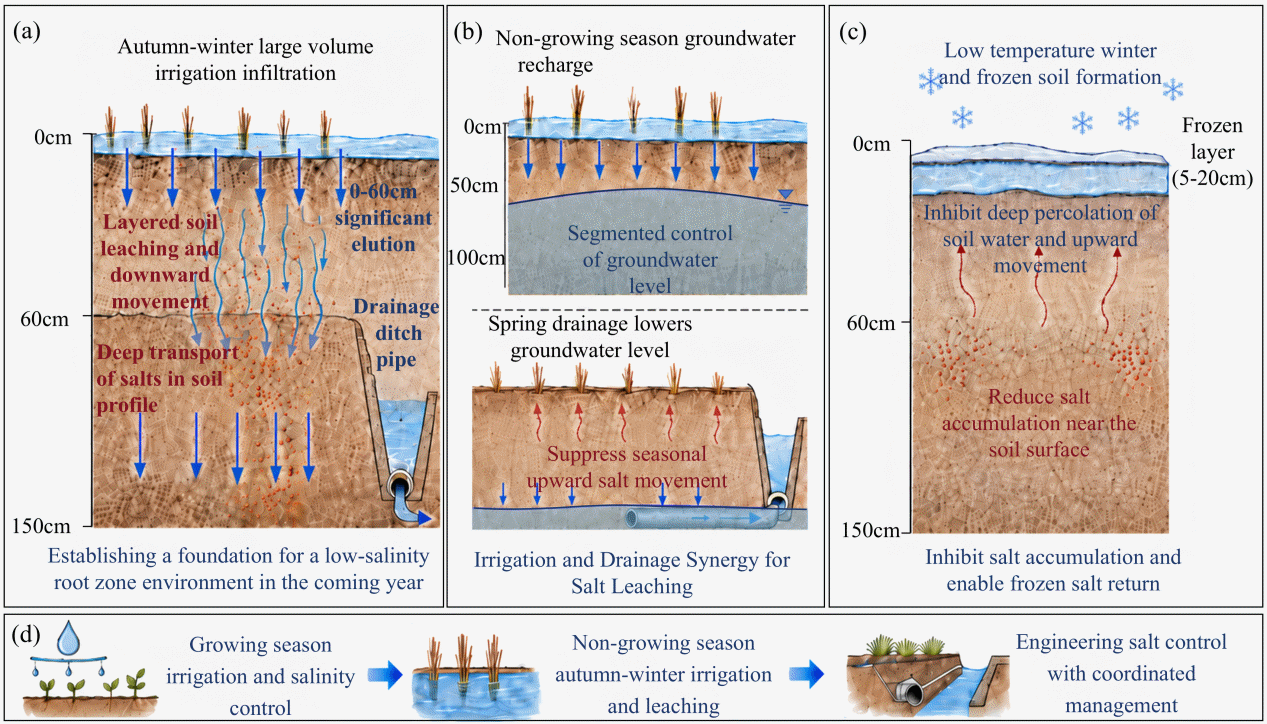
Schematic diagrams illustrating the core water-salt regulation mechanisms of autumn/winter irrigation. (Image by XIEG)