
Newsroom


Astronomers have revealed three dense cores at different evolutionary stages within the massive star-forming region G40.282−0.219, shedding light on the physical and chemical differences among cores within the same massive dense clump.
In recent years, Atacama Large Millimeter/submillimeter Array (ALMA) observations have shown that massive dense clumps are often composed of many lower-mass dense cores. These dense cores are located close to one another but differ in mass, evolutionary stage, and physicochemical properties.
Previously, low-resolution observations could only capture the overall properties of massive dense clumps, without resolving the individual dense cores or determining their physicochemical properties and evolutionary states.
Recently, A. G. TEGEGNE, a doctoral student in the star formation and evolution group at the Xinjiang Astronomical Observatory of the Chinese Academy of Sciences, conducted a study under the supervision of Prof. Jarken Esimbek and Andrey M. Sobolev. Using ALMA data, the researchers identified three dense cores within the massive star-forming region G40.282−0.219 and analyzed their physicochemical properties and relative evolutionary stages from multiple aspects.
The related results have been published in The Astrophysical Journal.
G40.282−0.219 is located at a distance of about 3.4 kpc from Earth, and previous low-resolution observations showed that it is a massive young stellar object. Using ALMA data observed at 1.3 mm band, the team resolved it into three dense cores located within the same parental clump: MM1, MM2, and MM3.
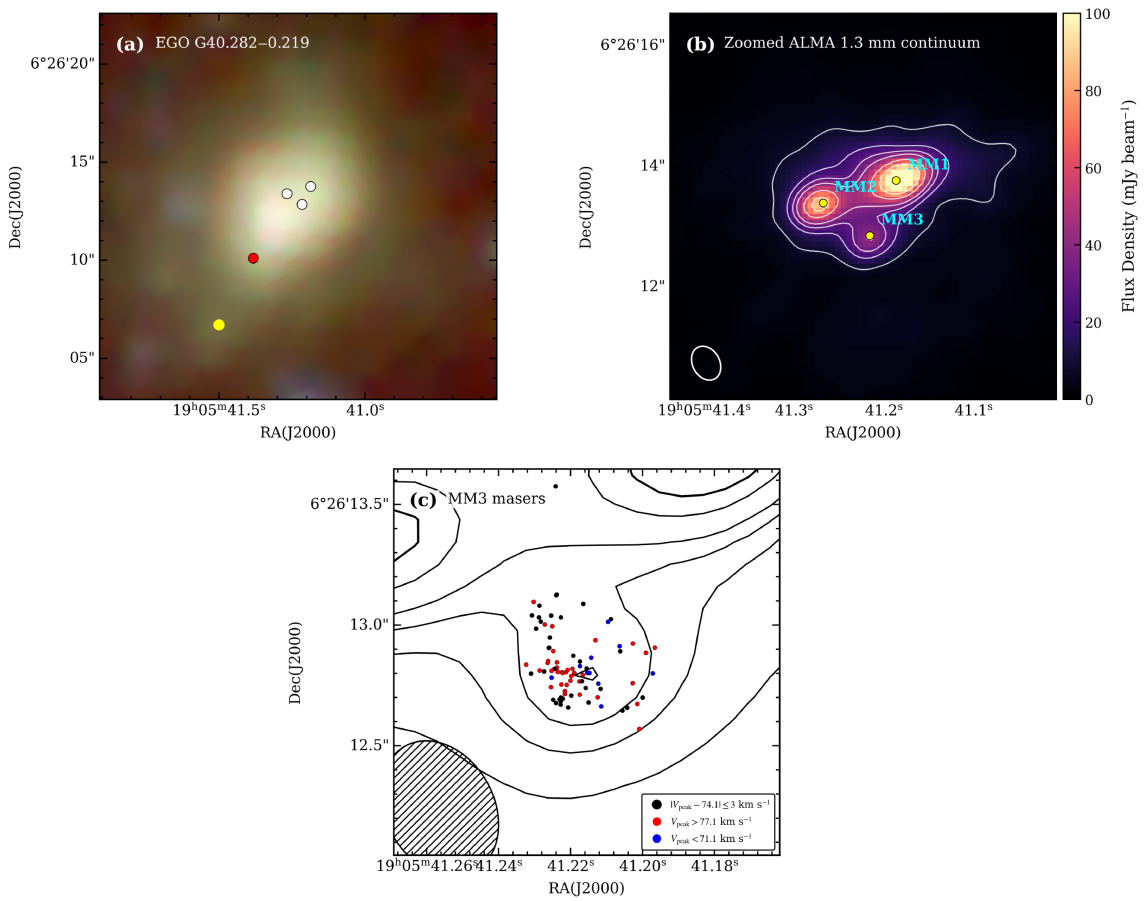
The G40.282−0.219 region seen by Spitzer (a), the three compact cores resolved by ALMA at 1.3 mm (b), and the methanol masers concentrated around MM3 (c). (Image by XAO)
The study found that MM1 has the largest mass, about 24.6 solar masses (M⊙), but has the fewest detected molecular spectral lines, and no associated outflows or masers were detected.
MM2 has a mass of about 8.4 M⊙ and drives a powerful outflow, with its silicon monoxide (SiO) jet having a velocity of about 25 km/s.
MM3 has the smallest mass, about 5.2 M⊙, yet has the highest dust temperature and the richest variety of molecules, and hosts a 6.7 GHz Class II methanol maser. Therefore, an evolutionary sequence exists within G40.282−0.219, from the youngest MM1 to the most evolved MM3.
According to the researchers, the results demonstrate that only by comprehensively considering multiple factors—such as mass, density, temperature and other physical properties, the presence or absence of outflows and jets, the richness of molecular spectral lines, and the types of detected masers—can the evolutionary stages of dense cores in massive star-forming regions be determined more accurately.
This research was supported by the National Key R&D Program, the National Natural Science Foundation of China, and other projects.
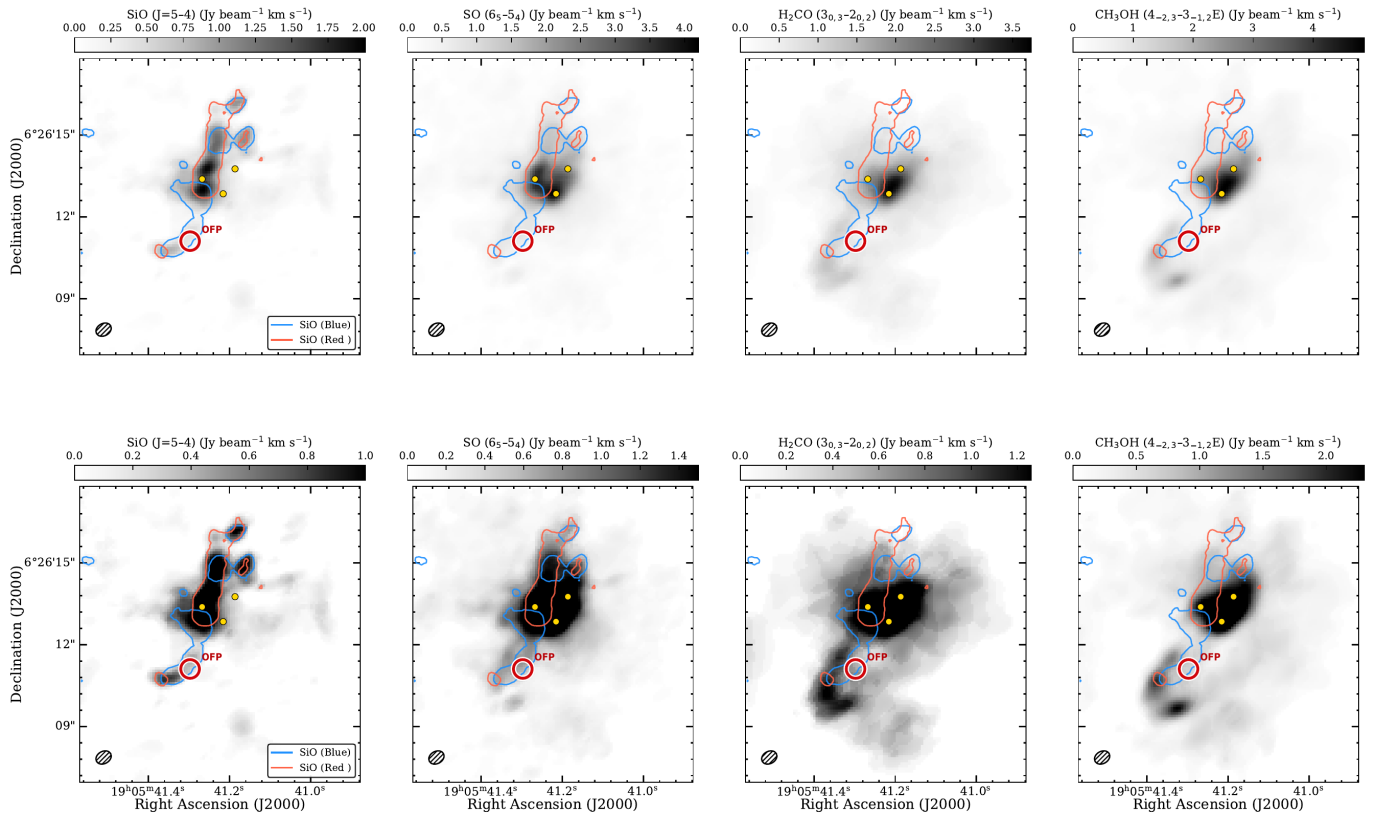
Molecular gas in G40.282−0.219, traced by SiO, SO, H2CO, and CH3OH. Blue and red contours mark the bipolar SiO outflow driven by MM2, and yellow markers show the positions of the three cores. (Image by XAO)
