
Newsroom


Scientists from the Institute of Metal Research (IMR) of the Chinese Academy of Sciences, in collaboration with researchers from Peking University and Chongqing University, have demonstrated how the geometry and electronic properties of sub-nanometer rhodium (Rh) active sites shape C–H activation, product desorption, and C–C bond cleavage during butane dehydrogenation.
Their work, published in ACS Catalysis, revealss that fully exposed low-coordination Rh3 clusters balance dehydrogenation activity with butene selectivity, offering a new strategy for designing efficient alkane dehydrogenation catalysts.
Butenes are key feedstocks for high-value chemicals, and butane dehydrogenation is an important process for producing them. However, alkane dehydrogenation is thermodynamically limited and typically requires high temperatures, which promote deep dehydrogenation, C–C bond cracking, carbon deposition and metal sintering. A central challenge is therefore to accelerate C–H activation while facilitating olefin desorption and suppressing cracking.
Rh exhibits strong C–H activation ability, but its catalytic performance is highly sensitive to active-site structure. Isolated Rh atoms can suffer from insufficient dehydrogenation activity, whereas larger Rh particles tend to promote C–C bond cleavage and side reactions. To resolve this contradiction, the researchers constructed Rh1, Rh2, Rh3 and Rh6 clusters on defective graphene, as well as stepped Rh(211) and flat Rh(111) surfaces representing Rh nanoparticles, and combined density functional theory calculations with experiments.
The calculations revealed a volcano-type relationship between dehydrogenation activity and Rh size. Fully exposed Rh2 and Rh3 clusters exhibited more favorable thermodynamics. The Rh atoms in these small clusters have higher d-orbital energy, which favors transition-state binding during C–H activation while inhibiting C–C bond cleavage. This causes butene to desorb rather than crack. On stepped Rh(211), the butene desorption energy is comparable to the C–C activation barrier. This indicates facile C–C cleavage and a likely site for carbon deposition.
Guided by these predictions, the researchers prepared Rh single atoms, atomically dispersed fully exposed Rh₃ clusters, larger Rh clusters and nanoparticles on defect-rich graphene by tuning Rh loading. In butane dehydrogenation, the Rh3 catalyst achieved an initial butane conversion of 10.3% and a C4 dehydrogenation product selectivity of 89.5%.
Kinetic and temperature-programmed experiments confirmed that Rh3 clusters outperformed other Rh sizes, with activity following a volcano-type curve. Rh nanoparticles produced far more C1-3 products and suffered rapid deactivation and much higher carbon deposition, consistent with the theoretical predictions.
This work establishes the relationship between Rh active-site structure and catalytic performance. demonstrating that low-coordination, fully exposed Rh clusters can simultaneously promote dehydrogenation and suppress cracking and coking. It provides a new basis for active-site design in efficient alkane dehydrogenation catalysts.
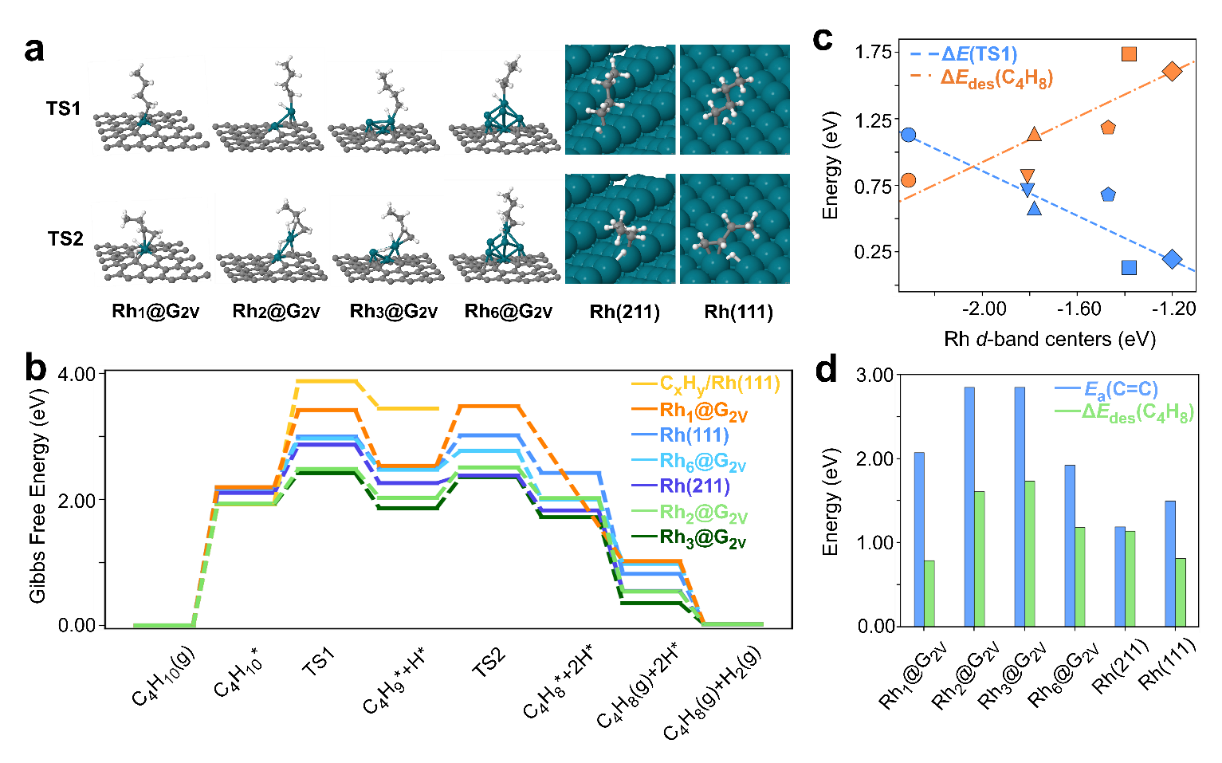
Theoretical calculation results. (a) Configurations of TS1 and TS2; (b) Gibbs free energy profiles; (c) Relationship among d-band center, butene adsorption energy and the first C–H activation barrier; (d) Comparison of butene adsorption energy and C=C activation energy for different configurations. (Image by IMR)
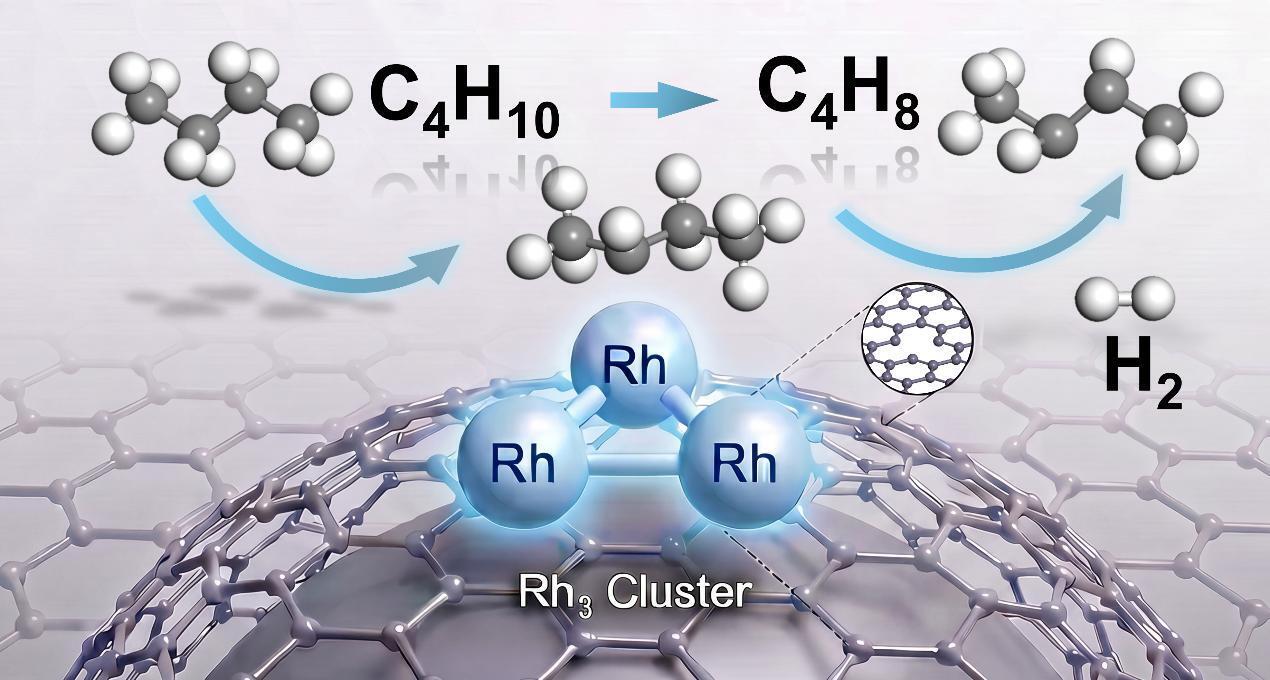
Schematic illustration of butane dehydrogenation over fully exposed Rh3 clusters. (Image by IMR)


