
Newsroom


A research team led by Prof. ZHANG Yuanming from the Xinjiang Institute of Ecology and Geography (XIEG) of the Chinese Academy of Sciences has revealed that the outcomes of desert plant-herbivore interactions are strongly context-dependent.
The study was published in Plant, Cell & Environment on October 7.
Plant-herbivore interactions are typically antagonistic: herbivores damage plant tissues, often reducing plant growth and reproduction. But plants do not always suffer from herbivory. Their responses can range from undercompensation to exact compensation, in which attacked plants eventually recover to levels similar to those of unattacked plants, and on to overcompensation, in which attacked plants show higher growth or reproduction.
For desert ephemerals, which have a short growing period and concentrate resource use in the spring moisture pulse, it remains unclear how often these less typical responses occur in the field and what they mean for the plants' ecological performance.
To address this question, the researchers conducted a comparative study of naturally infested and uninfested plants of the annual desert ephemeral Strigosella scorpioides and its stem-boring weevil Lixus ochraceus in the Gurbantunggut Desert.
The researchers tagged plants before visible weevil oviposition scars appeared, then compared growth and reproductive traits at different developmental stages. They also carried out phytochemical analysis, Y-tube olfactometer assays, and seed germination tests to examine how plant–insect interactions affect the plants and insects under low-intensity herbivory.
At the first sampling stage after weevil oviposition, no significant differences were detected between naturally infested and uninfested plants in the morphological and biomass traits measured. At later developmental stages, however, differences in growth and reproduction gradually emerged. At peak growth, the total biomass of naturally infested plants was about 2.2 times that of uninfested plants, and their fruit number was about 2.1 times higher.
This stage-dependent pattern suggests that, under a low herbivore load (usually only one weevil developing per plant), weevil occupancy can coexist with higher late-stage growth and reproduction of the host plant, consistent with overcompensation.
Chemical Changes and Insect Responses
The researchers also found clear differences in the chemical profiles of naturally infested and uninfested plants. Naturally infested plants had lower concentrations of the three glucosinolates detected and a lower relative abundance of benzyl isothiocyanate (BITC) among the volatiles. By contrast, they had higher benzaldehyde content in their tissues and a higher relative abundance of benzaldehyde among the volatiles.
Y-tube olfactometer assays showed that female weevils' orientation responses to the two candidate volatiles depended strongly on their concentrations. When the two odors were compared directly at the same low concentration, responding weevils clearly favored BITC. But as the concentrations increased, females began to avoid both BITC and benzaldehyde. Benzaldehyde produced the strongest repellent effect at high concentrations.
According to the researchers, these results suggest that BITC may be more involved in host recognition and relative attraction, whereas benzaldehyde may act as a repellent at higher concentrations. The combination of lower BITC and higher benzaldehyde in naturally infested plants could potentially alter how later-arriving females recognize and select already-occupied plants, thereby reducing the likelihood of repeated oviposition and larval competition.
In addition, the two seed lots differed in germination under different temperature conditions, with the lot from naturally infested plants showing higher average germination under some conditions. Overall, the overcompensatory pattern of growth and reproduction occurred together with differences in chemical phenotype and insect behavioral responses.
The study indicates that during the brief spring resource pulse, low herbivore load, plant developmental stage and host tolerance strategy may together influence interaction outcomes. It provides new field evidence for herbivory tolerance and overcompensation in desert ephemerals, and deepens understanding of how context shapes plant–herbivore interactions in extreme environments.
In future work, the team will use experimentally controlled infestation and multi-year, multi-site observations to further test the causality and generality of these associations. They will also extend the research to root resource acquisition and allocation, rhizosphere processes, and coordinated above- and belowground responses.
The researchers also plan to apply transcriptomic and metabolomic approaches to resolve the physiological and molecular basis of overcompensation and changes in volatile signals, and to further test their effects on host selection, repeated oviposition, and the fitness of both plants and weevils.
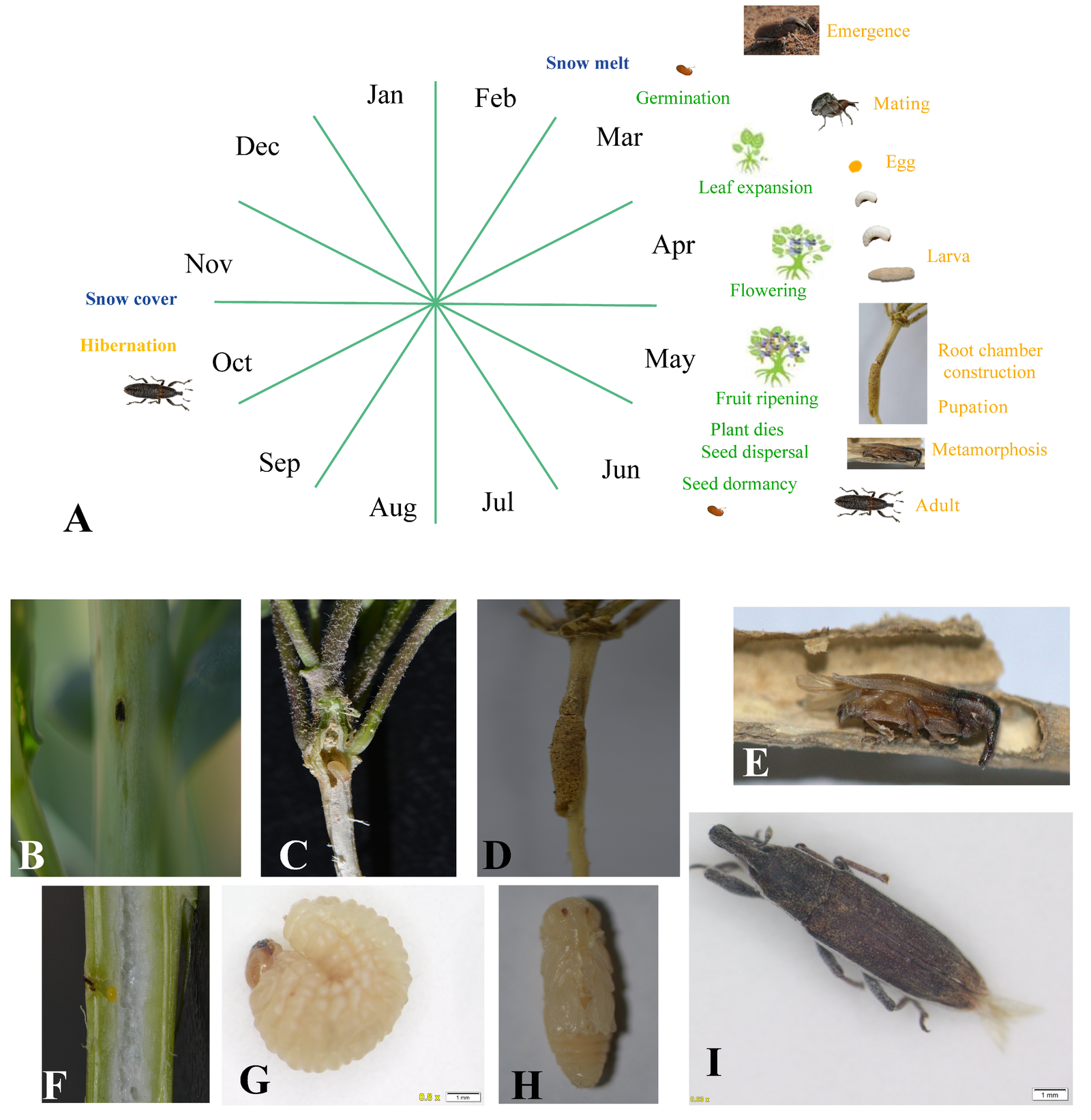
Phenological synchrony between Strigosella scorpioides and the stem-boring weevil Lixus ochraceus, and the development of the weevil inside the host plant. (Image by XIEG)

