Newsroom


A new study has found an association between odd- and branched-chain fatty acid (OBCFA) levels in breast milk and infant motor development, providing new population-based evidence for research on early-life nutrition and neurodevelopment.
The study, published in European Journal of Nutrition on October 31, was conducted by a research team led by Prof. GAO Ying at the Shanghai Institute of Nutrition and Health (SINH) of the Chinese Academy of Sciences.
OBCFAs, including fatty acids such as C15:0, C17:0, iso-C15:0, and anteiso-C15:0, are microbial metabolites. Their main dietary sources are dairy products and ruminant meat, as well as fermented plant-based foods; they have previously been regarded as biomarkers of dairy intake.
Existing studies suggest that OBCFAs may influence brain health through the "microbiota–gut–brain axis", but population-level evidence on the relationship between OBCFAs in breast milk and infant neurodevelopment remains limited.
Based on a prospective mother-infant cohort established in the Beijing area, the research team followed up 120 mother-infant pairs, collecting breast milk samples at 42 days and 8 months postpartum. Fatty acid composition was quantitatively analyzed using gas chromatography–mass spectrometry (GC-MS), and infants' cognitive and motor development at 8 months of age was assessed using the internationally recognized Bayley Scales of Infant and Toddler Development (Third Edition).
The study found that higher levels of odd-chain fatty acids (C15:0, C17:0) and total OBCFAs in breast milk at both 42 days and 8 months postpartum were associated with lower motor development scores in infants. This negative association remained significant after adjustment for multiple potential confounding factors.
The study also found that these associations were more pronounced among infants delivered by cesarean section, those born to younger mothers (≤30 years of age), and those whose mothers experienced excessive gestational weight gain.
The researchers noted that the observed associations may be related to the gut microbiota. OBCFAs may influence infant gut microbiota composition, which could in turn affect early brain development through the microbiota–gut–brain axis during a sensitive developmental window.
Notably, breast milk OBCFA levels among the mothers enrolled in this cohort were lower than those reported in European and American populations. This suggests that, in addition to dairy products, fermented plant-based foods may be an important dietary source of OBCFAs in breast milk among the Chinese population. The relationship between OBCFA levels and infant development therefore warrants further investigation in populations with higher OBCFA intake.
Furthermore, as an observational study, its findings require validation in cohort studies with larger sample sizes and longer follow-up periods, and the underlying biological mechanisms remain to be elucidated in depth.
BI Yanrui, a postdoctoral researcher at the SINH, is the first author of the paper, and Prof. GAO is the corresponding author. This research was supported by the National Key Research and Development Program of China, the Shanghai Natural Science Foundation, and the Major Science and Technology Project of Henan Province.
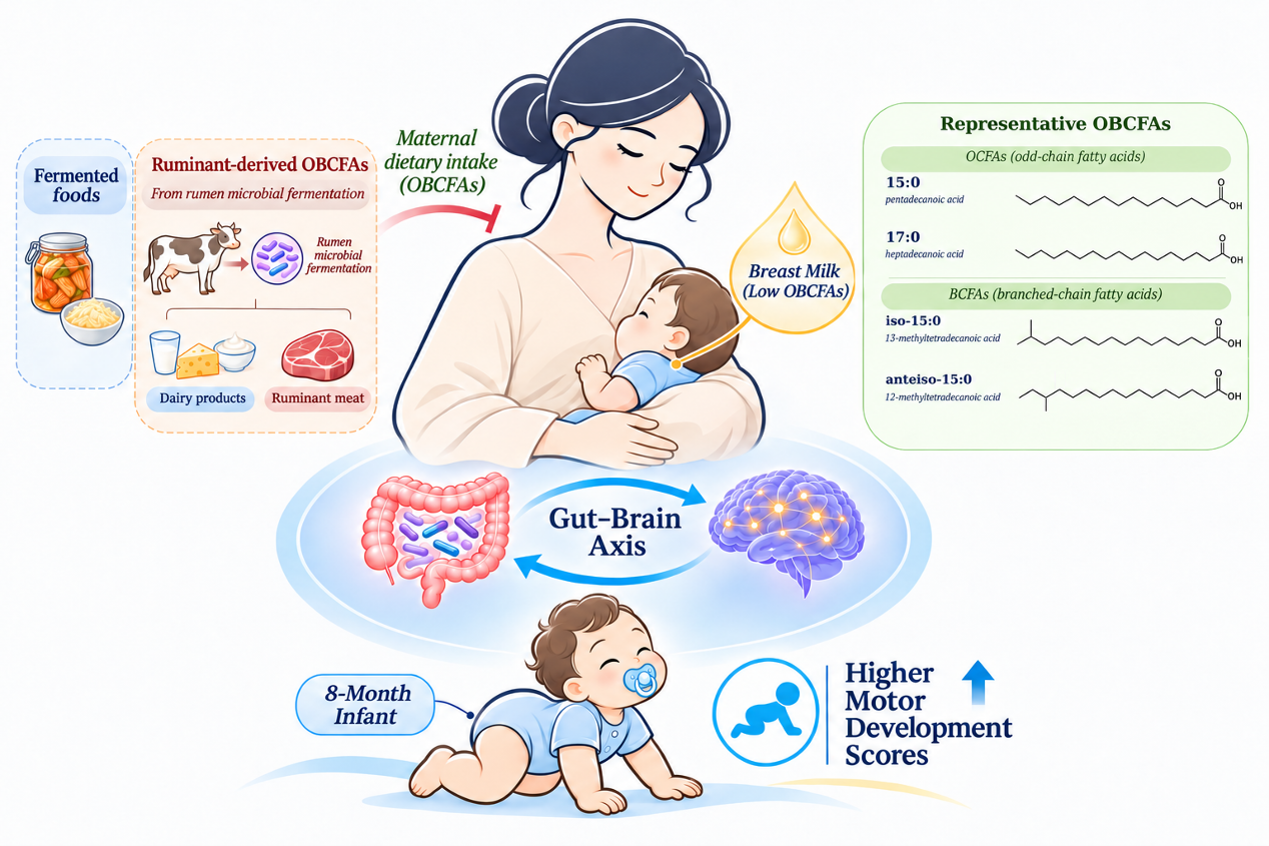
Lower levels of breast milk OBCFAs were associated with better motor development in early infancy.
(Image provided by Prof. GAO Ying's group)