Newsroom


Microbes build a long-lived nitrogen reservoir in soil from the remains of dead bacteria and fungi, which cling to minerals and resist decay. The microbial nitrogen pump turns nitrogen taken up by living microbes into this persistent pool, and microbial nitrogen use efficiency (NUE) has long been assumed to regulate this process.
A research team led by Prof. LI Dejun from the Institute of Subtropical Agriculture of the Chinese Academy of Sciences has explored whether this pump responds to climate in a consistent manner across different land uses.
Now, a new study published in Global Change Biology reveals the answer: climate significantly influences microbial necromass nitrogen accumulation in forests but has little influence on it in croplands.
The researchers studied 30 paired forest–cropland sites along a subtropical climate gradient, with mean annual temperatures ranging from 11.5–21.7 °C and annual precipitation ranging from 1,165–1,878 mm. They used amino sugar biomarkers for fungal and bacterial necromass nitrogen, 18O and 15N tracing for NUE, and soil geochemistry and structural equation modelling to identify the drivers.
Forest soils held more than four times as much fungal necromass nitrogen (341.4% more) and about 2.5 times as much total necromass nitrogen (150.6% more) as neighbouring croplands. Yet per unit of living microbial biomass, forests retained 50.8% less — a lower accumulation coefficient.
Furthermore, the relationships between climate and necromass nitrogen differed between the two land-use types. In forests, necromass nitrogen and its accumulation coefficient were significantly lower at warmer, wetter sites. In croplands, neither was significantly related to temperature or rainfall; necromass nitrogen instead tracked clay-related mineral protection and nutrient stoichiometry.
NUE was positively associated with necromass nitrogen in forests but negatively associated in croplands, suggesting that efficiency there reflects constrained microbial turnover rather than greater retention.
According to the researchers, land use does not merely change the size of the microbial nitrogen pump; it changes what controls it. Forests are biologically driven systems with fast cycling and strong climate coupling, whereas croplands are mineral-anchored systems where clay and managed nutrient ratios preserve residues. Earth system models that assume a uniform climate response may therefore need land-use-specific parameters.
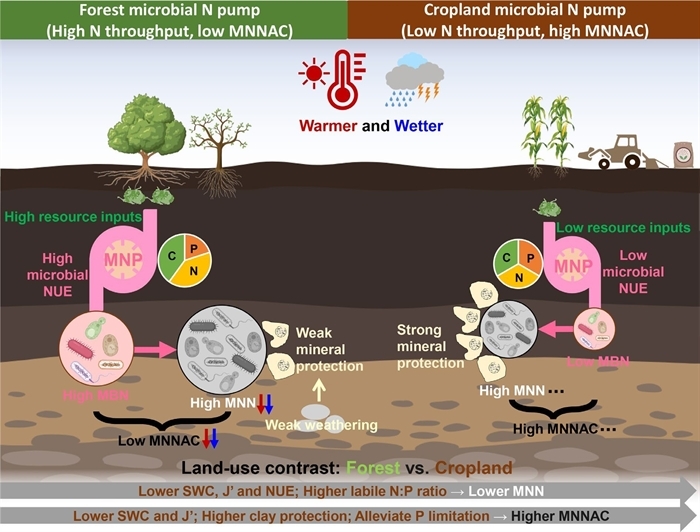
Conceptual framework for land-use-specific associations of the microbial nitrogen pump along climatic gradients. (Image by Prof. LI Dejun's research group)